English
 Español
 Français
 Deutsch
 Italiano
 Português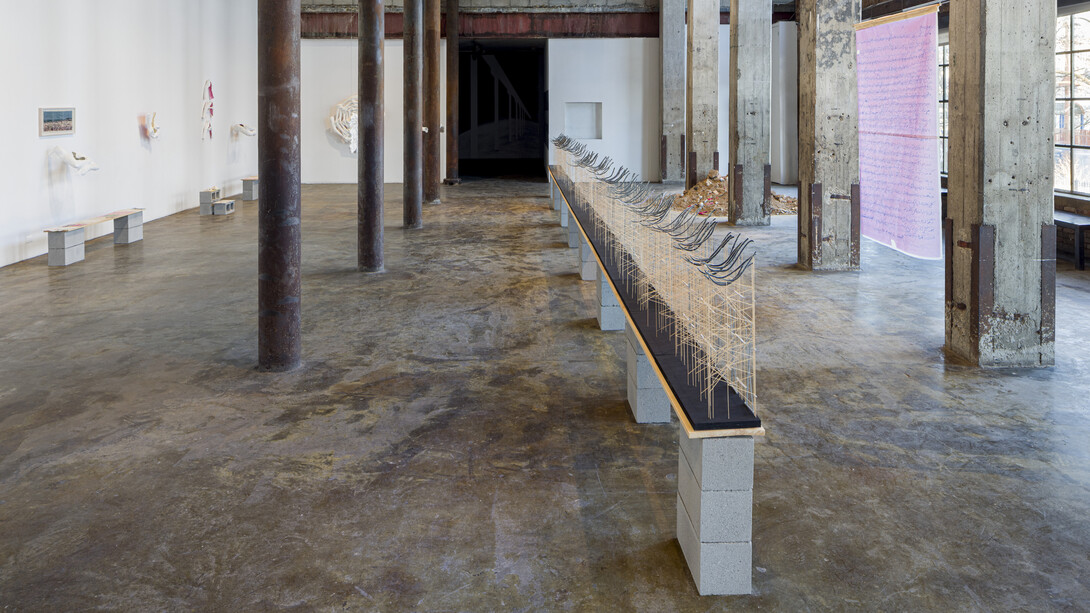
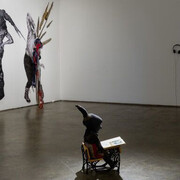
Golnar Adili’s site-specific installation gathers sculptures and reproduced texts as a mediation on language, memory, and material. The exhibition indexes linguistic gestures from the artist’s mother and late father, who were leftist activists during the Iranian Revolution, as well as fragments of the earth and bodies as a form of poetic calculation. The works in this exhibition evolve through repetition, where Adili’s playful transposition of form shifts into the potential for pain, death, sorrow.
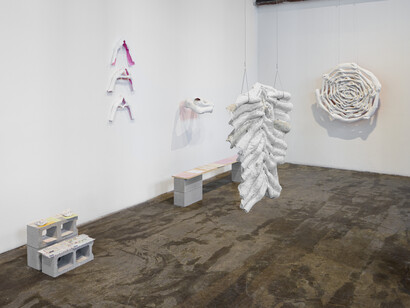
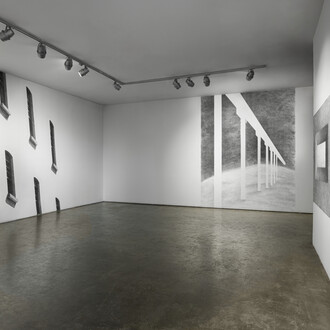
Traces of her father emerge as excerpted phonemes of his handwritten script. In 2016-2017, Adili extracted all of the alef’s and ye’s from an eleven-page letter that her father wrote to his lover, a response from whom was never recovered. The final letter in the Persian alphabet, the ye is the roman equivalent to the Latin “y.” It is both a consonant and a vowel. When combined with the first letter, alef, it creates a cry of pain: ay. A spatial study of the ye harvest from the eleven-page letter is a sculptural installation constructed from enlarged shapes of the isolated ye’s. Shown for the first time in its entirety, the installation stacks the ye’s in a line from the main gallery’s front to the back, held up by scaffolding that reveals the undulating variations in each individual letter form like ocean waves. These letters are arranged chronologically according to their occurrence in Adili’s father’s letters, rising and falling through the passage of time.
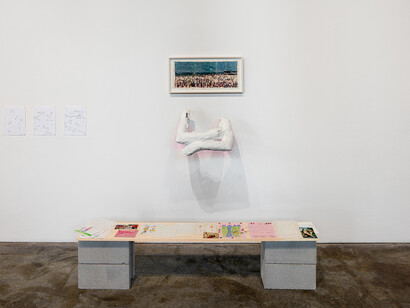
Also on display are excerpts of letters written by the artist’s mother to her father in 1981 after he fled Iran from fear of political persecution. This is the first time these letters, written on pink tracing paper, surface in Adili’s public work, after having been rescued from her Smack Mellon studio in 2012 following the Hurricane Sandy floods. The exhibition’s title is taken from a rough translation of one tender line pulled from the letters, where her mother writes, “If only one could measure the emotions of others.” Not directly translatable because of the limitations of the subject position in English, the sentence alludes to the sorrow and loss of something uniquely personal yet pervasive.
In a new sculptural work, Adili weaves together gauzy casts of hands and arms, folded into and around one another, creating organic wholes that both display and exceed their parts. Here, tangled limbs give way to softly patterned ripples; a synecdoche of bodies gathered en masse is counted in forearms, elbows, and fingers. The tension between individual and aggregate serves as an echo of the bodies and lives lost in Gaza–both those who have and have not been counted–and an empathetic reminder of the privilege, by proximity to the family letters, of those who still have time ahead to spend with loved ones.
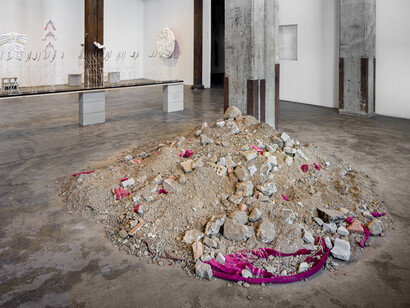
The final piece of this installation appears as piles of rubble. Evoking images of grave sites, this work harnesses the material destruction of war, itself a repetitive and senseless occurrence–one that increasingly fills social media and news feeds. Together with the limbs and letters, the heft of these earth fragments gestures to the action that binds the works of this exhibition: to be broken apart, then gathered back together. As with past work, Adili locates trauma in language and gesture
through this action, mining images, text, memories, and matter for their component parts. In so doing, she creates a space for lamentation and grief; one that is meant to be sat with rather than quantified.