English
 Español
 Français
 Deutsch
 Italiano
 Português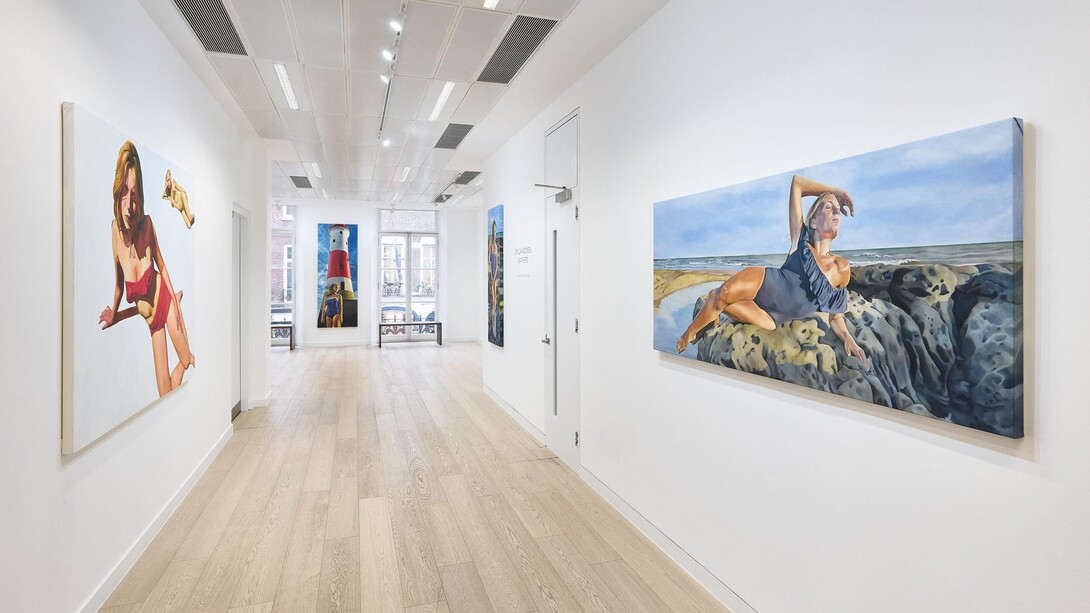
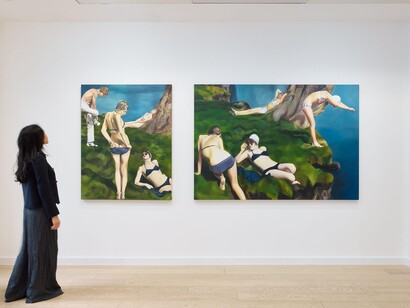
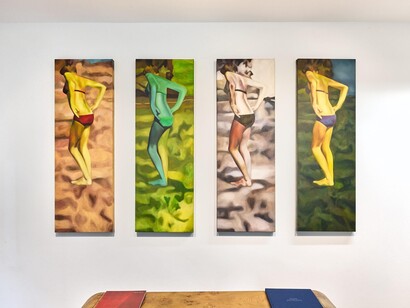
As the first solo exhibition held in Ronchini’s new 21 Conduit Street space, Emilia Momen: Bathers presents a radical reframing of the long-standing art historical lineage of bathers, stretching from Titian and Cézanne to Matisse. Bathers marks a decisive shift in Momen’s portraiture: personalities once sumptuously clad in her earlier works now abandon their opulent suits for vintage swimwear set upon grassy banks, engaged in the quotidian, but deeply intimate practice of bathing.
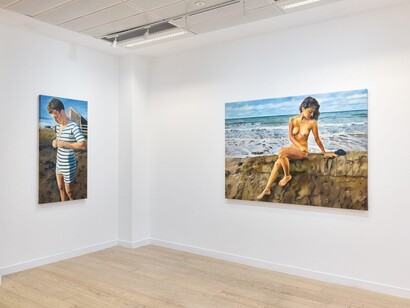
Animated, frisky, exuberant, figures take centre stage – whether about to dive into a meadow in Richmond, lying placidly in recline over Bexhill’s rocky seaside terrains, or stretched out beneath a treebank. Their poses are not rehearsed but arise from an open-ended creative process: Momen invites her friends to move freely around bodies of water, photographing their spontaneous gestures as they unfold and collaging chosen snapshots into her final composition.
Popularised by the Ancient Romans and Medieval English alike, communal bathing has been largely overlooked in contemporary culture. By re-engaging this visual language, Momen reanimates our historical relationship to water and the shared rituals that once bound communities together. Momen’s bathers draw out a space of their own, negotiating the rich boundaries between private and public, viewer and onlooker, ritual and play.
This exhibition both inherits and plays on the conventions of this rich trope. Momen’s Bathers I, II and III are all made in collaboration with the Estate of late fashion photographer Jim Lee, who was in turn drawing from Georges Seurat’s 1884 Bathers at Asnières. Entwining Lee’s theatricality and Seurat’s essence, inspiration travels from painting, to photograph and back to painting again.
The reclining pose in Bexhill bather recalls Cabanel’s 1863 The birth of Venus, with Venus’ highly stylised body stretched into a long, sinuous curve, with one arm draped coyly over the face. Yet in place of a milky, hyper-stylised Venus, one rendered lascivious for the male gaze, Momen’s models are sculpted, muscular, and sun-warmed. They are ungoverned by the burden of what film historian Laura Mulvey coined ‘to-be-looked-at-ness,’ that heightened awareness of being rendered the object of the male gaze. Instead, women move, stretch and inhabit space on their own terms, flaunting activity over passivity, subjecthood over objecthood. Here, the bather emerges not as an aesthetic object for our consumption but as an agentic subject in her own right.
Venus re-emerges in another painting, Daisy, in her classic contrapposto stance. Her hands cover the pubic area, echoing the trope of the Venus pudica, the so-called ‘modest Venus,’ where her obfuscating gesture draws the gaze to the very nudity it strives to conceal. Here, Momen subtly probes at the fine codes which stage, regulate, and make legible female sexuality.
This momentous presentation gathers ten new oil paintings made for this occasion, rendered with Momen’s newly emphatic painterliness: brushstrokes at its most lush and tactile, translating skin and water from mere surfaces into evolving, kinaesthetic sites of living histories. Together, the works map a quintessentially British choreography of water and leisure, at a moment when the latter is increasingly commodified and privatised. From Bexhill’s tranquil shorelines to Richmond’s Thames-side meadows, where city and pastoral meet, bathing unfolds as an egalitarian practice shared across both coastal retreat and metropolitan life.