English
 Español
 Français
 Deutsch
 Italiano
 Português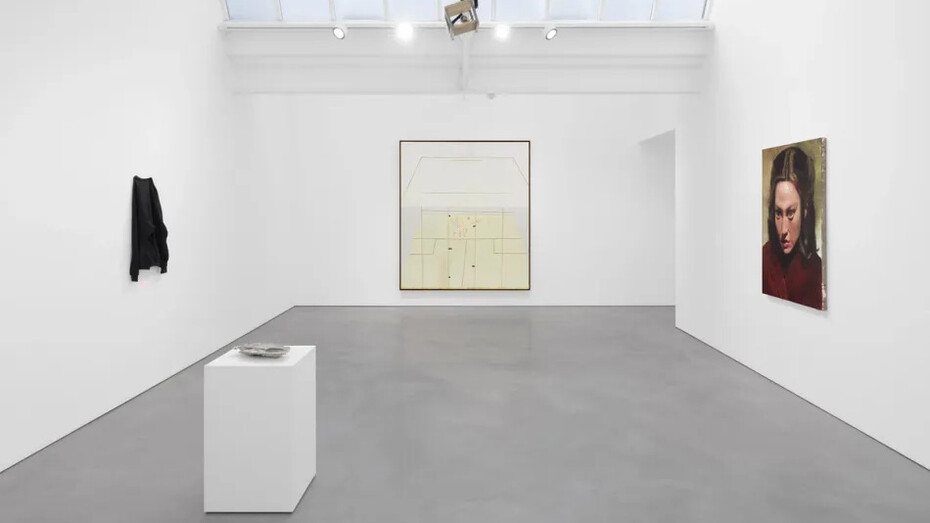
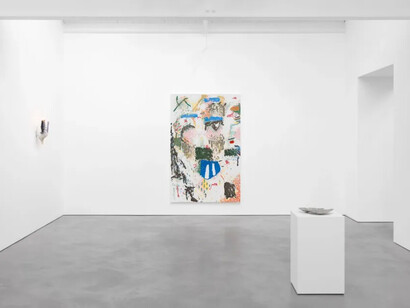
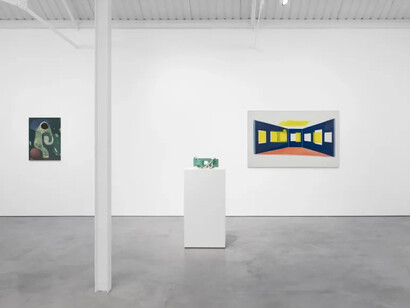
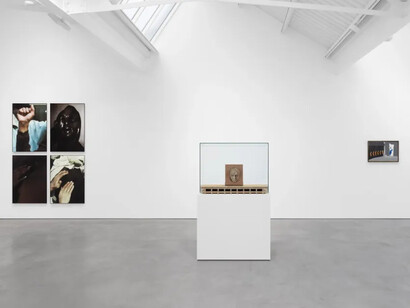
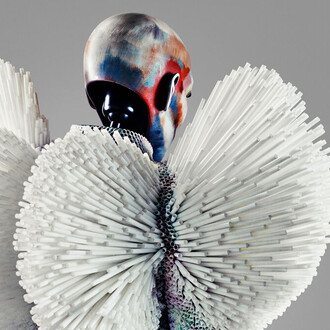
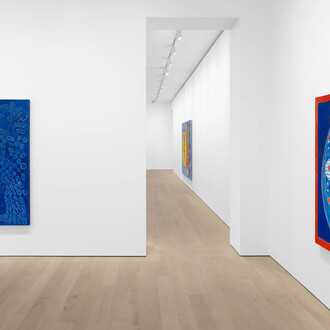
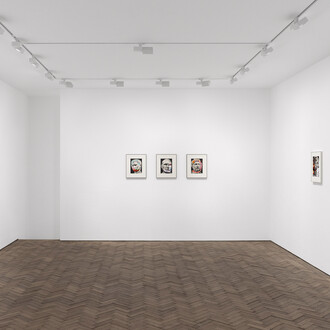
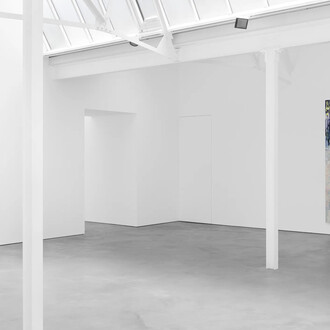
Modern Art is pleased to present a group exhibition of gallery artists.
Working within an expanded definition of painting, Richard Aldrich’s works alternate between expressing an abundance of visual information, and material reticence; a kind of withholding of their contents. In this way, they are like complex psychic environments that, like most minds, are in more than one world at once: the internal and the external. His imagery might range from richly dappled abstractions in oil and wax, to a primed canvas containing purely a line written by British psychiatrist Henry Maudsley in 1918. Such variation in imagery is matched by radical interventions into the materiality of the painting itself, such as physically dismantling the canvas, which he often incises to create insertable pockets or to expose the stretcher bars behind the canvas. As such, the focus of an exhibition by Aldrich is on the shifting states from one work to the next. Like fluctuating frames of mind, each work presents a different set of propositions which may simultaneously clarify and confound their neighbouring works. Within these contextual shifts, Aldrich’s exhibitions are constellations of interrelated, but heterogeneous parts that reflect on each other to create different levels of potential understanding, which, in a broader sense, seek to consider how intelligence is attributed to objects in the act of interpreting them.
Mark Handforth’s sculptures imbue the almost-invisible features of our lives – street lamps, road signs, fluorescent lights and fire hydrants – with formal properties that make them strange, larger than life, enigmatic and off-kilter. They are meticulously crafted, but deliberately imperfect, often containing wry humour and poetry in their references and arrangement. Seemingly strong and durable materials like metal and resin are mangled and deformed, becoming surreal objects. These sculptures are often deposited on their sides like the detritus of fallen worlds, having buckled under invisible pressures. As such, Handforth translates the bewildering scale and vertical imperative of the cityscape into dynamic compositions that register the momentum and implicit violence of their referents: an early sculpture of a Vespa is covered in burning candles and becomes an altar; a streetlamp is twisted into the shape of a five-pointed star, and a piece of driftwood is cast in concrete and juxtaposed with fluorescent lights. But while his works have a sense of distortion and manipulation of features of the urban environment, they also retain an archaic and poetic sensibility. His use of enlargements might recall the legacies of Pop art, but Handforth shifts his aesthetic position towards a post-punk paradigm through his incorporation of burning candles, aerosol paints and a general atmosphere of disarray and chaos. Handforth has undertaken several large-scale sculptural commissions in public spaces such as Central Park and Governors Island in New York City, Porte de Bagnolet in Paris, and the plaza of the Museum of Contemporary Art Chicago.
When sourcing a visual reference for a new painting, Joseph Yaeger seeks the concurrent sensation of attraction and disturbance, looking for an image that might be simultaneously jarring and enticing, with the artist driven by the subjective sensation that Roland Barthes memorably described as ‘the punctum’ of an image. Although initially intuitive, once certain themes or patterns begin to emerge in his selection, he will then cull and hone images more deliberately. In terms of process, Yaeger applies watercolour on thickly gessoed canvas or linen, centering the materiality of the pockmarked and undulating gesso in addition to the vicissitudes of the watercolour pigment. His compositions range and vary, from charged encounters between unknown protagonists in elusive environments, to more prosaic representations of animals and commonplace objects.
Attracted to pushing the boundaries of legibility, his compositions are typically cropped, both revealing and curtailing the viewer’s encounter with the scene, fostering an atmosphere of emotional and spatial ambiguity. While Yaeger’s writing practice evokes these phantasmatic spaces, with his illusory characters often made flesh, his painting attempts to grasp what language cannot convey. He has remarked how the action of painting exists outside of his own self, seeing his body as a conduit for the translation of an image: “The translation into paint I think of as a kind of projection – using my body as a projector, more specifically. I don’t sketch, nor do I use a projector, and I paint on the floor. The image, when everything is clicking, seems to emerge as if by magic out of the pooled paint. It’s genuinely quite mysterious to me – there is very little, if any, conscious or linguistic thought occurring in the act of painting.”
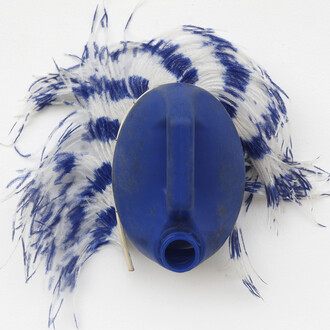
Michael E. Smith begins each exhibition by collecting and loosely assembling his materials in the studio. He calls these ‘material sketches’. This process also involves a rigorous investigation of the associations each object or material has: its relationship to the world and to people, its culturally specific referents, its place in the economy. To get to know the meaning of an object as closely as possible is also to make it suddenly become strange, unfamiliar, alien. His diverse material choices - a drone; a stork’s beak; nail guns; a dinosaur’s egg, for instance - tend to be objects or part-objects at the end of their lifespan of usefulness. Functionally spent, they evoke a variety of fragile states – physical, emotional, economic and political. Yet, in their plain materiality, they remain obdurately existent, uncannily orbiting the outer stretches of everyday life. In the gallery, Smith responds to the conditions around his works; his objects finding their final arrangements in relation to how they behave semantically in the room and with one another. Often the space itself is altered in subtle ways such as the removal or dimming of lighting, the addition of sound, or interventions into the way the room is moved through. In this way, absence or emptiness itself shapes Smith’s work, the tension built into it resonating between order and harmony and disarray and depression. Oscillating between humour and pathos, Smith exposes the lifespan of the object from the point of first desire to post- mortem; highlighting their life cycle, and - crucially - their retrievable value.
Over the last twenty-five years, Eva Rothschild’s sculptural practice has included both intimate exhibitions and large-scale public projects across Europe and the United States. Underpinned by the legacy of modernist sculpture – notably the work of Barbara Hepworth, Constantin Brâncuși, and Eva Hesse - and the enduring forms of classical architecture, Rothschild’s visual vocabulary also engages with the haphazard and aggressive realities of the contemporary built environment. Working with both traditional and new materials, including bronze, ceramic, polystyrene, Jesmonite and Perspex, she refers to her practice as ‘expansive’. Rothschild's sculptures are often episodic – her lexicon includes: totemic stacks, interlocking triangles, striped linear forms and block work partitions. Rothschild’s work is frequently presented as accumulated objects rather than singular solid form sculptures. She seeks to bring a wider range of materials and ways of looking into the work and often includes specifically made furniture in her exhibitions as a way to allow the viewer to feel present and welcome in the spaces created by the artworks. Understanding how objects acquire power, and perhaps even magical or spiritual meaning through the transcendent power of looking is central to her sculptural practice.
Since his first ‘crawl’ in Times Square in 1978, Pope.L was venerated for his incisive and subversive critique of social, racial and economic injustices. “My focus is to politicize disenfranchisement, to make it neut, to reinvent what’s beneath us, to remind us where we all come from,” he once stated. Working across performance, street action, painting, video, installation, and sculpture, he delivered an unflinching picture of the disparities and stereotypes that continue to define the world today. By donning a business suit and “giving up his verticality” in the 1978 work, he made New York’s homelessness crisis impossible to ignore. For Eating the Wall Street Journal (2000), he mounted an elevated toilet dressed only in a jockstrap before reading, ingesting, and subsequently regurgitating strips of the Wall Street Journal. As scholar Tavia Nyong’o has observed, “Pope.L’s ‘crawl’ pieces and his Eating the Wall Street Journal interrupt the bodily habitus of power, privilege, and able-bodiedness.” Pope.L’s works intersect a broad array of themes and concerns including spatiality and the vulnerable Black male body, physical and emotional discomfort, language, (in)visibility, eroticism, filth, and abjection. He confronted these ideas with seriousness and absurdist humour.
Frida Orupabo’s works are, in some sense, solutions to problems; the problems being that certain images do not exist and need to be created. Working mainly with collage, but also spanning sculpture and video, Orupabo’s work synthesises fragments of bodies to reconstruct narratives and imagine new configurations of subjectivity denied by colonial legacies. More often than not, the figures in Orupabo’s images are Black women, although the categorisation of gender, race and family heritage are not only questioned; they become the locus of her explorations. Mining digital archives mostly online, Orupabo’s process starts on a small-scale, collaging images on screen, but these often grow into much bigger, life-sized characters in the room. Enlarged, printed in tiles, cut out, and then pinned together, Orupabo’s process of combining images retains a hand-made simplicity, which carries within it a sense of possibility for play, experimentation and spontaneity. This liveliness is joined by a depth of difficult emotion held in her subjects – rage, sadness, or desolation, for instance - whose faces stare back, as though to a challenge their viewers to a duel.
Mark Manders’ practice, from its outset, has centred around the idea of a continuously evolving self-portrait and his proposition of a ‘self portrait as a building’. The different iterations of this conceptual blueprint mostly take the form of sculpture in bronze and wood, while also encompassing installation, painting, drawing, writing, and publishing. His sculptural works, often centrally focused on anonymous figures, tend to be made in bronze while having the appearance of crumbling clay. Frequently set in dialogue with domestic furniture, Manders distorts the scale of his sculptures – the furniture pieces for instance, are repeatedly scaled down to 88% of their true size – in a distortion of reality that reorganises the experience of his work into an unfamiliar formal and lyrical domain. Manders’ sculptures and installations, like words in a sentence, can be reordered infinitely, objects and forms creating new meaning and psychological interpretations each time, avoiding fixed interpretation while building a world of thoughtful propositions.
Forrest Bess’s small-scale, iconoclastic paintings encompass entire worlds of thought and experience. Living a life of solitude as a fisherman in a small camp on the Gulf Coast of Mexico and spending the majority of his life outdoors, Bess nonetheless showed for nearly twenty years with Manhattan’s pre-eminent modern gallerist, Betty Parsons, between the 1940s and 1960s. Through Parsons, Bess became known as a disaffected colleague of the Abstract Expressionists, and his works were well known by the leading curators of his day. Combining personal codes and universal truths, Bess’s paintings were one means of expression of his greater theoretical project based on the ideas of Carl Jung, Kundalini yoga, alchemy, and Australian Aboriginal culture. Through these ideas, he came to believe that a state of completeness, or in Bess’s own words “the perfect state of man” could only be achieved through what he called hermaphroditism. Despite the grandiosity of the intellectual frontiers that inspired him, his piercing paintings are executed with a modesty of scale and means. His images are formed through dense and vivid brushwork, their lines scratched in amidst a dense multitude of colours and textures, quietly revealing a mastery of technique. Often framed with driftwood, Bess’s small canvases combine his vivid, disquieting internal world and the elemental rawness of his external reality.
On his work, Meyer Schapiro once remarked: ‘So plain and frank is the painting, so much like the unmoulded strips of weathered wood with which he frames his pictures, that it seems at first sight the work of a self-taught civilized primitive with limited skill. But look at his wonderful blacks, of many nuances: granular, matt, shiny and rough, and you will recognize his knowledge and discipline, his mastery of an exacting technique. […] These grave little pictures, so broad and firm in conception, have held up over the years’.
Francesca Mollett’s work derives from observations of her immediate environment. Drawings in charcoal, graphite and watercolour inform the composition of her paintings. Anchored in the physical negotiation of their making, her paintings are made with various techniques, including impasto accumulations of paint with a palette knife, thinned paint smeared and rubbed across the canvas, and large sweeping strokes of colour, a process which continues the sensation of an encounter.
Mollett’s painterly technique engages a push and pull between luminosity, density, depth and surface. In particular, Mollett probes the phenomenology of iridescence, both in her experience of the world, and in the process of painting. Focusing on specific elements of an environment or place, such as doorways, rock formations, pools of water, and reflective and matte surfaces on buildings, she extracts from nature and place to produce an evocation out of time and place, yet very much materially present. Key to her process is a careful balancing of pure mark making – surface tension is created by the layering of painting marks, as they blend and contrast. Scale is abstracted, discernable forms are hinted at but never made evident, they are complicated or abstracted, constantly drawing the eye across the painted surface, allowing her painting to retain an intangible quality.