English
 Español
 Français
 Deutsch
 Italiano
 Português
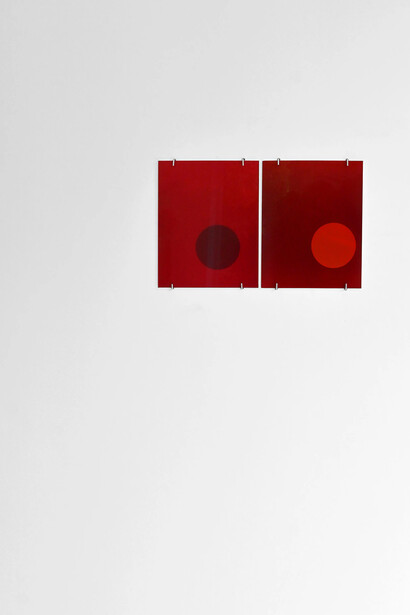
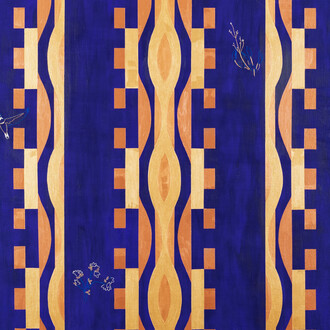
There is no memory. I mean there is no object that binds us to what occurred, beyond memory itself—at times diffuse, expansive, and therefore imprecise. Each of those points combined various geometric forms. With every turn, with every slight movement, it generated a radiance in the eyes. Small flashes of different colors that produced one abstraction after another. I was unable to bring that body into focus.
Everything happened one day in late July, in the south. After more than six hours of travel, I step out of the back seat of a Ford model. We are close to the ocean, and the humidity presses down on us. The heatis excessive; I feel my clothes clinging to my body. We head toward the reception of a campsite where we plan to spend the coming weeks. Upon entering, the place captivates us with its simplicity, the views it offers, and a certain air of decadence. An architecture anchored in the 1970s, with white stone floors, whitewashed walls, wicker light fixtures, and lush palm trees in what feels like a greenhouse. Decadence always points to the past, yet that place was devoid of any nostalgia. We felt entirely in the present.
Our state of mind for the weeks ahead could be summed up as an exercise in pure hedonism: doing each of those things we enjoy during the summer months and so deeply long for throughout the winter. After settling in, we decided to take a short walk and bid farewell to the day from a vantage point among the pines. The sun gradually disappears before us—imposing, almost amber, tinged with orange. Our direct gaze is momentarily blinded, caught between an optical tingling and a fade to black, only to regain sight as soon as we turn away from that radiance. At a glance, our vision seemed to multiply, like that of an insect. The pine needles intervened as a delicate silhouette, as lines and dark points heading straight toward our pupils. We found ourselves in a state oscillating between lysergia and the simple perception of an optical illusion.
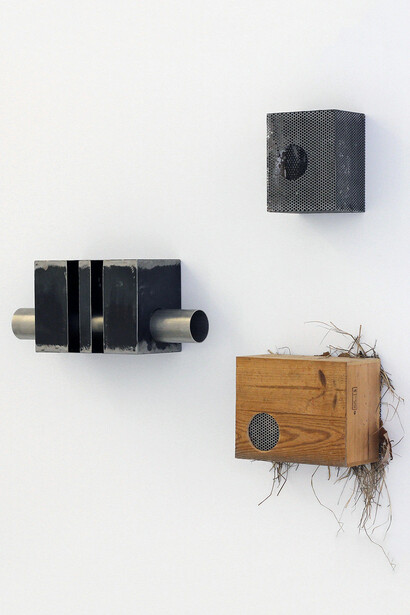
Just before twilight, a bird crosses before us, catching our attention, and perches on a nearby branch. Because of its size and our ignorance, we do not know what species it is. Nothing gives it away. We notice only its feathers—radiant and taut, not at all ruffled. Its shifting plumage appears traversed by ripples and gleams that generate reflections, ranging from deep red tones to an iridescent indigo. Its flank wounds the eye like moiré. Faced with the intensity of a sun that is gradually fading and the flashes produced by its feathers, at a certain moment it disappears. We lose sight of it until its glints betray it, and we distinguish it once again precisely at the entrance of what seems to be its nest. Its eye conceals it.
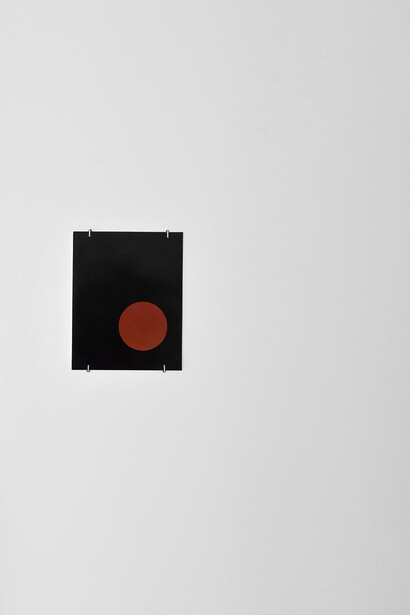
Slowly, the hole into which the bird has disappeared begins to overlap with a moon that is gradually drawing nearer. For a moment, it seems there are not two but three circles approaching and intersecting. They move from side to side. The movement is measured, and at a certain instant they all overlap, only to reappear moments later in a different position. We cannot discern whether the sun overlaps the eye of the nest or whether it is the moon that in turn overlaps the sun. One circle over another becomes defined, yet when separated they blur.
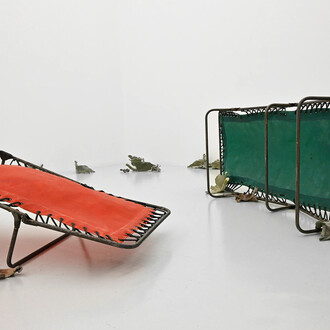
Thus, we have the sensation of playing with a kaleidoscope: from a geometry addressed to the senses, turn after turn. A tube that, with each rotation, carried an illusion to our eye. Each turn becomes faster and faster until the speed grows intense. The conduit first turns into a whirlpool and then into a tunnel, which is unexpectedly followed by the sound of a body plunging into water. When we open our eyes, we realize we are lying on the beach and it is daytime. Around us are children, parasols, sandcastles, deck Chairs, and a scorching sun. The sun's rays blind us. It is far too hot. Drowsy, we begin to understand that this is where our routine for the days to come begins. At that very moment, | became aware that | had never been so far south.
(Text by Antonio Menchen)