English
 Español
 Français
 Deutsch
 Italiano
 Português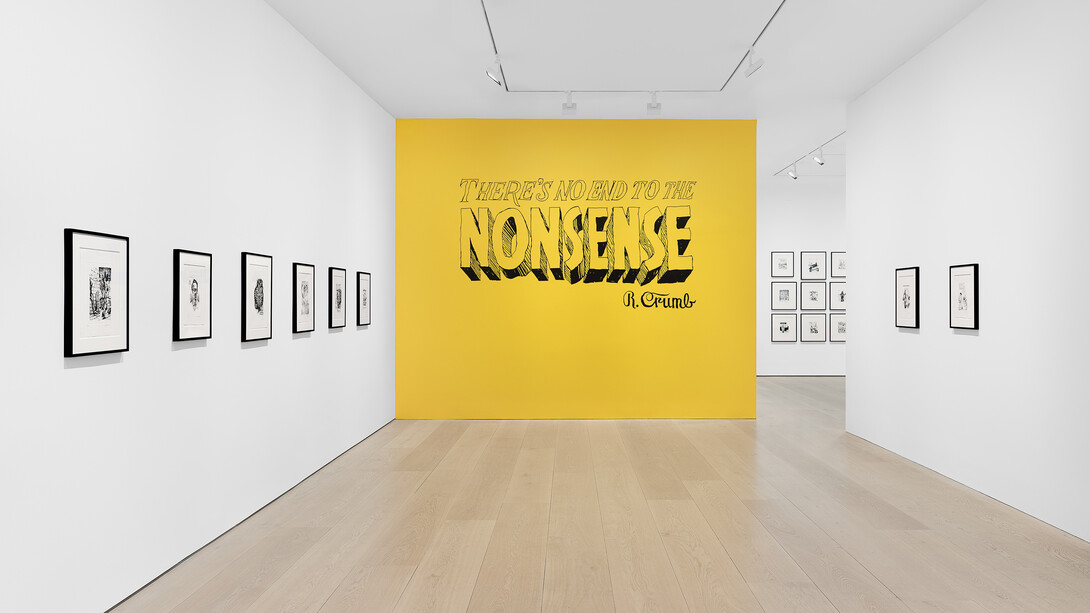
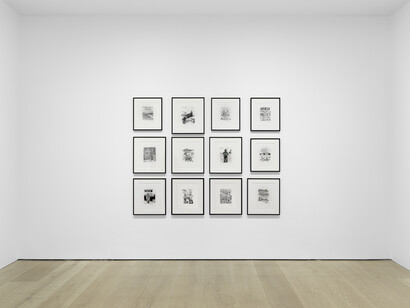
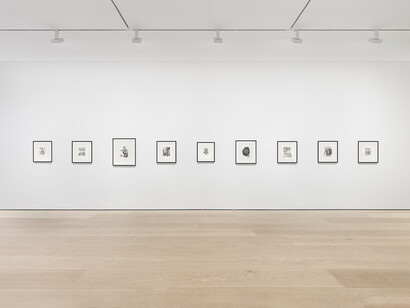
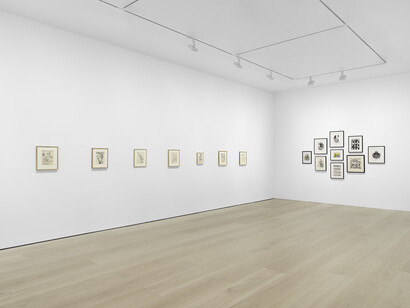
David Zwirner is pleased to present There’s no end to the nonsense, an exhibition of work by American artist R. Crumb opening at the gallery’s London location. There’s no end to the nonsense is an intimately scaled survey of Crumb’s work that spans across the adventurous and expansive arc of his storied sixty-year career. This is his first solo exhibition in London in a decade.
One of today’s most celebrated illustrators, Crumb helped define the cartoon subcultures of the 1960s and 1970s with comic strips like Fritz the cat, Mr. Natural, and Keep on truckin’. Instrumental in the formation of the underground comics scene, Crumb challenged and expanded the boundaries of the graphic arts, redefining comics and cartoons as countercultural art forms. The overt eroticism of his work paired with frequent self-deprecation and a free, almost stream-of-consciousness style have solidified his position as a renowned and influential artist whose work addresses the absurdity of social conventions and political disillusionment.
The exhibition title is taken from a page in Crumb’s 1998–1999 sketchbook, in which a nervous-looking character—the punning ‘little master baiter’ dressed in children’s clothing—converses with an anthropomorphic bird in front of a nondescript city space. Slurping a lollipop, the figure is surrounded by speech bubbles sharing internal dialogue that contradicts his discussion with the bird, framing a preposterous situation while speaking to the artist’s internal anxieties. Mapping the progression of Crumb’s trajectory, There’s no end to the nonsense features beloved characters as well as his own personal memories—as they manifested then and as they are now, looking back.
Early work on view introduces some of Crumb’s best-known characters such as Mr. Natural and the Snoid, of which a rare 1974 painted cutout is exhibited. Portrayed as an impertinent sexual deviant, the Snoid first appeared in Crumb’s drawings in the middle of the 1960s, and he soon became a fixture of many of the artist’s most well-known publications and comics, including Zap comix, Home grown funnies, and Mr. Natural. The character is seen as signalling a transformation in Crumb’s work, in which the artist began shifting from his comical look at 1960s new age culture and psychedelic mysticism towards his ironic and self-deprecating focus on representations of unbridled libidinous energies. Both depicting buxom women traversing cityscapes, What O’ Hail (1975) and Yeti woman (in color) (2000) are shown with other works that provide further insight into Crumb’s obsessions and perversities. Unknown Detroit bluesman (1970) was originally commissioned by Barrelhouse Records for a compilation of early blues music from the 1920s and 1930s—a particular passion of Crumb’s. A 1995 drawing shows the artist frazzled and overwhelmed—in Crumb’s standard self-deprecating way—during his first visit to Finland. The most recent works in There’s no end to the nonsense represent Crumb’s first extensive solo comic work in over two decades, marking an impressive late-career resurgence.
Many of these incisive, introspective, and formally adventurous illustrations were made for Tales of Paranoia, the artist’s first comic book in twenty-three years, which was published by Fantagraphics in 2025. Created in the wake of the 2022 passing of Crumb’s wife and longtime artistic partner, Aline Kominsky-Crumb, these drawings reveal a mind turning inwards without its usual counterpoint—absent her grounding presence, the work veers further into obsessive, unfiltered reflection. Crumb and Kominsky-Crumb had frequently collaborated, particularly in the decade preceding her death, and her absence is felt directly in the content of these recent works. While Crumb’s early work skewered both mainstream and countercultural figures with a hyper-libidinal, satirical edge, his recent drawings meditate on paranoia, particularly around medicine and vaccination. These works convey a heightened self-awareness, oscillating between genuine suspicion and conspiracy; they incisively mirror a broader culture of mistrust of authority and the erosion of shared meaning and reliable information in the world today. In A difficult conundrum (2025), each panel depicts an increasingly agitated Crumb, his speech bubbles multiplying in a spiralling monologue directed against a pharmaceutical company. Through the familiar conventions of the comic form, Crumb constructs a self-portrait steeped in uncertainty and vulnerability.
In other works he revisits his past, exploring difficult and disturbing moments that continue to affect him. As the title suggests, The very worst LSD I ever had (2025) documents a harrowing acid trip that Crumb experienced in 1966, which led him to seek several sessions of regressive hypnosis. Also on view is a rare sketchbook from earlier in Crumb’s career, which offers an intimate glimpse into Crumb’s process and preoccupations. Placed in dialogue with both early and recent drawings, it highlights not only the evolution of the artist’s style and tone but also the enduring idiosyncrasies—formal, psychological, and narrative—that continue to define his work. Numerous recent etchings Crumb produced in collaboration with the renowned print studio Two Palms, New York, are featured as well.