English
 Español
 Français
 Deutsch
 Italiano
 Português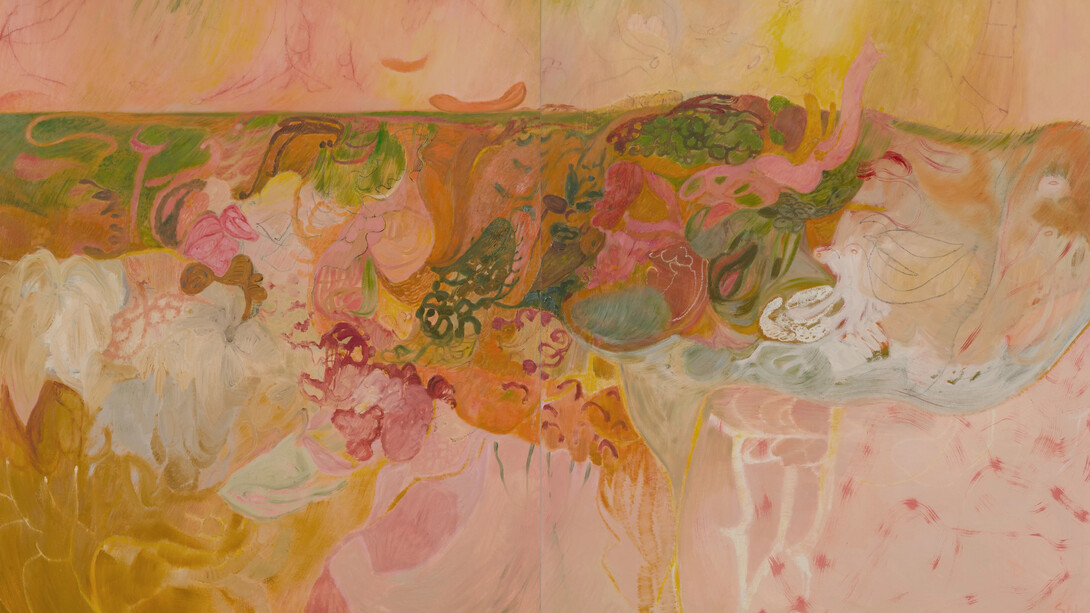
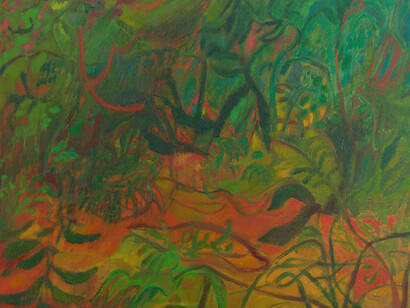
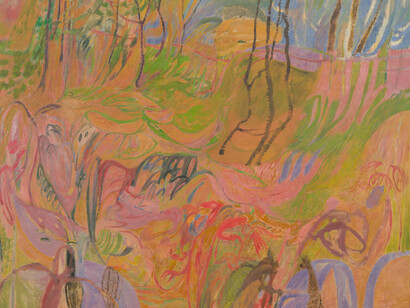
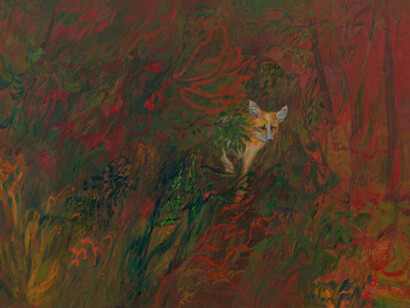
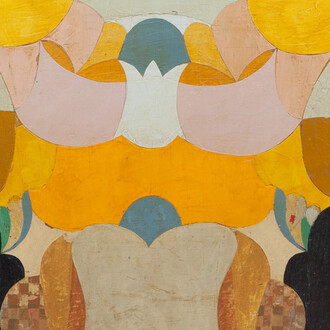
Soumya Netrabile (b. 1966, Bangalore, India) does not think of herself as a landscape painter, nor of what she paints as landscapes. Instead, her works – though occasionally revealing glimpses of swirling, golden foliage, or the jewel-like offerings of a misty sea – take on the notes of lyrical abstraction, forged through a ritualistic and intuitive approach to artmaking.
Netrabile’s practice is one of interconnectedness: borne from the natural world, channelled through the body, and returned to the perceiving soul. In this sense, the artist is a poet of the canvas: each of her brushstrokes is a suggestion of something expansive and deeply personal, drawn from the crunch of a twig or the ostensibly impenetrable surface of a stone in the pocket. Indeed, the title of this show – suggesting an intimate and talismanic engagement with nature – originates from the artist’s collection of forest detritus on her daily walks.
It also refers to a poem by Pablo Neruda, Oh Earth, wait for me, in which the Chilean poet writes of an ancient woods filled with the damp aroma of larch needles and a breeze like a beating heart. His ending note immortalises the purity of a stone, borne by the river – a simple but dignified incarnation of such a rich and evocative world:
I don't mind
being one stone more, the dark stone,
the pure stone which the river bears away.
Netrabile’s paintings are like these stones: singular object portals into somatic presence. Their sensory lushness evokes a cellular, embodied awareness of the self, and of its interconnectedness. The artist exists in a lineage of artists aiming to transcend the purely optical through the ostensibly two-dimensional medium of painting.
After all, as Netrabile reminds us, the complete senses are tools held by humans not just for survival, but for building memories, exchanges, and connections. A stone in my pocket works at the intersection of the material and spiritual worlds, drawing on traditions of vitality in ritual objects, as well as theories of energy transference and – importantly – a playful rediscovery of sensory engagement. In these works, the soothing glow of a setting sun and the statuesque posture of a mountain become the raw matter of desire and conflict, or transition and turbulence. The surface of their canvases become playgrounds for movement, energy, and transformation – from being to being, and body to spirit.