English
 Español
 Français
 Deutsch
 Italiano
 Português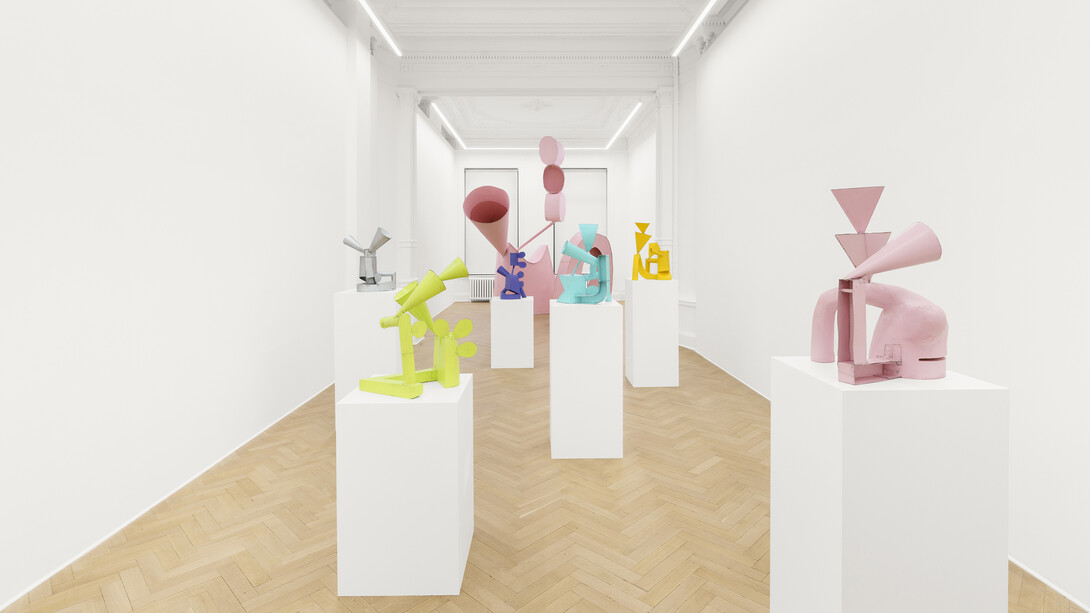
Just as I sometimes dream at night, I am assailed during the day by impressions that I hasten to seize. They must be given real contours ; thus I construct [...]”.
(Maurice Sendak)
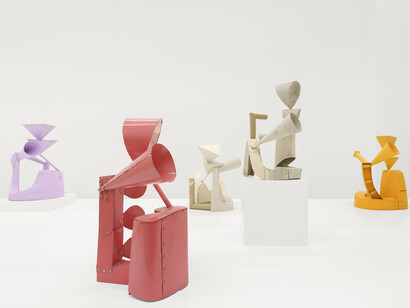
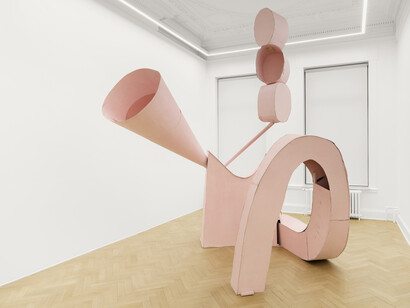
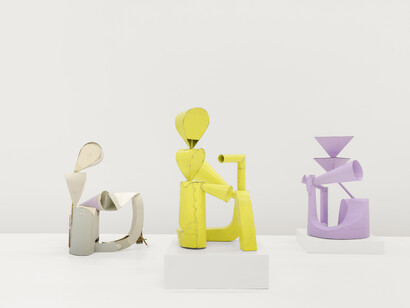
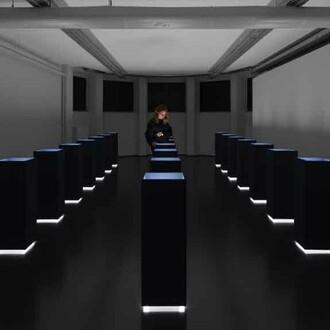
To encounter a sculpture by Thomas Kiesewetter—to confront it, to walk around it—is to see one’s imagination carried beyond the confines of the real. It is to be invited to a local fairground, to a vast formal game of pursuit. One faces an object fixed in its movement, an object that exists only in and through itself: a pure play of forms and motions. A play of consciousness.
Sculpture is said to suggest movement 1. Kiesewetter suggests nothing. He constructs movement itself—real, living movement—and holds it. His sculptures signify nothing; they refer to nothing beyond themselves. They are. That is all. They are absolutes. Their tensions, their forms, their complex combinations escape rational determination. Even when we persist in imposing upon them a symbolism or a recognisable form, they elude us and seem to murmur, in the hollow of our ear: I am free.
For each work, Kiesewetter establishes a general destiny of forms, then abandons it to itself. Thus the object remains perpetually suspended between the servitude of the statue and the independence of the gesture. Each of its transformations arises from the instant. One recognizes the theme set by the artist, yet the work embroiders upon it countless singular variations. It is a jazz improvisation—unique and ephemeral, like the sky, like the morning; if one has missed it, it is lost forever.
Valéry said of the sea that it is always beginning again. A work by Kiesewetter resembles the sea and fascinates in the same way: always beginning again, always new. One does not glance at it in passing; one must live it, abandon oneself to it. Then the imagination rejoices in these pure forms in exchange, at once free and regulated.
These sculptures possess a profound meaning, almost metaphysical in nature. They are strange beings, poised halfway between matter and life. At moments their contours appear purposeful; at the next instant, they seem to have lost their guiding idea and to wander astray. Thomas Kiesewetter composes scales and chords of movement hitherto unknown—lyrical inventions at once technical and almost mathematical—of which one never knows whether they result from the blind succession of causes and effects or from the timid, endlessly delayed, interrupted, traversed development of an Idea.
Notes
1 Starting from this sentence, the text by Jean-Paul Sartre / Alexander Calder, Mobiles, stabiles, constellations (1946), is entirely freely paraphrased, with cuts and adaptations.