English
 Español
 Français
 Deutsch
 Italiano
 Português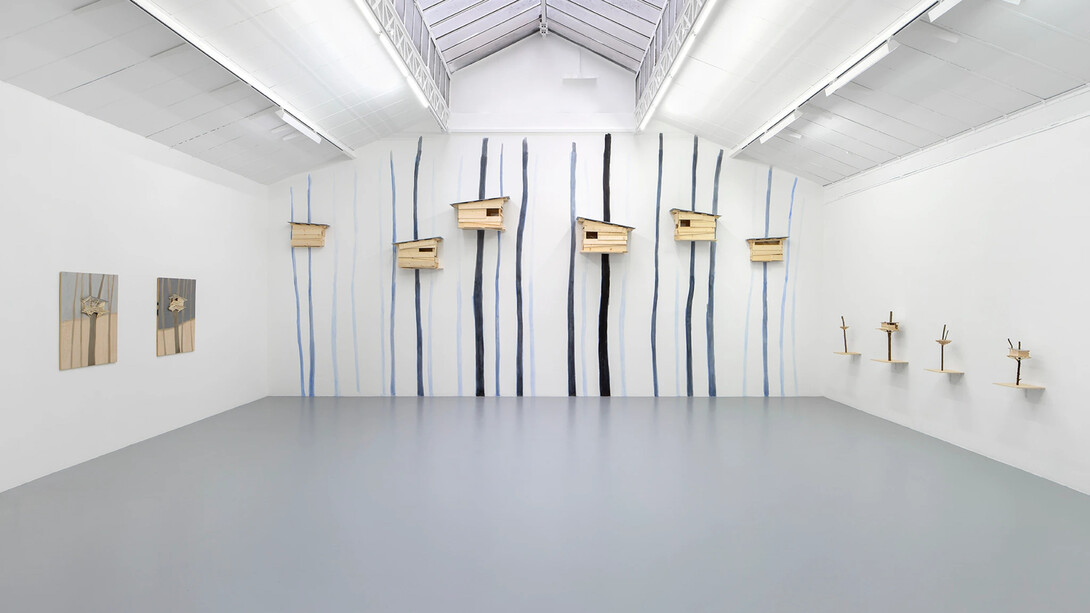
For his eighth solo exhibition at Mennour, Tadashi Kawamata once again takes over the space at 6 rue du Pont de Lodi.
The exhibition provides an opportunity to present a new series of works, Bonsai, named after miniature trees whose tradition—likely imported from China—is ancient and deeply rooted in Japanese culture. For many years, the artist has been a regular visitor at the Bonsai Museum in the Shunka-en garden near Tokyo.
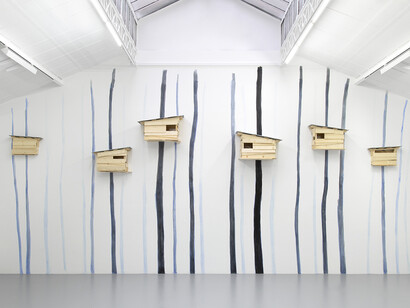
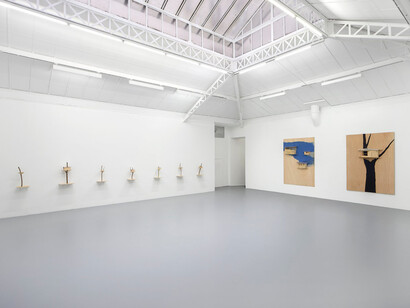
Tadashi Kawamata’s Bonsai are derived from a simple branch onto which the artist attaches a miniature cabin (Tree hut). Highly poetic, these works also respond to a technical imperative imposed by the vegetal form itself: how can a construction be durably implanted in it? How can a human creation be grafted onto a fragment of nature?
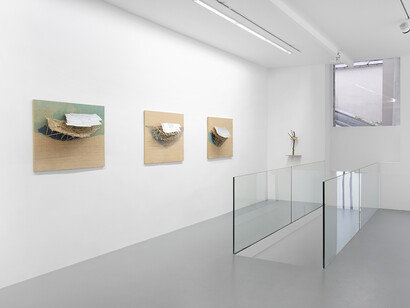
These Bonsai belong to the Maquettes and Models, two series the artist has been developing for many years, and which should be distinguished. The Maquettes are plywood panels, painted and enhanced with constructions, that play with the second and third dimensions; the Models are small-scale realizations, close to what, in Western culture, we call model making.
Traditional bonsai involves the recreation of an entire landscape in miniature. It was inevitable that Tadashi Kawamata’s art would eventually reach its shores, he whose work gives pride of place to constant back-and-forths between the miniature (Maquettes and Models) and the monumental (the Projects). Somewhat of a zoom effect, so to speak. In his catalogue raisonné, Catalogue raisonné, Maquettes / Models 2006-2023 (2025), the artist reflects on the reasons why he engages in the exercise of small-scale works, he who readily intervenes on an architectural scale. When the family and the city are asleep, he devotes himself to making maquettes and models in his studio. These works, which he considers perfectly autonomous, are made solely by his own hand. They are moments of great happiness during which his imagination allows him to free himself from norms—whether social, architectural, or related to safety—which he constantly confronts. When he begins to fix pieces of wood onto the plywood, a vague spatial form appears, which may or may not take shape in reality. “My role is to support this image and guide it toward a real landscape.”1 Maquettes and Models are a release valve of freedom that makes it possible to transcend constraints and let inspiration run free, perhaps with a touch of chance. It is within this context, close to that of the drawn sketch, that the blooming of the Bonsai should be understood.
It is also within this framework that one can analyze the large fresco created in situ. Trees painted directly onto the wall have grown like perennial grasses. On these two-dimensional vines, Tadashi Kawamata has attached wooden huts, each like a budding sprout. The Bonsai come to life. And spring is on its way.
(Text by Richard Leydier)
Notes
1 Tadashi Kawamata, “Why do I make maquettes”, in Catalogue raisonné, Maquettes / Models 2006-2023, 2025, p.7.

![Mary Cassatt, Fillette dans un fauteuil bleu [Enfant dans le salon bleu] (detail), 1878. Courtesy of Musée d’Orsay](/attachments/3ddcf3630b2e6b21d055a8488350d949784be8fa/store/fill/330/330/9b97dc5b17cad42577b6453f0968e961b1231ceb2b8b5ceb2c09057b2695/Mary-Cassatt-Fillette-dans-un-fauteuil-bleu-Enfant-dans-le-salon-bleu-detail-1878-Courtesy-of.jpg)