English
 Español
 Français
 Deutsch
 Italiano
 Português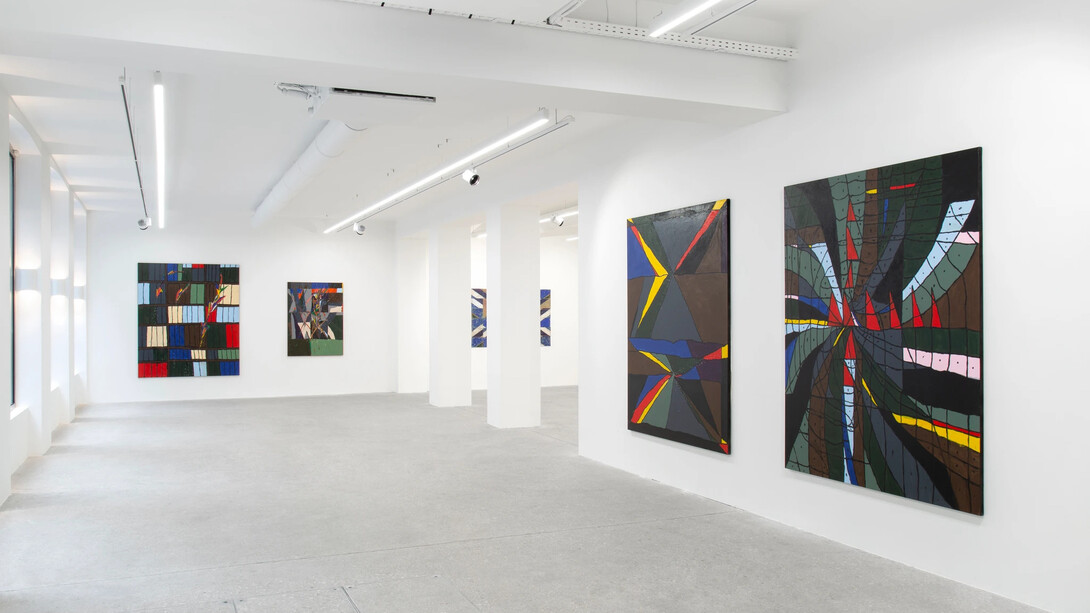
The comet is a small solar body that produces an unbound atmosphere or coma. Evanescent, that luminous trail is only released when passing close to the Sun. Upon entering the Earth’s atmosphere, a comet can burn and, as such, disintegrate. Free in its trajectory, it can come close to humans and to the Earth while maintaining a safe distance to protect itself and not be consumed.
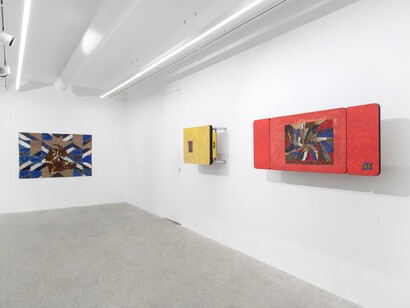
From his father’s passion for astrophysics, Matias Agafonovas has kept a few scraps of ideas. For his first solo exhibition at Mennour, entitled Comet fields in a matchbox, he presents a body of new paintings and ceramic sculptures in which cosmogony 1 occupies a central place, and the imaginary wanderings of a comet act like a common thread. The fascinating nature of the cosmos and the haphazard trajectory of the stars are simultaneously evoked. Captivated by the infinitely small place we occupy in the universe, the multidisciplinary artist, trained at the École des Arts Décoratifs, chooses to capture a celestial landscape in which a surrealist constellation of stars would have come to gather before continuing on their way to the Sun to burn out without leaving any trace. The infinity of the cosmos, measured in billions of light-years, could then be put away in a matchbox, kept deep inside one’s pocket or in the hollow of one’s hand.
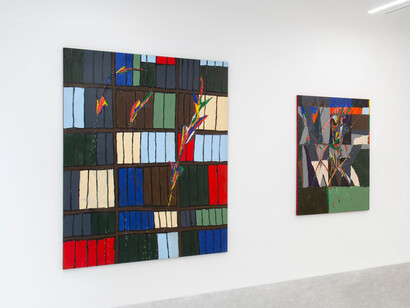
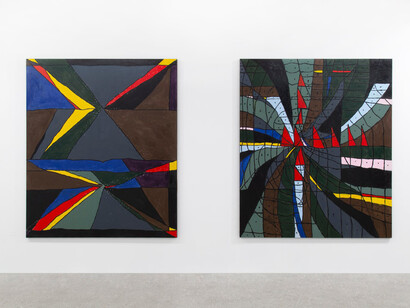
The idea of containing while categorising and playing on scales by shaking up the traditional perspective is a major part of the artist’s practice. Arranging in boxes and organising mixed elements is firstly about using the formal constraint to then facilitate a free composition. Delimiting several pictorial fields and disrupting the scale ratio in order to construct planes with multiple readings is the way his instinctive relation to composition develops. The same pictorial elements can be reused several times and reproduced in different media, acting like a straightforward demonstration of the deliberate blurring in scales: some details of the paintings are reproduced in smaller formats on drawings stuck to canvases or on mural ceramics. In his compositions, various fields come together, the eyes rest on repeated modules without quite knowing if they constitute the front of an urban development or the shelves of a library. A same motif is often repeated but never to be identical, keeping the irregular outline of the black ring that delimits it.
Of the hours spent on the benches of his primary school, Matias Agafonovas especially remembers the autodidactic techniques of carving with a compass on the melamine-covered surface of his desk, experimented clandestinely in the delightful dissidence of the back of the class. Far from claiming he was a “bad student”, he has always questioned the dominant authority and the educational systems that rule the conventional transmission of education. Mindful of the ways to organise knowledge and of the codes imposed by the school system, he works at redeploying the same formal elements through an art of subversion. Grids and topographies, defined zones for colouring, primary colours, Tipp-Ex and Scotch, felt tips and A4 sheets… In his paintings, we find a similar repertoire and the same set of tools as in the pencil case of a pupil’s schoolbag.
Here too the constraint is retaken, if not subverted to form the basis of a singular language. In his sculptures, the Formica table, icon of the Glorious Thirties and a nostalgic symbol of the modern homes of the 50s and 60s, is hijacked to become a wall framework for his ceramics. Finally, the mosaic fresco inspired by a view of the Earth some 250 million years ago, stands like a universal flag, fragmented but united, a viable utopia of an alter-world seen from outer space. Fluctuating between represented motifs and free abstraction, the artist develops an experimentation both graphic and playful that combines sources as varied as outsider art, automatic writing, Brazilian native arts and urban art–all in all formal languages articulated around a certain marginality. In the course of repeated and hazardous wanderings, his inspiration emerges at the crossing of casual meetings, personal reminiscences, incongruous shifts and impossible translations between his two cultures, French and Brazilian. In Comet fields in a matchbox, Matias Agafonovas revisits our relation to norms and intended uses, inviting us to reconsider the boxes instead of ticking them.
(Text by Megan Macnaughton)
Notes
1 The science studying the formation of celestial bodies (planets, stars, galaxies, etc.)

![Mary Cassatt, Fillette dans un fauteuil bleu [Enfant dans le salon bleu] (detail), 1878. Courtesy of Musée d’Orsay](/attachments/3ddcf3630b2e6b21d055a8488350d949784be8fa/store/fill/330/330/9b97dc5b17cad42577b6453f0968e961b1231ceb2b8b5ceb2c09057b2695/Mary-Cassatt-Fillette-dans-un-fauteuil-bleu-Enfant-dans-le-salon-bleu-detail-1878-Courtesy-of.jpg)