English
 Español
 Français
 Deutsch
 Italiano
 Português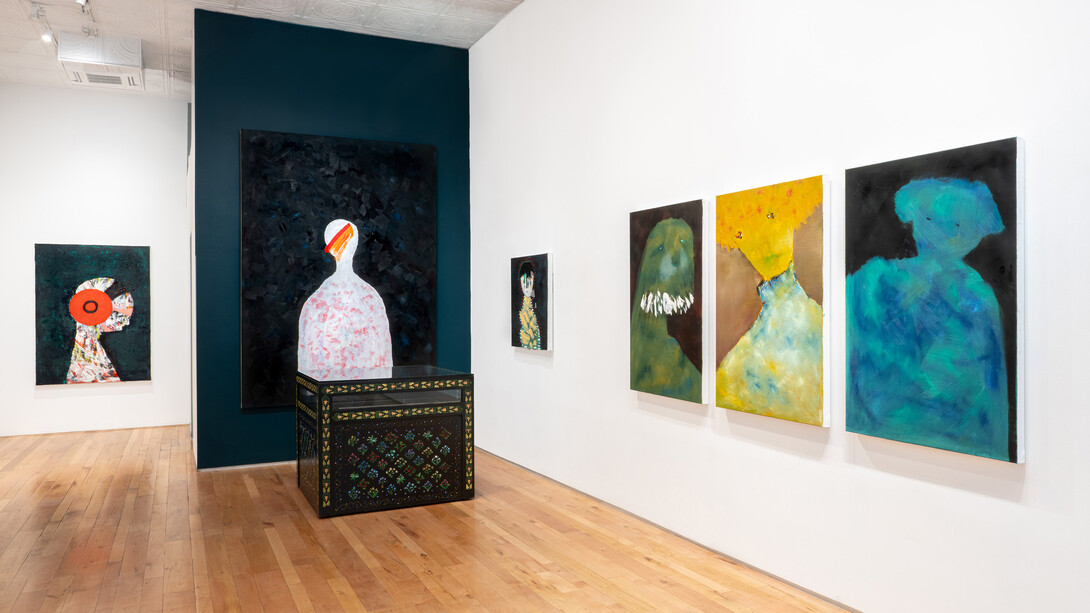
In Existential, being, Chinese American artist Liu Shuishi turns to ancient Greek gods and goddesses as a way of confronting the world after a profound, life-altering event. Rather than centering the drama of an “existential crisis,” the exhibition understands existence as an ongoing condition, one shaped by revelation, suffering, sacrifice, and transcendence.
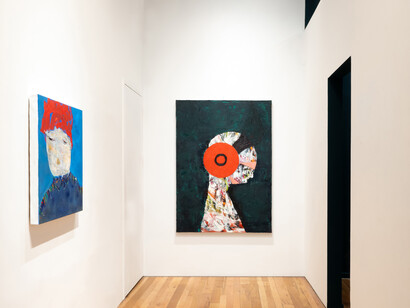
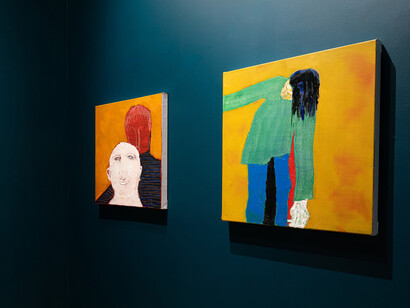
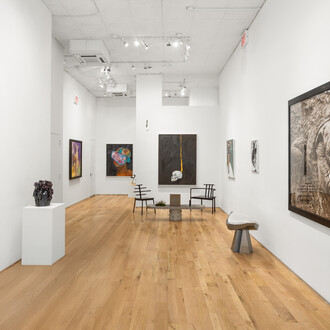
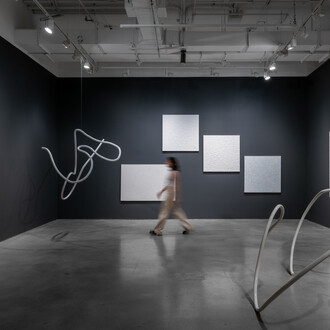
Existential, being brings together fifteen new paintings and a central installation, marking Shuishi’s first solo presentation in New York since 2020. Together, the works trace a journey of self-reflection, with mythological deities standing in for the shifting emotions, memories, and inner states that shape who we become over time.
Each painting reads like a different room within the same unfolding story, from different moments in the artist’s becoming. Collectively, they pose enduring questions: Who am I becoming? Who do I want to be to myself, and what parts of my existence must I revisit in order to get there?
Many of the works take their titles from Greek mythology. Celebrated in epic poetry for their heroic feats, supernatural power, and deeply human flaws, these figures offered the ancient Greeks a way to understand both the world and human nature. For Shuishi, they serve a similar purpose.
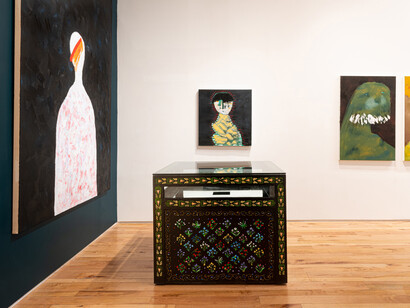
In Dionysus (the god of wine), a monstrous figure painted in greens and yellows bears large white teeth in place of a mouth. These white brushstrokes function as a metaphor for language, reflecting Shuishi’s belief that wine loosens truth and enables dialogue. In Achilles (the great Greek warrior), a fiery red profile confronts the viewer. Small, multicolored stripes in the upper right corner represent the fundamental tensions that define existence: violence and peace, rage and desire, creation and destruction.
Using light, art, and installation, Shuishi cultivates a stillness in the gallery, creating the conditions that foster a sense of inward connection. On the central wall, a monumental painting presents a silhouette set against a dark black-blue background. The silhouette hints at the presence of a figure emerging from the abyss. Its vertical scale encourages humility and awe, reminding viewers of their smallness in relation to something vast.
Below the monumental figure is an installation titled Art of the covenant, drawing inspiration from the biblical Ark of the Covenant, a sacred container believed to hold divine presence. Shuishi reimagines art itself as a vessel, one capable of bridging revelation and creation, the metaphysical and the human. The installation takes the form of a hand-painted “flower cabinet,” its ornate exterior concealing mirrors and a deep central void. When viewed from above, the viewer’s reflection appears, shifting the work into an encounter with oneself. The void symbolizes absence and longing, the insatiable desire that propels both artistic creation and human existence. The work was conceptualized in 2017, whereby Liu used a material form to confine the elusive, formless existence of “art.” The question of what exactly “art” is has dominated Liu's practice for over 10 years.