English
 Español
 Français
 Deutsch
 Italiano
 Português
Porcelaine et faits divers, the exhibition by Bachelot & Caron, stages a teeming and unsettling world where horror comes cloaked in aesthetic precision. At the crossroads of photography, ceramics and performance, the duo revive forgotten myths in a baroque feast pitched somewhere between grotesque opera and expressionist cinema.
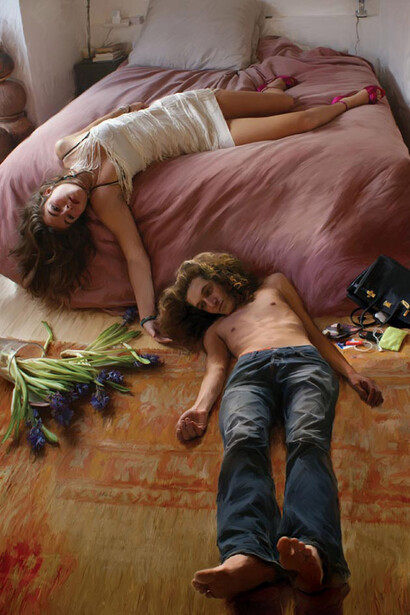
Louis Bachelot (Algiers, 1960) and Marjolaine Caron (Paris, 1963), who graduated in 1984 from the École Nationale des Arts Appliqués and the Beaux-Arts de Paris respectively, have worked as scenographer and costume designer for film, theatre and opera, and later as press illustrators (notably for Libération, Détective, FHM, VSD and The New Yorker). For twenty years, the pair produced numerous illustrations for Le Nouveau Détective, a so-called "popular" true-crime magazine often disparaged by the intelligentsia. Photographing their friends and relatives staged in crime scenes as frightening as they are sordid – hands strangling, rifles raised, women fleeing – Bachelot & Caron construct their images gradually through collage, assemblage and painted effects; all made possible by one of the earliest digital retouching softwares.
Their style is baroque, colourful and intensely expressive. Although it may be difficult to distinguish truth from illusion – their photographs reconstruct real events even as they distort them into fiction – the work gives form to what lies deepest in human mechanisms. Their pictorial culture is informed by images drawn from the history of art and cinema. Their approach recalls that of the pictorialists who, in the early 20th century, fought against the standardisation ushered in by the first Kodak camera, sought to surpass mere imitation of reality, and asserted photography’s place as a fully fledged art form.
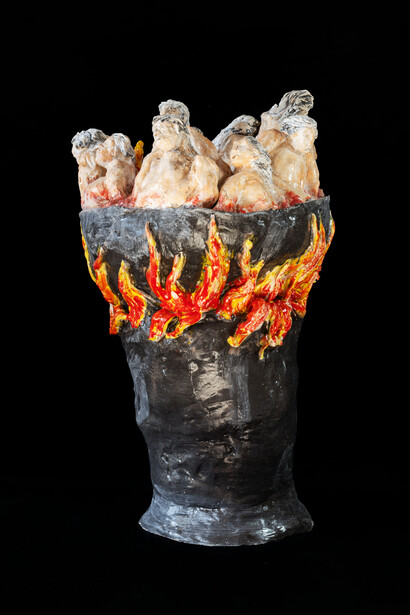
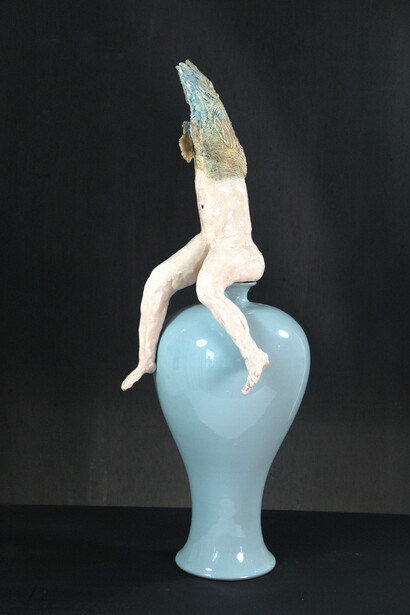
For more than eight years now, Bachelot & Caron have shifted from photography towards material and volume. Still working closely together, they practise glazed ceramics and performance, which they incorporate into their photographic tableaux within large immersive installations. Celebrated for their carnivalesque imagery and trompe-l’œil tinged with black humour, they mischievously and eruditely probe contemporary modesties and unsettle our relationship with death, sexuality and transgression.
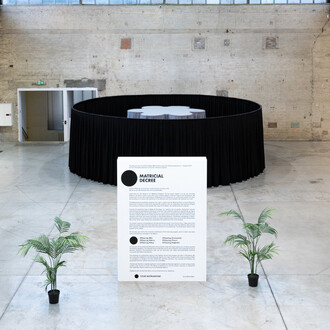
This image-making, serving a narrative endlessly reenacted in an aesthetic mode, has led the artists to devise a performance to be presented in March at the heart of the Grande Halle of the BPS22. On a cylindrical stage, Bachelot & Caron drag and bury a corpse before transforming themselves into human ceramics, revealing their naked, martyred artist bodies, addressing survival in the art world, redemption through creation, and recounting their everyday life as a couple. Highly illustrative, this performance cements the transition from true crime to ceramics by engaging with the fragility of both the human body and the artefact.
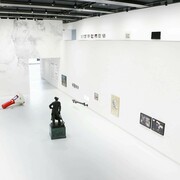
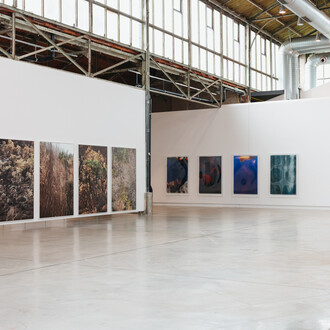
The first retrospective devoted to Bachelot & Caron, the exhibition Porcelaine et faits divers brings together for the first time their photographic, painted and ceramic works within a vast installation-performance designed to provoke feelings of beauty, desire and disgust. Alongside a grand table set for an orgiastic banquet, salons are dedicated to the surrealist universe of René Magritte, the feminine world of Chantal Ackerman, and the vegetal imagery of Jean Lurçat. In the manner of cabinets of curiosities or collectors’ rooms, the artists share their off-kilter, exuberant reading of art history, delving close to the hidden, repressed or censored springs of the human soul.