English
 Español
 Français
 Deutsch
 Italiano
 Português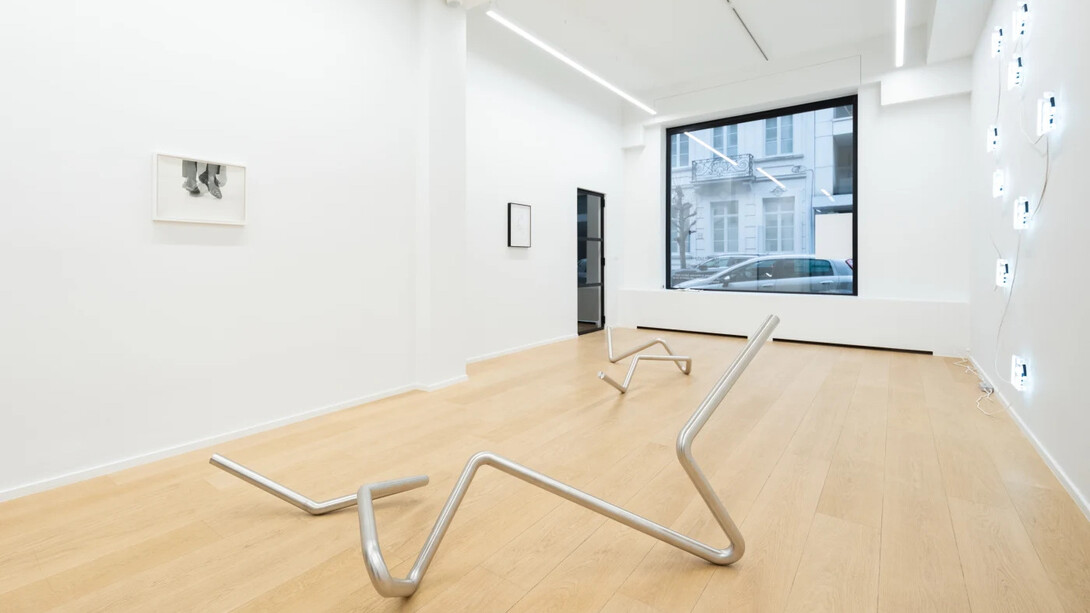
QG Gallery is pleased to present the new solo exhibition by French artist Quentin Lefranc.
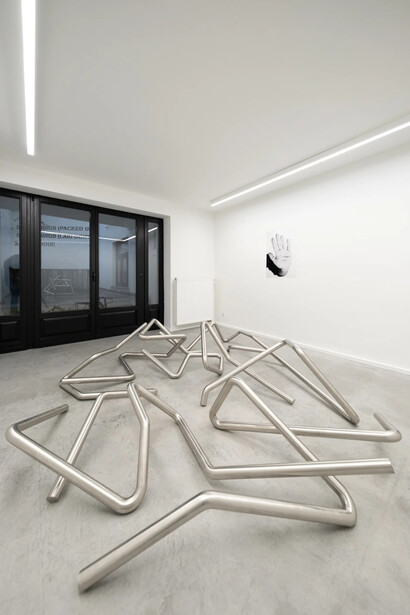
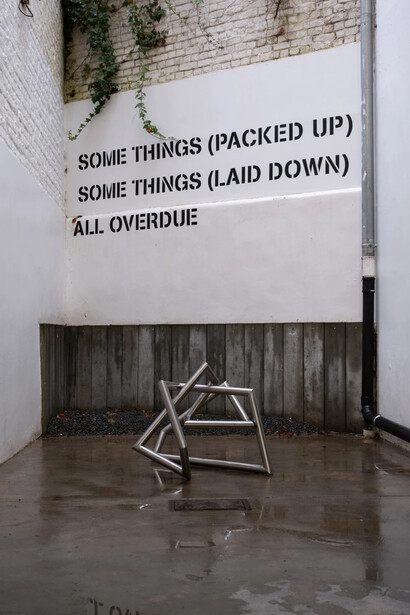
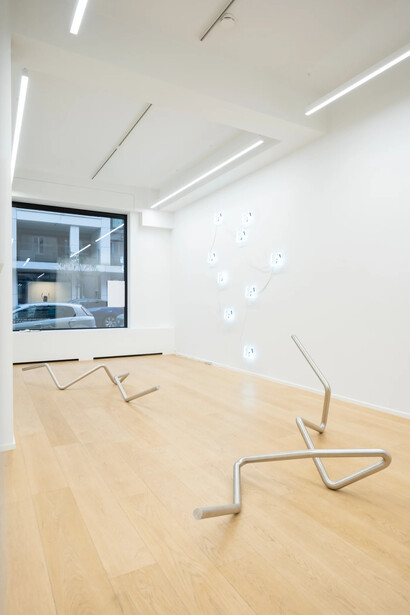
In keeping with the title of his exhibition, Quentin Lefranc (born 1987) explores space as well as the ways in which it is designated and defined. For his exhibition at QG Gallery (2026), he employs a variety of techniques and media—including video, photography, drawing, and sculpture—while also making use of his own body, language, and scientific illustration. While the multiplicity of the artist’s stylistic approaches may come as a surprise, the work reveals a deep coherence grounded in a sustained attention to the very conditions of experience.
In 2025, Quentin Lefranc presented Around nothing (2023): a transparent cube printed with reference markings and the silhouette of the artist in three different postures, installed at the base of the building designed by Le Corbusier and Pierre Jeanneret at the Cité Universitaire in Paris. The reference to the Modulor naturally comes to mind—Le Corbusier’s system for scaling architecture to the human body. But what, exactly, does Around nothing index? The exhibition space, the architecture, or the artist’s body as a unit of measure? This disturbed or shifting indexation constitutes one of the generative principles of Lefranc’s practice.
Behind the methodological diversity lies a profound coherence that partly engages with the concepts of the Concrete and the Abstract. These notions run throughout the history of philosophy, from Antiquity to dialectical thought. The Concrete refers to what exists materially and is accessible to sensory experience, while the Abstract points to general ideas that are isolated from concrete things in order to think them more clearly.
Quentin Lefranc is interested in phenomena and their observation: observing the details of his own body, examining the relationship between that body and space; drawing a line, observing the movement of pollen in water (Robert Brown), or reasoning through the knot of a rope (Max Dehn). It is worth noting that these modern theories have numerous connections to both the art world and everyday life—Max Dehn taught at Black Mountain College and influenced Anni Albers, while Brownian motion has profoundly transformed modern finance.
Whether he deploys complex and enigmatic forms or meticulously observes the details of a back, Quentin Lefranc reminds us that phenomena are inseparable from scientific and verbal speculation. While the exhibition may at times adopt minimalist or analytical appearances, it ultimately asserts that no work—no matter how irreducible it may seem—escapes phenomenon and performance, understood here as both a physical and intellectual process.
In the wake of American minimal and conceptual art, whose models remain operative, as well as the European research traditions that deeply informed them—from Rudolf Arnheim to Ludwig Wittgenstein—Quentin Lefranc advances no argument of lineage or competition. Instead, he emphasizes how artworks, however abstract they may appear, are never autonomous or isolated, conceiving them instead as dynamic, relational, and fundamentally performative.