English
 Español
 Français
 Deutsch
 Italiano
 Português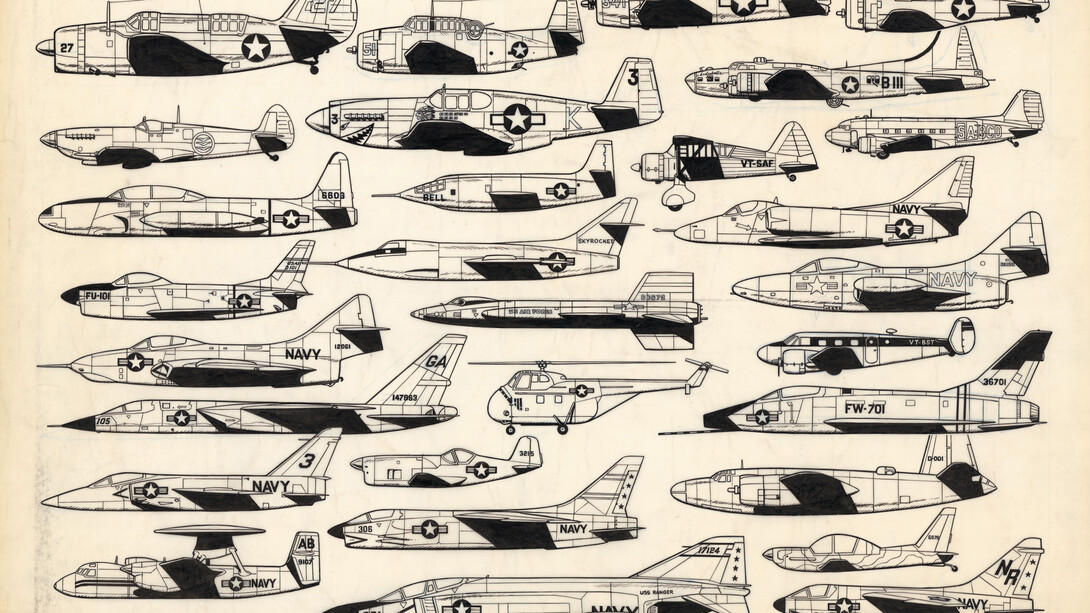
At the end of 2025, as part of its annual series of cultural, non-commercial exhibitions dedicated to iconic figures from the world of Belgian comics – following Morris in 2023 and Jean Roba in 2024 – Huberty & Breyne is hosting a retrospective dedicated to another famous name associated with the 9th art, that of Victor Hubinon.
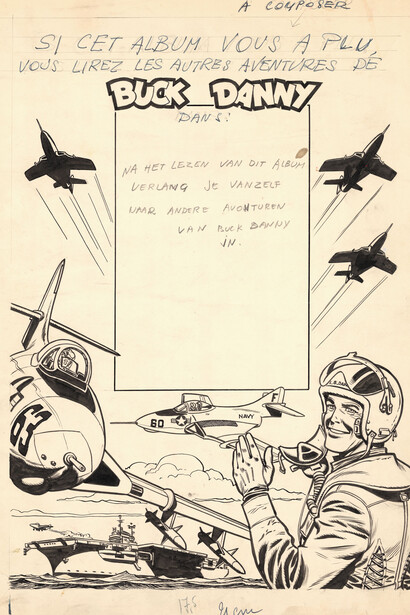
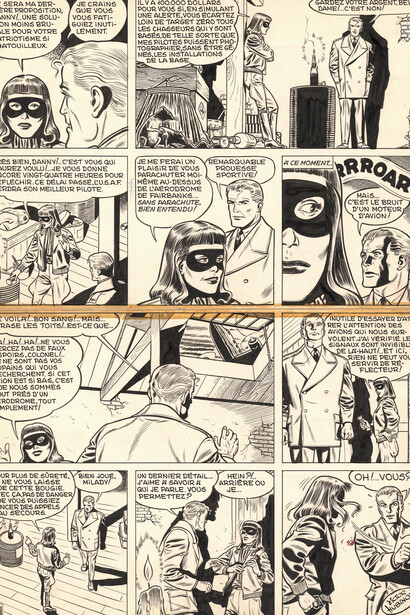
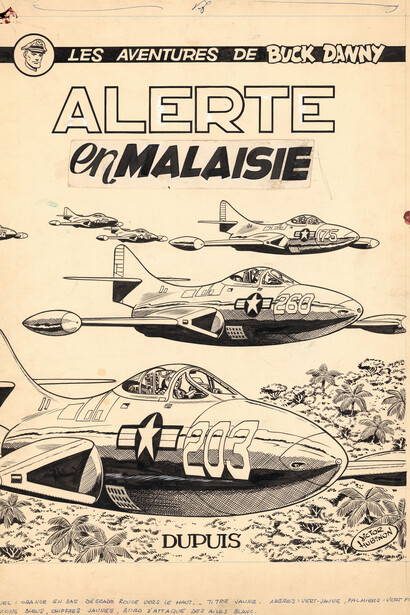
To celebrate Hubinon’s long and fruitful career, the gallery is showing an exceptional selection of original works from the first forty albums of the Buck Danny series, with three originals from each album, including – for the first time ever – some thirty covers.
A rare opportunity to (re)discover the graphic universe of a pillar of classic Belgian realistic comics.
The origins of a mythical hero
- On the Hawaiian island of Oahu, a young engineer, newly qualified, gets a job at a shipyard in Pearl Harbor. We do not yet know his name – which will only be revealed in the ninth plate – but this is Buck Danny, as he will come to be called. After directly witnessing the Japanese attack on Pearl Harbor, he enlists as a pilot in the US Navy and joins a fighter squadron on a bombing mission.
On 2 January 1947, readers of Spirou magazine (no. 455) got to see the first plate of Les Japs attaquent…, based on vivid memories of the conflict and situated midway between military realism and adventure story. Through its unconventional use of the first person over some dozen pages, the story drew the reader in and created the feeling that this was a fictional tale rather than mere war documentary.
From Troisfontaines to Charlier: the evolution of a narrative and a style
In the first episodes of Buck Danny, Georges Troisfontaines was responsible for the script and, thanks to his rapid, concise writing style, successfully condensed six months of war into a few pages. The drawings for the series were still evolving and were the work of the young Victor Hubinon, whose fluent style was influenced by Milton Caniff.
Troisfontaines’ business activities soon took precedence and he handed over the writing of the series to Jean-Michel Charlier, whose job was also to draw the aircraft and the aircraft carriers.
Our styles were actually quite different. Charlier used a pen and I worked primarily with a brush. As the years went by, I was doing more technical, documentary stuff, whereas Charlier was working increasingly on his various storylines. So, I took over drawing the aircraft and all the Buck Danny material around the time of Attaque en Birmanie. That explains why the aircraft and the settings suddenly changed from being quite finely drawn to being drawn with much thicker lines.
(Victor Hubinon)
Hubinon very soon made his mark. An innovator in the art of the mise-en-scène, he equalled the leading exponents of a realistic comics style, transforming the narrative approach of the Buck Danny series with a return to the use of the third person, more meaningful dialogues, greater technical precision and documentary realism. This combination of fiction and historical realism would become the hallmark of the series.
To the delight of its fans, the series would see Buck Danny and his two sidekicks, Sonny Tuckson and Jerry Tumbler, navigating the Korean War (not without censure from the French ), the virgin flight of the X-15 and the early days of space exploration.