English
 Español
 Français
 Deutsch
 Italiano
 Português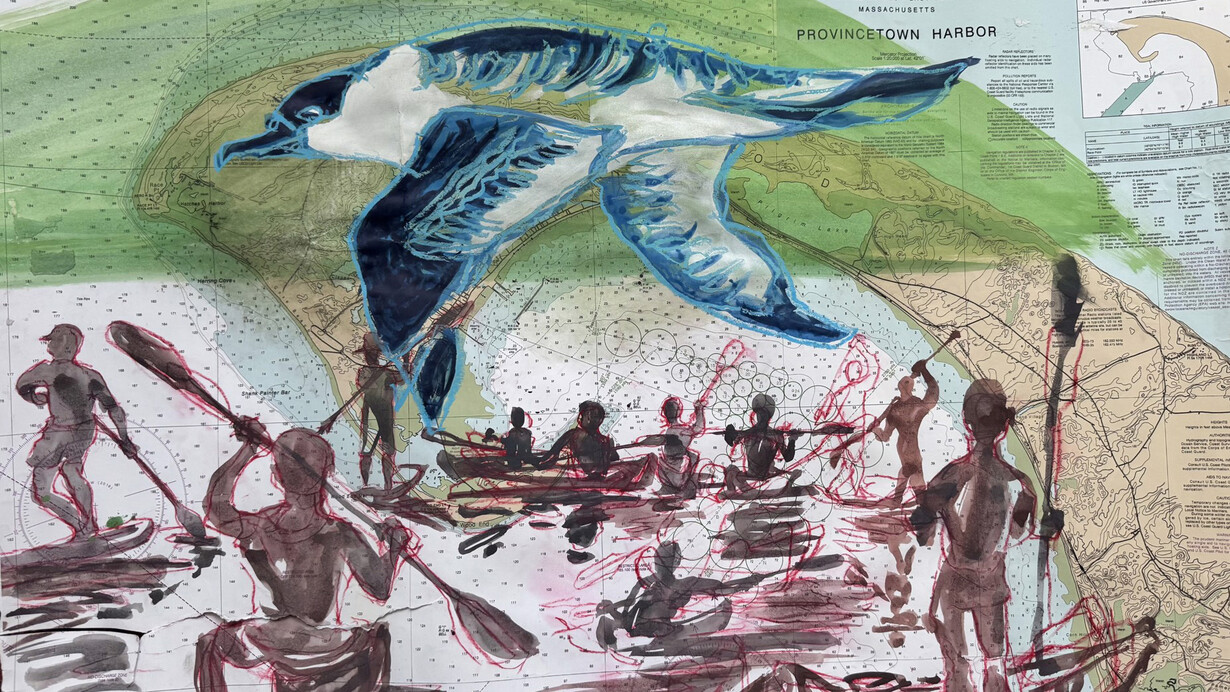
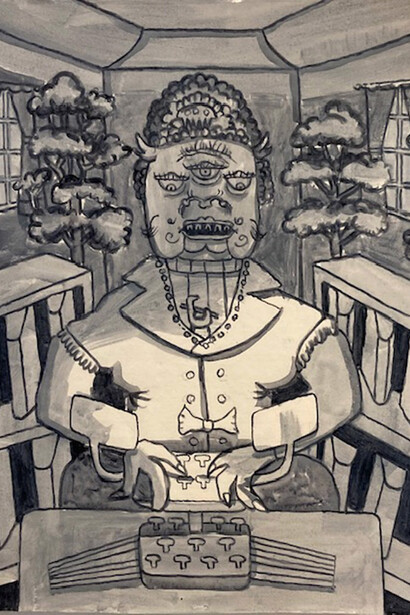
People: An exhibition of acrylic paintings on canvas by Hannah Barrett that activate us in a multitude of ways. These five works were made as studies, prompts, maquettes for Barrett’s suite of recent paintings titled Word Processor. Painted in black, white, and tones between they speak to Barret’s drawing practice, an essential component of their work and a place where language, mark, and speculation together dissemble the binary aspects of the work and the surrounding viewing spaces.
The subjects of these paintings appear to be secretaries, record keepers, and writers…administrators and holders of information and protocols. Their environments and tools look to be dated, analog, and mechanical, but further examination reveals them as players in a dialogue about order and archival notions. Claw-like hands seems designed to impair the work to be done here, but also might be the only appendages that could accomplish something in these strange, specific spaces. Here is where these painted stories of gathering and holding begin to flip the script. Rather than simply commenting, depicting, or informing us about these mundane positions, these curious works actually unravel and reorganize the static, binary definitions of how we look at things; how we receive information. For Barrett, the act of adding something: marks, tones, and narrative prompts, actually remove sets of habitual and expected obstacles. We find ourselves experiencing the work freed from conventional restrictions, as participants in a new space apart from the towering hierarchies known to cement oppressive power structures in place. Smart, funny, sly, and mesmerizing, we are left with a new and disarming sense of possibility, even freedom.
For over two decades, Hannah Barrett has explored the concept of gender ambiguity in their work. The characters in their paintings inhabit richly decorated settings and gain their persona through both personal and historical references. Barret develops the scenes through extensive research, multiple layers of paint and mark, and these detailed preparatory sketches where they tell me that they are often themselves surprised by the ways that the characters grow and change. As a drawing practice extended, pursued, and perfected these works show possibility within and beyond form with style, humor, and rigor.
“I thought of paintings the same way I thought about the text in stories,” they say. “I was so used to using my imagination with stories in books that when I looked at pictures, I would animate them in my mind.”
Hannah Barrett (b. 1966, USA) attended Wellesley College and The School of the Museum of Fine Arts, Boston before receiving their MFA in painting from Boston University. Their work has been exhibited at Decordova Museum, Lincoln, MA; Museum of Fine Arts Boston; The Gibson House Museum, Boston, MA; National Museum of Women in the Arts, Washington D.C; The Schoolhouse Gallery, Provincetown, MA; Bill Arning Exhibitions, Kinderhook, NY; Childs Gallery, Boston; La MaMa Galleria, NY; Spring Break 2020, NY; Platform Project Space, Dumbo, NY; Callicoon Fine Arts, NY; and Mother Gallery, Beacon, NY.
Barrett received the MOTHA Award; Artadia Fund Award; and a Fire Island Artist Residency. Academic engagements include Pratt Institute, Brooklyn, NY, School of the Museum of Fine Arts, Boston, RISD, Boston College and recently Bard College where they served as the Executive Director of the Milton Avery Graduate School of the Arts.
Barrett is also the illustrator of a vegan and lesbian themed children’s book Nuts in Nutland. They are based in Brooklyn and the Hudson Valley, New York.
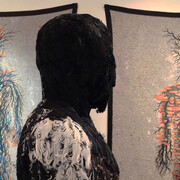
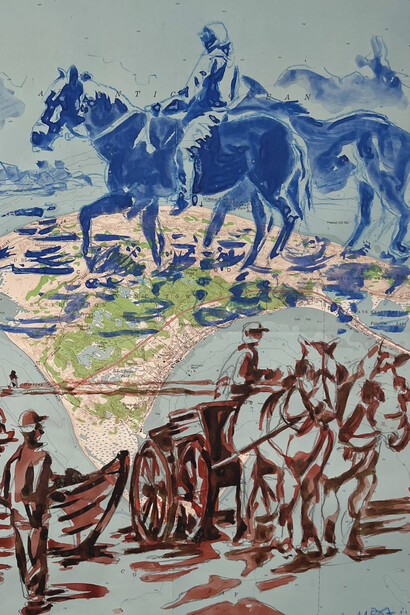
Places: Mark Adams is a visual artist, writer, cartographer, scientist and storyteller based in Provincetown on the Outer Cape in Massachusetts. Adams employs painting, printmaking, and public art installations to instigate immersive experiences about places where nature and shifting populations meet such as shorelines, wetlands, marshes, and refugee camps.
Adams’ art features layered images of maps, personal notebook pages, text, data, and images of animals and friends. Adams’ volunteer work with refugee relief organizations has spurred his interest in the intersection of climate change and human ecology. Large-scale public projects invite viewers to consider injustice and the repercussions of climate migration throughout the world. He studied biology, landscape architecture, printmaking and photography at the University of California, Berkeley, the California College of the Arts. Adams teaches regularly at the Castle Hill Center for the Arts (Truro MA), the Fine Arts Work Center, the Provincetown Art & Artist’s Museum and the Provincetown School, and has been a guest presenter at MIT’s Media Lab.
For this exhibition we present five paintings on vintage maps. Adams received a trove of vintage navigation charts from all over the world, occasionally plotted in pencil with courses and bearings - from the collection of Whale Scientist Stormy Mayo. Maps have been a part of Adam’s art making practice for many years. Drawing from expeditions and dreams they become the background for narratives, fragments of stories. He employs them as substrates in building mixed media works, as notebooks for field notes and journal entries, as visual prompts, and as evidence of citizen action and motion in a changing landscape.
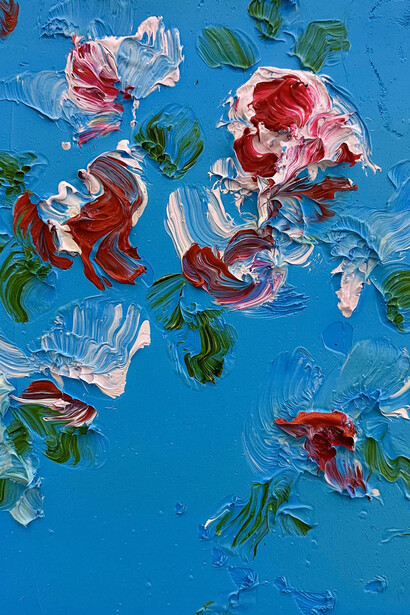
Things: Tess Michalik. Born in Richmond Virginia and based in Brooklyn, Tess Michalik received a BFA from Herron School of Art in 2010 and an MFA from Northern Illinois University in 2014. She has exhibited nationally and internationally at art institutions, university galleries, community spaces, contemporary art galleries, and art fairs including Art Los Angeles Contemporary, Papier Montreal, Palm Beach Modern + Contemporary, and Future Fair 2025, etc. In 2018, Tess had her first museum exhibition at the Winnipeg Art Gallery in Manitoba, Canada. Her paintings have been published internationally in Architectural Digest and her work is in the collection of the Museum of Modern Art Library in New York in the permanent collection of WAG-Qaumajuq.
Michalik makes paintings with oil paint on canvas, linen, and on solid substrates like wood panels. Her work, often sourced from garden spaces and textile patterns that define certain worlds of etiquette and class, are thick, rich, frosting-like paintings made in a sequence of wet on wet studio sessions. Her lush and sensual object-like paintings show what paint can do and are made as if paint is simply an everyday means to an outlandish and too beautiful end. Michalik’s work seems about to swoon forward from their backgrounds directly into our laps, as if to recognize our desire for too much cake and tasty syrup.