English
 Español
 Français
 Deutsch
 Italiano
 Português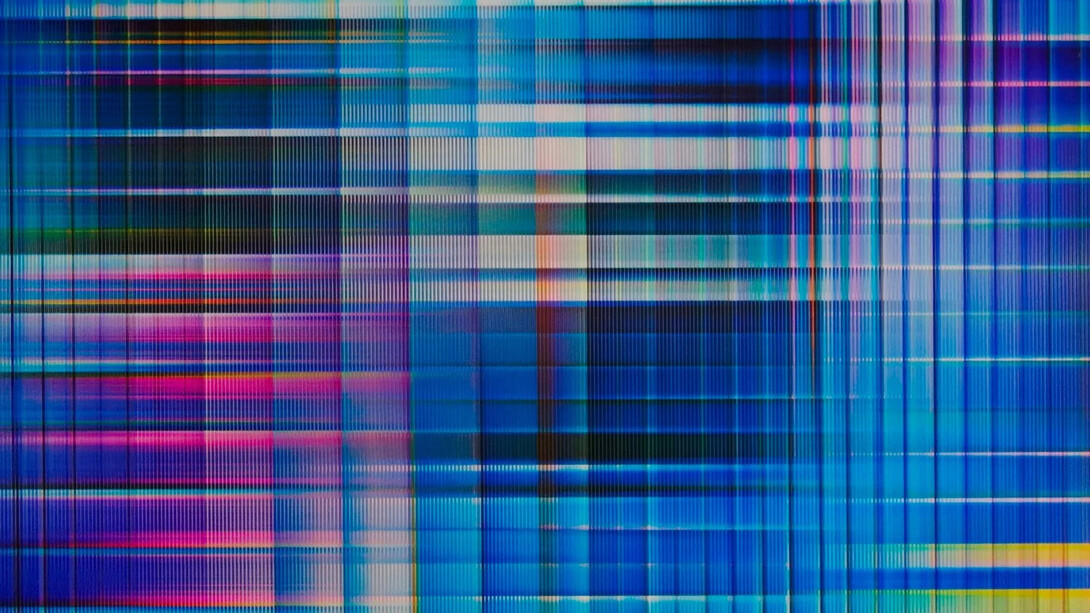
Cicer's rigorous and multidisciplinary approach is deeply rooted in the history of twentieth-century avant-gardes - movements that made time and space the pillars of a new artistic language and gave life to a cultural revolution whose effects are felt even today.
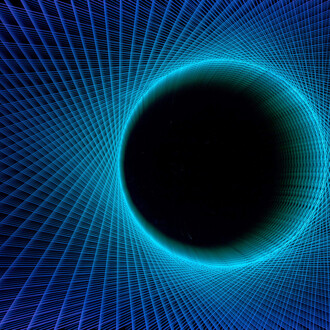
A pure contemporary Visibilist, Ciceri speaks to us of kinetic Nanoimpression-ism. His artworks capture the moment in which the visible alternates between materialization and dematerialization of time, thus raising a reflection on perception while re-evoking Maurice Merleau-Ponty's phenomenological per-spective, according to which the world is not given, but built by the subject's gaze and experience.
This dialog introduces the concept of Hypertraits - a «portrait» of reality that goes beyond the limits of traditional representation, and redefines the relationship between subject and object. «It is a cinematic work using photo-grams coupled with optical lenses, like a sequence shot; what we see condensates and rarefies rhythmically, thus producing shapes that dissolve into more and more shapes. The Hypertrait is an ideal tool through which to explore the immaterial; it does not reveal the subject at a glance because, like music, this technique is inscribed in time, hence it doesn't communicate literally decipherable concepts, but moods, may they be stable or passing.
It is eurythmics trying to subjugate rhythm to the harmonic functions of shape and force», Ciceri explains.
The exploration of movement as an illusion, the apparent immobility of infinite imperceptible motions, and the audience's participation to the activation of the artwork are all aspects that would persuade one to mistakenly compare Umberto Cicer's pieces to those of programmed and kinetic art, or even optical art. However, what mainly distinguishes Cicer's artworks from those of his predecessors is the fact that he developed what we could define as «poetics of time».
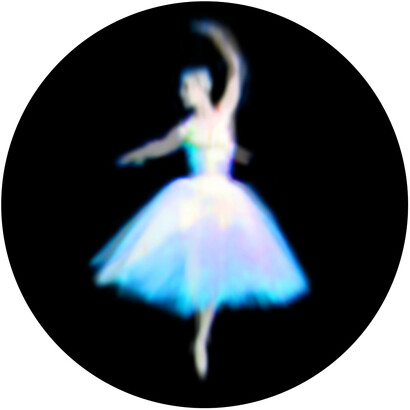
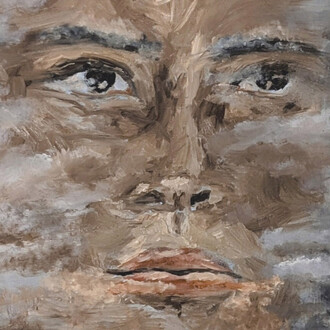
The subjects Cicer named Personaggi ritmici [Rhythmic Characters] possess a narrative and symbolical dimension that makes them actual meaning hubs, inviting us to reflect on our unexhausted research for centrality and balance.
The creative process in each work follows a Hegelian scheme, in which thesis, antithesis and synthesis give life to an actual phenomenology of light, that intersects time, rhythm and the viewer's frame of mind, forming an interdependent relationship which is necessary in order to activate the artwork. The interaction between artwork and viewer puts the latter in an intermediate space: the audience plays an active role in the creative process as they move through it, thus performing an «Intra-action».
Everything is interconnected, after all, as Ernst Gombrich said: an artwork is never an isolated entity, but rather the product of a dynamical relationship between artist, audience, and context.