English
 Español
 Français
 Deutsch
 Italiano
 Português
“They said it was contamination,” said Professor Sangkot Marzuki. “But we found no bacteria—only the toxin.”
Eighty years later, the Klender tragedy is no longer just a mystery—it’s a war crime hiding in plain sight.
Jakarta, Indonesia—In the sweltering heat of August 1944, at a Romusha transit camp in Klender, East Jakarta, over one hundred Indonesian laborers collapsed within hours of receiving a mandatory vaccine injection. What unfolded was not an outbreak but a mass death event. And what killed them wasn’t a virus—but a toxin.
Eighty years later, scientists now believe this was no tragic accident but a deliberately orchestrated medical experiment carried out under the Japanese occupation of Indonesia during World War II.
At the heart of this revelation is Professor Sangkot Marzuki, a leading molecular biologist and former director of the Eijkman Institute for Molecular Biology. His decades-long investigation has unearthed disturbing new evidence pointing to one of the darkest medical atrocities in Southeast Asia—one the world has largely forgotten.
It looked like an outbreak, but it wasn’t
On August 7, 1944, dozens of Romusha—forced laborers under the Japanese regime—were brought to the Central Public Hospital, convulsing violently. They had received a vaccine just days before. Within hours, every one of them was dead.
“The Japanese report said the vaccine was contaminated with Clostridium tetani, the bacteria that causes tetanus,” Marzuki told us. “But when samples were examined at the Eijkman Institute, there were no bacteria—only pure toxin.”
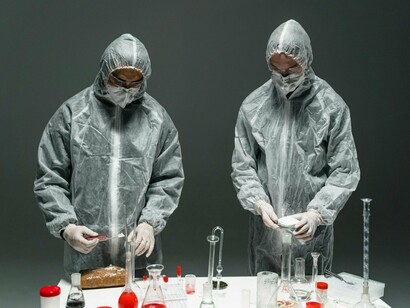
The distinction is crucial. Tetanus bacteria can survive in the body without causing harm. It is only when the bacteria begin to release toxins that symptoms occur. Yet in Klender, the toxin appeared in lethal concentration, without the presence of bacteria. The only explanation? The toxin had been deliberately injected.
The perfect cover
The vaccine in question was part of the standard TCD series—typhoid, cholera, dysentery—typically administered to Romusha before deployment. But the mortality rate in Klender was not just suspicious—it was biologically implausible.
"A hundred percent of them died. That’s not contamination. That’s murder,” said Marzuki.
He and co-researcher Kevin Baird calculated that the dosage of toxin administered far exceeded any accidental exposure. “If the toxin had simply failed to inactivate properly, maybe a few would’ve died. But not all of them,” Marzuki explained. “That kind of lethality had to be intentional.”
A pattern of silence
Japanese doctors at the time attributed the deaths to a storage mishap. But multiple autopsy reports and archival documents tell a different story—one that leads to Unit 731, the infamous Japanese biological warfare unit based in Manchuria.
According to Marzuki, the vaccine was produced at the Pasteur Institute in Bandung, which was under the supervision of a sister organization to Unit 731 operating out of Singapore. While not directly tied to the Harbin-based operation, the institutional structures mirrored the same hierarchy—cloaked in scientific legitimacy, yet brutally experimental in practice.
Indonesian doctors reported seeing hundreds of similar cases in other regions, suggesting that Klender may have been only one part of a larger, systemic testing campaign across occupied Indonesia.
A scapegoat in cold storage
The most tragic subplot in the Klender case is the fate of Professor Achmad Mochtar, the first Indonesian director of the Eijkman Institute. Though the vaccine was manufactured in Bandung, it was stored overnight in the cold room of Eijkman during transit.
That single logistical detail was used to pin the entire tragedy on him.
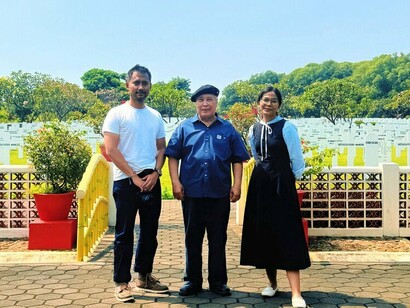
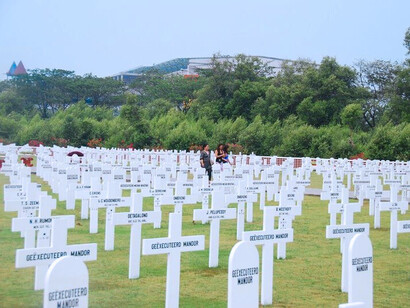
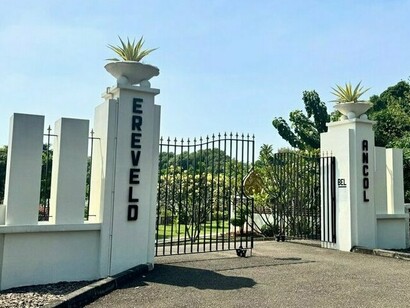
He was arrested, tortured, and ultimately executed in 1945—just weeks before Japan surrendered. His grave was lost for decades, until Marzuki and Fegan, with the help of Dutch archives, located it in Ereveld Ancol, North Jakarta.
“We believe he was beheaded,” Marzuki said quietly. “He was innocent. He never even had access to the toxin.”
Evidence buried and resurrected
Proving a war crime without access to Japanese archives has been a monumental challenge. Post-independence Indonesia had little political power to demand justice, and many documents remained in the Netherlands or Japan.
But Marzuki persisted. His work, in collaboration with historian Kevin Baird and Japanese scholar Aiko Kurasawa, has started to piece together the full horror. Kurasawa’s upcoming book, releasing on August 9, draws on Dutch and Japanese records that confirm similar vaccine incidents occurred in other parts of Indonesia.
When Marzuki and Baird launched the Indonesian edition of their book “Eksperimen Keji: Kedokteran dan Penjajahan Jepang” (War Crimes in Japan-Occupied Indonesia: A Case of Murder by Medicine), Kurasawa confirmed the documents’ authenticity. "The evidence is strong now," Marzuki said. "It’s no longer just theory."
Unacknowledged. Untaught. Unforgiven.
Despite mounting evidence, the Klender incident remains unacknowledged by Japan and absent from most Indonesian textbooks. No memorial has been erected for the Romusha who died. Professor Mochtar’s name is still largely unknown to the public.
Yet to those who have studied the case, the verdict is clear.
“Whether or not it is legally recognized,” Marzuki concluded, “this was a war crime. Using Romusha as test subjects, without their consent, without ethical approval—that violates every standard of medical practice.”
Klender is more than a historical footnote. It is a brutal reminder that science, when untethered from ethics, can become a weapon. And for the families of those who died, it is an open wound—one that still waits for justice, acknowledgment, and remembrance.