English
 Español
 Français
 Deutsch
 Italiano
 Português
There isn’t a more fun topic to discuss, bathe in, or write about.
At the core of our humanity is the beautiful feeling we all know as love. No matter what the language, the culture, the gender, or ethnicity, it is the sense, vibration, and fragrance we all warmly respond to when we’re in its presence.
Love of beauty and the beauty of love form a circularity we enjoy daily as naturally as our own breath.
Love goes by many names as does God, yet everyone has their own felt sense of what they mean when they say each, and often each means the same, hence the phrase “God is Love”.
When it comes to describing God or love, there is this inherent quality of je ne sais quoi, I feel this, it’s beautiful, yet it defies being reduced to words.
The ancient Chinese sage, Lao-tse, speaks of the Tao as the “ineffable, that which cannot be described or named”, yet everyone knows what it is. It’s so close to us, like our face, we cannot see it, but we can feel it and know it.
Perhaps the life-force is the Universe’s way of saying “I love you. So now from the love, may thee go forth and propagate, multiply! Live and let live! And as you do, you are, by nature, propagating and multiplying love through you and all around you. This is what God’s creatures are designed and meant to do!”
“The eye through which I see God is the same eye through which God sees me; my eye and God's eye are one eye, one seeing, one knowing, one love”, a quote attributed to both St. Francis of Assisi and to Meister Eckhart. No matter who may have said it first, it’s a beautiful way of saying that “love is everywhere”. It all depends on through which lens one chooses to see.
Glimpses of Love
Sometimes, as I walk down the streets in New York City, I see a man holding a door for a woman or the other way around, and in that simple, ordinary gesture, I experience an immediate feeling of the love behind it. There is an intention of providing care and kindness.
Gestures of kindness are acts of love, and they abound everywhere, every minute of every day. It suggests that we are inherently good, inherently kind. Unless we are traumatized and abused, we are likely to be good, kind and probably even often flourishing with good feelings, which are biologically programmed in us in the form of oxytocin and endorphins.
Gestures of love: chivalry still exists!
Why does the gesture exist? Why does kindness, courtesy, or chivalry show themselves every hour of the day across all cultures?
Certainly, the person can open the door for themselves—it’s not about ability. For the collective good, our ancestors embedded high-minded values into the very fabric of society, which encourages, supports, and assures that acts of kindness flourish and are plentiful, to propagate and to “multiply like fish and loaves”.
When I observe a door being held by someone of any color, gender, size, shape, background, or socio-economic status for another person or any combination of these, it demonstrates the Global Good and Universal kindness that I’ve strongly suggested is inherent in us all.
Tibetan Buddhist teacher Chogyam Trungpa, Rinpoche, established a program in the 1980s called Shambhala Training1, which was based on Buddhist principles but absent the religious component. Its premise was that all beings are inherently and essentially good. If someone acts at variance with that, it’s because they have lost touch with their essential nature.
It’s pretty obvious that there is a minority of humans across the planet, especially those in positions of leadership, who are “at extreme variance” with this principle for any number of reasons, due to actions in this life or previous ones. It’s up to us all to help them, shepherd them to “find their way back” to their essential nature.
When people act in ways that are contrary to the expression of love, their fundamental nature, one can reasonably suspect that they have experienced extreme prenatal and postnatal trauma.
Unfortunately, with the number of wars and violence on the planet today, these numbers are not dropping but increasing considerably. The reason for more love to be generated to heal these wounds becomes all the more evident.
Love is everywhere
When you look from the point of view that love is everywhere, as the mystics have always said, you can see love everywhere, in the smallest gesture of helping someone on the street to the grandest wedding ceremony of two people in love.
This is what gives love its universal nature, the thing everyone wants more of. This is why almost every song, aria, novel, dance, or film is about love, its loss, or our longing for love. This is what enriches and inspires us all, even in the face of danger.
Love is the biggest motivator on Earth. When you see love everywhere, you see beauty everywhere. This is what uplifts the spirit and enhances our physical, mental, and emotional states, literally like nothing else. In effect, seeing love everywhere is a spiritual practice with profoundly healing and health-producing effects. The quality of one’s life becomes elevated to another level. People can see it and feel it “in the air”. They can see it in one’s glowing face and beaming eyes. It is palpable.
The different flavors of love
If love is the life-force of the Universe, it comes to us in different forms and varieties. We’ve all experienced them all at one time or another. This variety and breadth of experience are both healthy and attune us to a higher intellectual, emotional and kinesthetic intelligence.
Before zeroing in on the one most popular among most cultures and one in which we all love to partake, Eros, romantic love and its obviously juicy, ebullient, effervescing chi, I find it useful to take a broader sweep of love as it “comes from the Gods, from Heaven to Earth” as some ancient cultures, such as the Greeks may say, from Eros to Agape. Each has its place in the broader scheme.
In light of appreciating love’s largesse, I will lay out the classic Greek view of love as it comes to us from the ancient philosophers. Of course, we all love Eros, yet love is as expansive as the Universe itself and these different tones seek full engagement and recognition.
Plato & Aristotle offer seven types of love2
Eros
This is what we know as romantic love, charged with passion and sexual attraction. Almost every song, poem, opera, and film are either about this explicitly or at minimum, tangentially. It rouses our imaginations, our emotions, and our libido.
When we think of erotic love, we typically conjure images of lovers and courtship. It’s beautiful and most everyone is roused, inspired and swoons.
From the Chinese energetic view, our life-force is awakened through this courtship, the polarized power of the Yin-Yang attraction is activated and it seeks expression.
Interestingly, love-making from a Taoist point of view is not simply about sexual gratification and orgasm though it can include these and better to some extent, but it focuses first and foremost on the woman’s pleasure.
It includes the circulation of the chi that gets generated from arousal. The life-force emerging from sexual arousal is consciously circulated through the body. Its next stage is to connect one’s own vital life-force with that of the Heavens.
From that point of view, sexual attraction, while fully enjoyed in the body, also acts as a vital link when directed to a higher, cosmic dimension. This is the basis of Taoist love practices, which start with Eros and the depths of pleasure, and then evolve into a much larger, refined, spiritual expression and experience. In short, the micro- and macro-levels of life itself become intertwined, mind and body with spirit.
The world’s literature twists and turns on Eros. The continuation of our species is grateful.
Philia
Philia is translated from Greek as “friendship”. Such a simple word, yet so replete with depth and multiplicity of meaning. Let’s take it first as goodwill and good cheer among people.
Depth emerges through shared values, experience, and the shared enjoyment of play and humor. It is further expanded by expressions of goodness, being available to each other during times of joy and hardship. A sense of sturdy reliability and trust emerges. Virtue is its backbone.
Is there a relationship between Eros and Philia? You betcha! Eros without philia can begin to wither after sexual attraction begins to diminish. If romance dissipates, which it does not have to at all, Dr. Bruce Lipton3 reminds us in his excellent book “The Honeymoon Effect”, philia is there to ‘catch it’ or to further enhance Eros. Granted, it’s a different frequency of love, but it strengthens the bond between lovers.
Both Eros and Philia involve mutual benefit and the joy of companionship, reliability, and trust. These help to define the meaning of friendship with Eros present or not. When the relationship includes both a romantic-sexual quality, and Philia includes philosophy (“friend of wisdom”), the synergy here is what many would call an optimal form of friendship and romance.
Storge
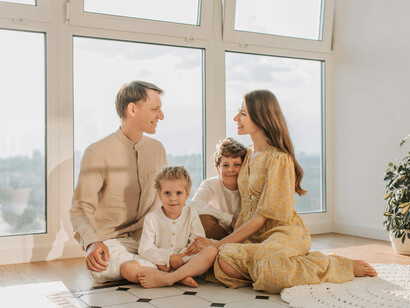
Pronounced ["store-jay"], it is known as the love of family, between parents, children, and siblings. It is perhaps as close to unconditional as we humans get. It is the bedrock of society, the place of modeling good, healthy attitudes and behaviors, integrity, being compassionate, virtuous, and loving.
When a couple forms a family, they move from Eros to Philia to Storge, which includes the prior two—it’s a process of ripening and maturing.
Real friends seek together to live truer, fuller lives by relating to each other authentically and teaching each other about the limitations of their beliefs. They provide reflections to each other.
In effect, they play each other’s therapist, assisting each other in becoming the best of their potential.
Agape
Well-known as universal love. This includes love of life, love of Nature, love of God. In fact, it doesn’t exclude anything and is experienced as a deep appreciation and affinity for all Creation.
Out of this emerges compassion, service, philanthropy (“love-friend of man”), and altruism.
This universal sense of love of all sentient beings, of life itself, confers an experience of enthusiasm in the original Greek sense of “inspired by the Gods” or later, inspired by “the God within”.
Those who embody this kind of love often feel elated by the very reality of life itself unfolding.
Ludus
Ludus is less well-known but no less important. Its Latin root means “sportive and playful”. While it may be a precursor to Eros, it remains on the lighter side of flirtation and the game of seduction. It allows for a free-wheeling, open quality to a relationship without necessarily deep commitment, though Philia may fully be present. One way to describe it in modern parlance is “friends with benefits”.
It may seem extremely light touch (so to speak), but it can have the depth of any other kind of friendship, depending on the individuals involved.
Ludus relationships are casual, undemanding, and uncomplicated, and can be very long-lasting.
Ludus works best when both parties are mature and self-sufficient, in alignment with the nature of the relationship.
Pragma
The root of words such as “practical and pragmatism” can be associated with traditionally arranged marriages, or marriages for political or economic benefit, typically of the family. Its purpose isn’t Eros, though this can emerge, but rather emphasis on the practical needs at hand.
This kind of love, if you will, is found more among the upper classes of society, which seeks to preserve wealth, social class and bloodlines. These are prioritized above joy and the other kinds of love.
Philautia
Finally, self-love. This doesn’t need to edge toward Narcissism though it can. Short of self-inflation, its healthy expression is simply respect and appreciation of oneself. Perhaps our world would be much better off if people truly valued themselves, their natural gifts, talents, and beauty that they are here to bring into the world.
Each person would take better care of themselves and their loved ones. In that case, the entire world would be taken care of by oneself and one’s family and community of friends (Philia). This is the way to create peace, health, happiness, and love across the world.
Unhealthy self-love is a form of excess in the direction of hubris. This leads to a false sense of self-importance and, not uncommonly, self-righteousness. Then, we’re in trouble. Crusades emerge from such distorted thinking. It’s not really love at all but a form of emptiness disguised as self-importance.
Unfortunately, many politicians and the captains of industry tend to suffer from this pathology.
Telling the story of love
I would be remiss if I didn’t spell out the larger view that comes to us from our ancestors, from Greek to the Chinese, as I just did above. Jumping solely into the “juice of love” that we experience as intimate, romantic love, delicious as it is, would be omitting the varying kinds and frequencies love has in our lives and in our Universe.
This article is but the first glimmer of love to be told. They blend inside us all to varying degrees to make us into the amazing human beings that we are.
The biology of love
It’s also true, much to our benefit, that the mind-body loves love. It responds by the release of oxytocin. It responds with the release of endorphins. It responds by deepening breath, increasing the circulation of blood and chi, leading to our healthy longevity. To love well is to increase not just one’s quantity of life, but the joy and quality of life.
It is as though love is the essence of life itself. The more we love, the healthier we get, the shorter our telomeres, and the longer our lives. For what, you may ask? Ah, to love even more.
In short, we are biologically wired to love. While we are able to fight, freeze and flee, these take a powerful physiological toll on the body and emotions. To love and feel joy, however, confers the highest and greatest sensations life has to offer, increasing blood flow, vitality and longevity.
Love is resonant with living a long, healthy and happy life. It has been found that those who have love of family, friends and community have a greater probability of healthy longevity than those who rely primarily and diet, sleep and exercise. These are obviously important, but not as important as love.
The power of love
We live in a world where tension, conflict, war, destruction, and even famine amidst plenty of resources and food are rampant. Governments fight over land, oil, and people over religion. So little makes sense unless one recognizes that some humans love money and power more than anything else, which leads to great harm. The power of love is great, and much greater than the love of money and power.
Humanity has been lost by those who perpetrate these horrors.
At base, everyone wants and cherishes love. Everyone loves the joy of family, friendship and relationship when one digs down deep enough.
Could it not be that we apply the joy of love and the fact that we know that everyone at the level of heart and soul, wants love, that it could help to resolve and overcome the love of power?
As Jimi Hendrix so wisely said:
When the power of love overcomes the love of power, the world will know peace.
Notes
1 Shambhala New York.
2 These are the seven types of love at Psychology Today.
3 Dr. Bruce Lipton.