English
 Español
 Français
 Deutsch
 Italiano
 Português
Every time I visit the United Kingdom, I order fish and chips at least once. This summer, I ordered it four times in a week.
To keep prices down, fish and chips were often served wrapped in old newspaper. My first fish and chips was sampled this way decades ago. The practice was discontinued in the 1980s when it was ruled unsafe for food to come into contact with newspaper ink without grease-proof paper in between the food and the paper.
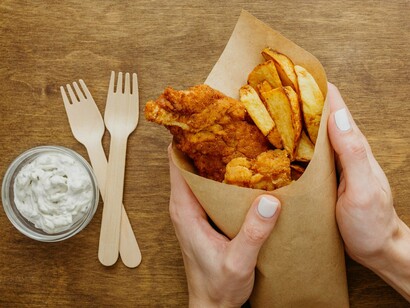
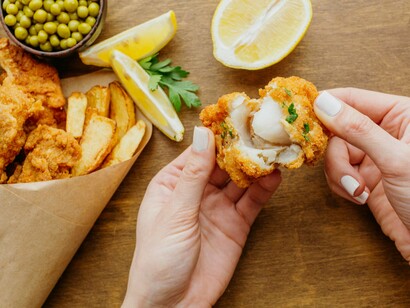
Chips are known as French fries in the United States. They are a savory, delicious accompaniment to fried fish. Also common as a side dish are mushy peas—marrow fat peas boiled to a near paste—which are uncommon in the U.S., but pleasing as well.
The meal is ubiquitous in the U.K., with more than 10,000 fish and chip shops in the country, down from an estimated 35,000 in the 1930s. Nearly a quarter of Britons eat fish and chips at least once a week. Many consider fish and chips the country’s national dish. Burgers, fried chicken, pizza, Indian and Chinese dishes have overtaken fried fish somewhat, however, in the takeaway market.
The accompaniments have local variations. In England, the typical condiments are salt and malt vinegar. In Scotland, salt and a sweet, savory brown sauce that resembles Worcestershire sauce are usually served with fish and chips. In Ireland, typical condiments are lemon wedges for the fish and ketchup for the chips.
This classic British dish originated in the 19th century, during the Industrial Revolution. Novelist Charles Dickens mentions “fried fish warehouses” in his classic novel Oliver Twist, published in 1838, and “chips” in his 1859 A Tale of Two Cities.
The type of fish used typically is cod or haddock, though cheaper types of white fish are sometimes used. The method of battering and frying fish – coating fish in flour and frying it -- was introduced in the U.K. by Sephardic Jewish immigrants from Spain and Portugal. The method was suitable for the British climate and became popular among London street vendors.
Fried potatoes originated in France or Belgium. Chips became an inexpensive staple in the working-class diet in England, especially in industrial towns.
It is believed that Joseph Malin, a Jewish immigrant from Belgium — where fried potatoes were popular — was the first to pair the two foods, selling them on the street and then opening a shop in Bow, East London. The National Federation of Fish Friers, established in 1913, made Malin’s shop its first member and presented a plaque to Malin’s as being the world's first fish and chip shop. A competitor fish and chip shop in Yeadon, near Leeds and Bradford, was open from 1865 to 2016 and billed itself as the oldest in the world. The other main contender for the first fish and chip shop, the present site of Oldham’s Tommyfield Market, is located in London’s Covent Garden. The Rock & Sole Plaice, dating from 1871, is London's oldest fish and chip shop still in operation.
In 1928, Harry Ramsden set itself apart by earning a Guinness Book of Records designation at his fish and chip shop in Guiseley, West Yorkshire, England. Ramsden served 10,000 portions of the dish on a single day in 1952.
When Malin's shop went out of business in the early 1970s, they sold the exclusive rights for the fish recipe and custom-designed frying equipment, unchanged since the 1860s, to the American fast food chain Arthur Treacher’s Fish & Chips, which I visited from time to time. Only a handful of Arthur Treacher's are still in business, but it is the last place in the world where the historic Malin's fish and chips recipe is still made with the same equipment design, frying techniques, and recipe.
During the World Wars, fish and chips became a national institution in Britain. They were one of the few foods not subject to rationing during those times, since Prime Minister Winston Churchill supported the dish as a morale booster for the nation.
Apart from being a fast-food favorite, fish and chips are also typically served as a Friday meal, in schools for lunch, and at home for dinner. Fish and chip shops have emerged in many places in the world, particularly in English-speaking countries.
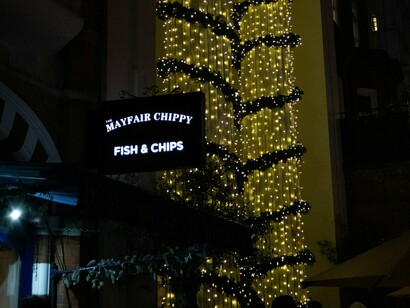
Portions are generous. Seashell of Lisson Grove offers indoor and outdoor seating, as well as takeaway. It was a nice stop after a visit to Abbey Road’s famous iconic crossing featured on a Beatles album cover, recording studio, and gift shop. The Laughing Halibut, not far from Buckingham Palace, serves “the best traditional British fish & chips” in a friendly atmosphere. It is hard to go wrong with fish and chips in the U.K. The moist white fish encased in crisp golden batter and a heap of chips contain a fair amount of vitamins and minerals, but both are also deep-fried in oil that contains unhealthy saturated fats.
In any event, it is worth trying this culturally significant dish at a “chippy” (modern British slang). It is comfort food and has been beloved for generations.