English
 Español
 Français
 Deutsch
 Italiano
 Português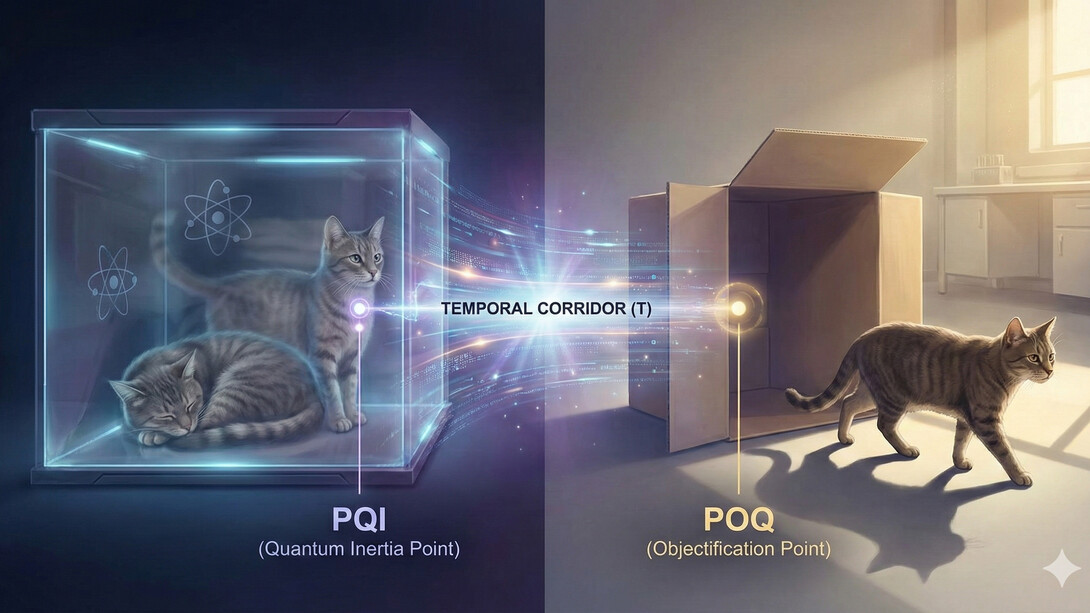
Everyone knows Schrödinger’s famous cat experiment: a closed box, an internal mechanism, and two possible outcomes. Yet behind that overused scene hides a much more basic question:
At what moment is the cat’s survival a fact?
When we open the box?
When we look inside it?
Or earlier?
The paradox is not in the cat or in the box, but in the temporal uncertainty surrounding the outcome. Is there a precise instant when life is preserved or interrupted, or does that moment dissolve into a process we cannot pinpoint? For decades, physics has described probabilities and dynamics, but largely sidestepped this direct question: the question of when.
The story of Schrödinger’s cat is so ubiquitous that this doubt—the instant when something stops being avoidable even though it has not yet occurred—never crossed my mind while I was studying physics. It appeared when I was studying law. The mere intention to carry out an act already generates consequences. In criminal law, with the notion of dolo (intent), and in civil law, with the theory of damage, I was always struck by that intermediate zone between intention and consequence: the moment when an outcome is already set in motion, even though it does not yet exist in material form.
Later, when I began studying quantum mechanics—a journey that has now lasted seven years—I discovered that the same unease was hidden inside the cat paradox. The crucial question was not what we discover when we open the box, nor even what happens inside it, but when it happens. And that question felt strangely familiar.
In an earlier article in Meer, I wrote about this intuition and called it the quantum point of inertia: the point at which a process can no longer avoid its outcome, even if nothing visible announces it yet. At the time, I presented it as a metaphor to explain the dynamics of human change. I did not imagine that, some time later, it would become a conceptual tool to describe the temporal structure of physical processes.
Quantum physics offered me a territory where that intuition could be formalized: a setting where there is an instant when a process starts to lean toward an irreversible outcome, and another—much later—when that outcome becomes an objective fact. Between those two instants, a silent stretch lives on that we had not yet known how to name.
The point where reality starts to lean
If there is a common element between law, everyday life, and quantum theory, it is that important processes do not happen all at once. They build up, they tilt, they settle. There is a moment when something has not yet happened, but is no longer an open range of possibilities.
That moment is subtle.
It has no announcement.
It carries no obvious sign.
Yet it exists.
In human life, it can be the decision that precedes the action. In law, the instant when a behavior already carries the consequences that will follow. In civil liability, the point at which the causal chain can no longer be reversed, even if the damage has not yet manifested.
In physics, something similar occurs, though more quietly. Inside the cat’s box, there is no magical jump: there is a process, a continuous evolution, a chain of microscopic changes that gradually loses alternatives and gains direction. The question we avoided for decades is simple to state and hard to answer:
At what instant does reality stop supporting all its possibilities and begin to lean toward a single one?
I call that instant PQI (Physical Quantum Inertia Point). It is not a visible act or a spectacular event. It is the threshold at which a physical process overcomes its own “natural inertia”—that tendency to preserve its indifference, its open options—and starts moving toward an outcome that, from that point on, can no longer be avoided.
PQI does not mark the end of the process. It does not mark its manifest appearance either. It is simply the moment when the trajectory becomes fixed, even if nothing in the surroundings allows us to perceive it. From that point forward, the evolution may be faster or slower, more obvious or more hidden, but it will no longer be reversible.
In the cat story, this instant does not coincide with opening the box or looking inside it. Nor with the visible activation of the mechanism. It happens in an early, silent region where the cat’s life—still present—starts to lose its condition as a multiple possibility and turns into a destiny already in motion.
This is the first boundary of the quantum process.
Later, the second will appear.
The point where the inevitable becomes a fact
If PQI marks the instant when a process begins to commit to one outcome—even if no one perceives it—then there must necessarily be a second instant: the one in which that decision ceases to be internal and becomes a fact in the world.
Because every deep process has two boundaries:
The boundary of irreversibility: when the outcome is already underway, even though it does not yet exist materially.
The boundary of objectivity: when that outcome is already evident, accessible, and stable in reality.
Between one boundary and the other lies a silent stretch where reality advances but does not yet show itself. In the cat story, this interval is the most unsettling: a span in which the fate is already sealed but has not yet manifested as a fact.
The second boundary—the one that closes the process—is what I call POQ (Physical Objectification Point). It is the moment when a change ceases to be contained within its own interior and becomes part of external reality: verifiable, stable, and shareable.
POQ is not the cause of the outcome.
Nor is it its origin.
It is the boundary where the outcome becomes ascertainable.
In everyday terms, it is the moment when something stops being a mere process and becomes an event. When what was happening on the inside turns into a fact on the outside. When what was irreversible acquires presence.
In the cat paradox, POQ is neither opening the box nor the observer’s gaze. POQ is the instant when the signals of the cat’s fate cease to be encapsulated in its internal dynamics and spread into its immediate surroundings: traces, marks, physical changes that, if a suitable medium were present to detect them, would allow us to assert what happened without opening the box.
It is the moment when reality leaves a record.
POQ is neither the cat’s life nor its death. It is the moment when the world can already sustain a stable claim about that fate.
Between PQI and POQ—between the silent tilt and full objectification—there is an interval during which everything happens without yet being assertable. In that temporal corridor, reality is changing its nature.
A process with two edges and a corridor in between
If we accept that every deep process has two boundaries—the irreversible and the objective—then we also have to accept that between them there is more than a blurry instant. There is an interval with structure, with dynamics, with physical content.
In the cat paradox, that interval exists from the moment the fate begins to tilt (PQI) until the moment when stable traces appear in the surroundings (POQ). It is not a jump or a sudden drop: it is a transit, a temporal corridor where change advances without yet becoming ascertainable.
For decades, quantum theory described with great precision the evolution of states, superpositions, and probabilities, but it did not usually distinguish these internal boundaries of the process at a conceptual level. It was as if physics had grown accustomed to talking about the beginning and the end without naming—and without asking about—what connects the two.
Different interpretations tried to fill that gap with narratives—some elegant, some more philosophical—but none provided an operational language to identify when a process changes regime:
When does it stop supporting all its possibilities?
When does it cease to be purely internal?
Leaving this corridor unnamed amounts to treating reality as a system without history: as if outcomes emerged fully formed, without a process that leads to them.
This intermediate space—neither visible nor reversible—is what I want to illuminate. Not as speculation, but as the physically meaningful part of the story that we have been omitting.
Between the cat and the lab: why this interval really exists
Up to this point, everything might sound like conceptual reflection. But the interval between PQI and POQ is not a legal metaphor transplanted into physics. It is a real, observable, and increasingly measurable phenomenon.
Not in the cat—that is a parable—but in the systems we can now dissect with nanosecond and femtosecond precision.
Take an example: an atom exposed to an external field. Its transition between states does not happen in a magical instant. It begins at a silent point where the interaction crosses an internal threshold (PQI), long before any macroscopic property changes. And it ends when the signals of that change have spread into the environment enough to be recoverable as a fact (POQ). Between those two instants, the atom is no longer the same, even if no external detector can yet assert it.
The same happens with:
A photon in an interferometer, whose possible paths begin to lose symmetry (PQI) long before any detector registers a result (POQ).
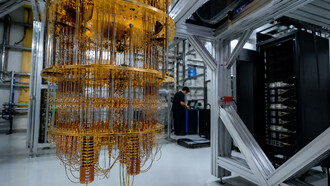
A superconducting qubit, whose state starts to tilt toward an irreversible outcome (PQI) before the outgoing microwave signal leaves a recoverable trace in the measurement apparatus (POQ).
In all these cases—and in many others in contemporary physics—we can identify two distinct times: an early instant when the process ceases to be reversible, and another, later, when its outcome becomes objective.
And here is the key:
Between those two points, there is a physically meaningful interval, even though no visible “fact” exists within it.
It exists in the data.
It exists in the dynamics of the equations.
It exists in the temporal structure of the process.
All that was missing was a conceptual framework to point to it and give it a name.
The minimal geometry of the PQI→POQ interval
To describe this trajectory, we do not need a new theory; we only need to organize what already exists. It is enough to spell out its temporal geometry.
Think of any deep physical process. Its structure in time has two fundamental milestones and a corridor connecting them.
1. The two fundamental instants
Every physical process has:
t_PQI: the instant when the process crosses its internal inertia threshold and its outcome ceases to be reversible.
t_POQ: the instant when the process leaves stable traces in its environment and its outcome becomes objective.
The only essential condition is the order:
tPQI < tPOQ.
The fate is fixed before it manifests.
2. The temporal corridor (T)
Between these two instants extends the interval we care about:
T = [tPQI, tPOQ].
This is the corridor where reality has already changed its nature, but is not yet showing itself.
3. How to identify them (without magic)
To find tPQI, we look at the internal signal of the process: an interaction, a flow, a rate. tPQI is the moment when this signal, in a sustained way, crosses a critical threshold characteristic of the system. It is the statistical or dynamical point of no return.
To find tPOQ, we examine some metric of “traces in the environment”: correlations, dispersed energy, and information redundancy. tPOQ is the moment when this metric reaches a stable plateau, indicating that the outcome is already accessible and verifiable from the outside.
4. The duration of the process (Δt)
The length of the corridor is a concrete physical quantity:
Δt = tPOQ – tPQI.
In controlled quantum systems—qubits, atoms, photons—this Delta t is starting to become directly measurable, and no longer merely an abstraction.
This is not an equation to “compute the collapse.”
It is the minimal temporal geometry that allows us to describe any process that has a silent beginning and an objective end. A process with two defined edges and a path with its own internal structure.
How PQI→POQ reshapes the cat paradox
Let us return to the cat, now not as a symbol but as a real physical process.
The cat’s PQI
Inside the box, there is a mechanism evolving continuously: radioactive decay, particle emission, and switch activation. That process does not have a single, magical “critical moment.” It has a specific point at which:
The reaction exceeds its internal threshold.
The causal chain stops being neutral.
The outcome can no longer be avoided, even though it does not yet exist materially.
That is the cat’s PQI: the instant when life is still present but no longer an open alternative. The cat is still alive, but its fate has begun. This moment occurs long before any visible manifestation.
The cat’s POQ
Much later—and this is essential—come the physical traces that allow us to assert an outcome: chemical changes, emissions, physiological signals, thermal shifts, transformations in the immediate surroundings.
That is POQ: when the outcome leaves enough trace to be objective, stable, and external. It is the instant when, even without opening the box, a suitable detector could assert what happened.
The intermediate interval (T)
Between PQI and POQ stretches the temporal corridor T, where the process has already begun (it is irreversible), but it has not yet left any testimony (it is not objective).
It is the interval in which reality changes its nature without showing its change.
The paradox rewritten
With this structure in hand, we have to abandon the image of the cat as “half alive and half dead.” That image is a literary artifact used to describe something that, lacking the right language, became absurd.
The apparent paradox only exists because we never distinguished these two temporal edges:
The instant when the outcome becomes inevitable (PQI).
The instant when that outcome becomes objective (POQ).
Once we identify them, the cat’s story stops being a paradox. It becomes a physical process with a trajectory, with thresholds, with edges, and with a defined temporal structure.
The absurdity dissolves when we recover the time that quantum physics had left in the shadows.
How PQI→POQ fits into contemporary quantum physics
Once we clarify that PQI and POQ are two real instances in the evolution of any physical process, a natural question arises: how do they relate to what modern quantum physics already describes?
The answer is encouraging: they fit in naturally, filling a temporal gap that existing theories had not made explicit.
Decoherence: describes the fall, not its onset
Decoherence explains how a quantum system loses its coherence when it interacts with the environment: how superpositions fade, and classical probabilities emerge. It is a powerful framework that describes the slope, but rarely points to the precise instant when that slope begins—when the system crosses the threshold beyond which a return is no longer possible. That initial edge is PQI.
Quantum Darwinism: describes proliferation, not consolidation
Quantum Darwinism explains how the environment acts as a witness: it copies, disperses, and multiplies information about the system until it becomes redundant, allowing multiple independent observers to access the same reality. However, it does not identify the moment when that redundancy becomes sufficient to constitute an objective and unquestionable fact. That final edge is POQ.
Spectrum Broadcast Structures: describe the shape, not the boundary
Spectrum Broadcast Structures (SBS) define with mathematical precision the structural conditions a quantum state must satisfy in order to be considered objective. But, like the other theories, they do not specify when those conditions are stably fulfilled in the temporal dynamics of a process. That consolidation instant is, again, POQ.
The contribution of PQI→POQ: temporal clarity
The PQI→POQ framework does not contradict these theories; on the contrary, it complements them by providing what they lack: an explicit chronology. Its contribution can be summarized as:
Explicit temporality: It identifies two measurable physical instants (PQI and POQ) that were implicit but unnamed.
Process structure: It turns evolution into a corridor with two clear edges, one of inevitability and one of objectivity.
Compatibility: It overlays smoothly onto existing formalisms (decoherence, Quantum Darwinism, Spectrum Broadcast Structures).
Interpretive neutrality: It does not take sides on any interpretation of quantum mechanics; it simply organizes the temporal line of processes.
Experimental anchoring: It corresponds to intervals already observable in controlled quantum systems.
The PQI→POQ framework does not add new physics; it adds clarity where it was needed. It provides the temporal scaffolding that lets us narrate, from beginning to end, how a potential becomes a fact.
Closing the circle: back to law
Quantum physics has never struggled to describe states or dynamics. Its equations are extraordinarily precise. What was missing was not theory, but a chronology of the process: a way to explain when something stops being merely possible and when it finally becomes an actual fact.
The PQI→POQ distinction fills that temporal gap.
It identifies the instant when a process becomes irreversible and the instant when it becomes objective. Between them, it reveals a silent stretch where reality has already changed, but has not yet shown it.
That stretch is not a philosophical ornament or metaphor.
It is operational in atoms, qubits, and photons.
It is measurable.
It is, quite simply, physical.
And, intriguingly, it is also the echo of the legal intuition that accompanied me from the start: in every deep process—criminal, civil, or quantum—there is a point of no return and a point of ascertainment. Between them lives the real history of the fact.
Schrödinger’s cat ceases to be a paradox when we understand its process in this sequence.
What seemed like an inexplicable jump becomes an interval with two clear edges.
What seemed like an absurd superposition reveals itself as a transit with an internal chronology.
The PQI→POQ framework does not redefine quantum theory. It does something more urgent: it gives time back to the processes it describes.
And any theory that aspires to explain reality must, at the very least, know when what it describes begins and when it truly ends.