English
 Español
 Français
 Deutsch
 Italiano
 Português
Bouldering can be an excellent mix of exercise, problem-solving, and community. It can also be tough in the beginning, even for experienced athletes coming from other fields. My wife, Lauren, and I have been climbing/bouldering for about 35 years between us. I was a trainer for beginners and kids in Louisville, Kentucky. In Louisville, Lauren grew the Ladies Training group from a handful to over 40 regulars. Now in Berlin, she leads an inclusive meetup called the “Boulderinas” that is largely FINTA, though it is open to all who are supportive and maintain a “safer space” for those in the group.
Over the years, we have not become elite competitive athletes but rather focused on being the “welcome wagon” and helping grow the sport. With that in mind, these are suggestions that we have found most helpful to make it even more enjoyable and quicker.
Basic technique
Use your legs
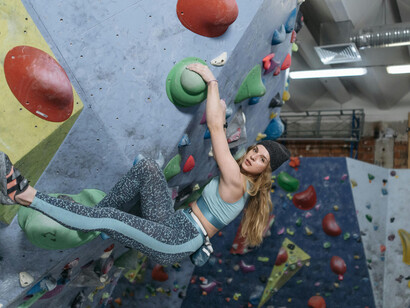
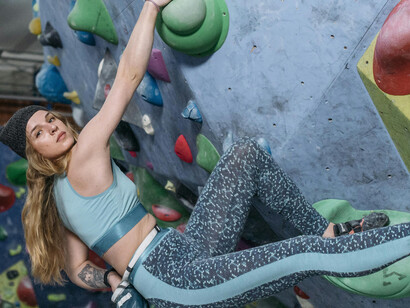
It is very tempting to focus on using your arms. You’re looking up at the best holds, reaching with your arms, and that’s what hurts when you’re done for the day. And you will, of course, still use them, but if you start focusing on good foot placement and pushing up with your legs, you will have more stamina and start finishing harder routes.
Keep your body close to the wall
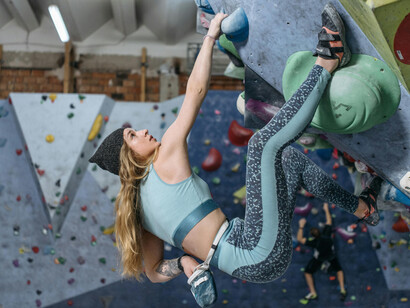
For vertical routes (not always for overhung ones), keeping your body close to the wall will reduce strain on your arms. Sometimes this might mean that you “frog leg” and bring your chest and hips into the wall. You can also turn sideways and bring one hip closer to the wall, which might also give you slightly more reach to the next hold on that side of your body.
Pulling your body in also helps you utilize the first tip by putting more of your weight on your legs and taking strain off of your biceps and triceps. This is true for the third basic tip as well:
Hang like a monkey
Until you are ready to move to the next hold, it can be helpful to squat so that your arms are straight and you can swing like a monkey up to the next hold. Every time that your arms are less than 180 degrees, you’re engaging more of your muscles. Many beginners (in our experience) will pull up into a 90-degree position and look for the next move. Very quickly, your arms will start shaking in that position. Rather than burning energy, you can hang with straight arms, close to the wall, then push up with your legs and use that momentum to reach the next hold. Then repeat!
Safety and care
One easy way to lose the joy of climbing is to get injured. Accidents do happen even to experienced climbers, but there are simple ways to reduce that risk. The main keys are stretching, falling practice, and awareness.
Stretching and warming up
Warm muscles not only prevent injury but can also help you make more difficult moves. It is important to stretch your whole body: hamstrings, quads, calves, ankles, forearms, fingers, back, torso, and neck. Each climber has a different routine, but you can do some yoga poses like cat-cow, cobra, and downward dog; dynamic stretching; and/or climb the easiest routes and take a deep several-second stretch on each move.
Falling practice
Falling can be quite a scary part of bouldering and climbing. It can lead to injury, but it can also just be a normal part of the sport. The key is in how you fall.
A short physics lesson might help you understand the process! The higher you climb, the more potential energy you have. When you fall, that becomes kinetic energy, and when you hit the mat, that energy and momentum have to go somewhere. Thankfully, the foam mats literally “cushion” your fall, slowing your descent before you come to a stop. In physics, the impulse looks at your change in momentum over time due to a force. As the time increases in slowing your descent, even by a few milliseconds, the force on your joints and bones decreases.
Another way to slow and distribute that energy is to bend your knees when you hit the mat. A good strategy is to land on your feet with bent knees and use your momentum to go into a squat until your bottom hits the mat, then continue to roll backward onto your back. It is crucial not to use your arms to brace yourself, as this can redirect all that energy into your arms and cause injury.
Playfully, we tell people “Feet, Butt, Back.” If you can follow that order, you can almost always just pop back up and try again!
Awareness
A final note on safety is to pay attention to who is above you and who is below you. You do not want to fall onto someone or something (like a large chalk brush), and you do not want someone to fall on you!
This can be particularly important at crowded gyms or with young kids and dogs running around. Awareness can also help with not getting on routes that will cross over another route where another climber has already started.
Etiquette
This gets us into etiquette and some “unwritten rules” of bouldering. Some tips take us back to childhood. Take turns. Ask nicely. Share. Be kind.
Taking turns
Sometimes there are brand-new routes that everyone wants to try or perhaps an easier route that is both great for beginners and for experienced climbers to warm up. A line can form. It is good etiquette to take turns and not try the route multiple times in a row, especially if there are people waiting. Before hopping back on, you can look around and see if anyone seems to be queuing up to try it.
Conversely, if you see people working on a route that you want to try, you can ask nicely to join in as well. You can try “Do you mind if I hop on next?”, “Is it ok if I work on this with you as well?” “Can I get in line for this one?” Our experience has been overwhelmingly positive with this, and it is even how we’ve made new friends—by working on a route together. Kindness goes a long way!
Beta-spewing
This is some very specific jargon, but it basically means giving tips on the route when someone does not want them. It comes from old Betamax tapes that some climbers would share with each other, showing how to complete routes.
We sometimes talk about bouldering routes as “problems” and wanting to “solve” them. If you give away a secret to the route, it can be like spoiling a book.
It can also sometimes feel condescending or like mansplaining, as if “You are doing it wrong and won’t be able to figure it out without my help.”
However, some people love it! They might feel stuck and need guidance to finish it. Or they might be new to climbing and want to learn technique and tips from advanced climbers—like it’s free coaching!
The important thing is consent. You can ask, “Would you like to bet on this?”
Summary
Overall—safety first, kindness and fun as close seconds. With some basic techniques of using your legs, keeping your body close to the wall, and bending your arms only when you need to make your move, you can start to see success and joy quickly!