English
 Español
 Français
 Deutsch
 Italiano
 Português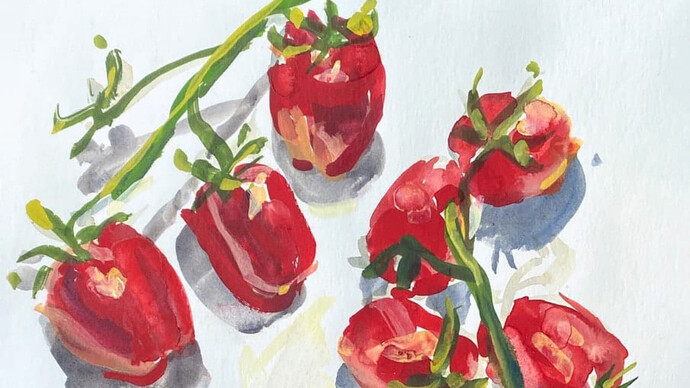
Spring and weave was born out of a residency I participated in in the Danish countryside earlier this year. I had intentionally sought out a residency in Scandinavia to reconnect with my roots. My father is Swedish, but immigrated to Australia as a teenager and was encouraged to let go of the Swedish language and traditions in order to assimilate. As a result, I’ve grown up feeling fairly disconnected from that side of my identity. So, when I was accepted into a residency, even in neighbouring Denmark, I was thrilled at the chance to explore those roots more deeply.
The residency took place at the Leif Hasles Foundation, housed in an 18th-century barn in a small village called Vindbyholt. Nestled amongst rolling farmland, I had access to the freshest Scandi spring produce. I’d simply pop next door to the honour-system farm shop to pick up freshly harvested fruit and vegetables. Every so often I’d ride a bike several kilometres down to the local village to top up my supplies.
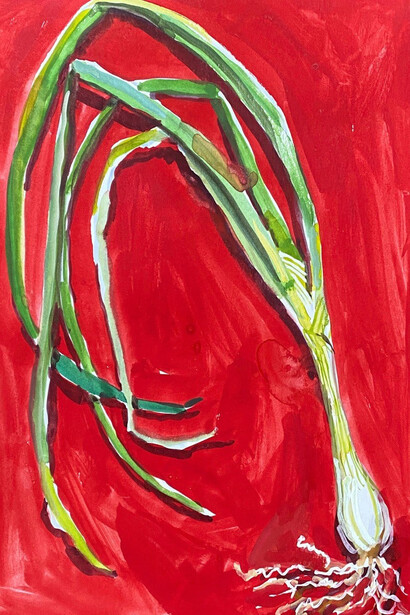
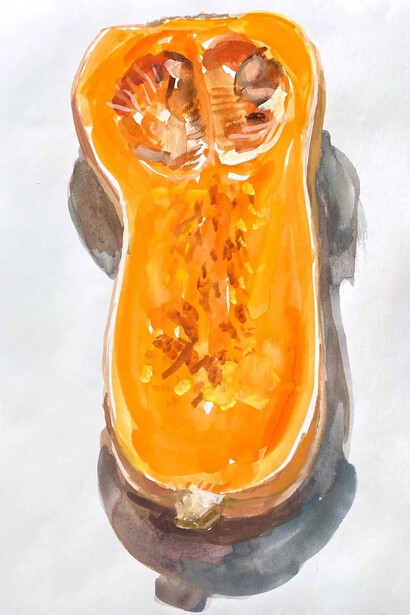
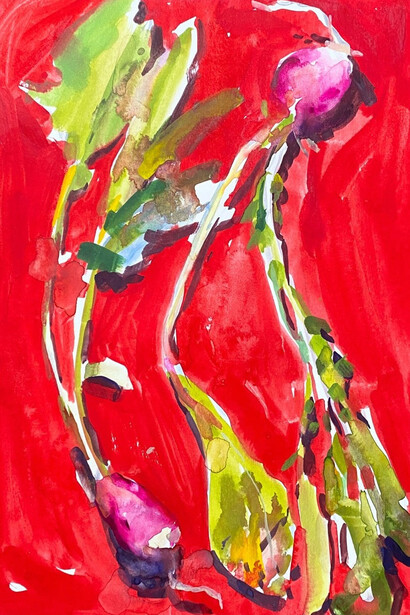
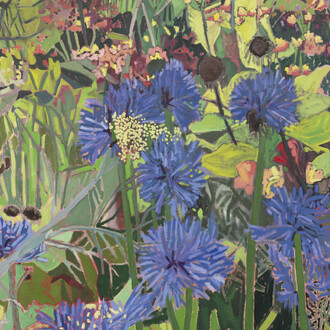
The simplicity of life in Vindbyholt was quietly addictive. With little to focus on besides eating and painting, I began to paint what I ate.
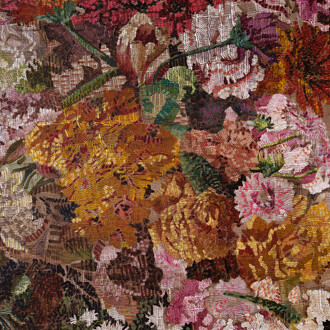
As the paintings of my food came naturally to me, I still wanted to tie them back to my Swedish heritage in some way. Through research and conversations with local Danish residents about Swedish culture, I came across Swedish flatweave rugs known as Rölakans. In my Swedish family, there’s a history of women weaving on looms, and as I often work with textiles in my own practice, referencing the Rölakan felt like a natural next step. I began experimenting with weaving paper, treating it like fabric. The paintings of local vegetables were soon woven like Rölakan rugs.
Inspired by my Swedish textile heritage, I also decided to reference the textile craft of quilting, which I learned from my maternal grandmother. This is reflected in the way the work has been installed: the A4 paintings hang closely together, as if each piece is a patch in a larger quilt.
Quilted and woven, these works reflect both my Swedish and Australian heritage, and the way they meet through quiet, domestic acts of eating and making.