English
 Español
 Français
 Deutsch
 Italiano
 Português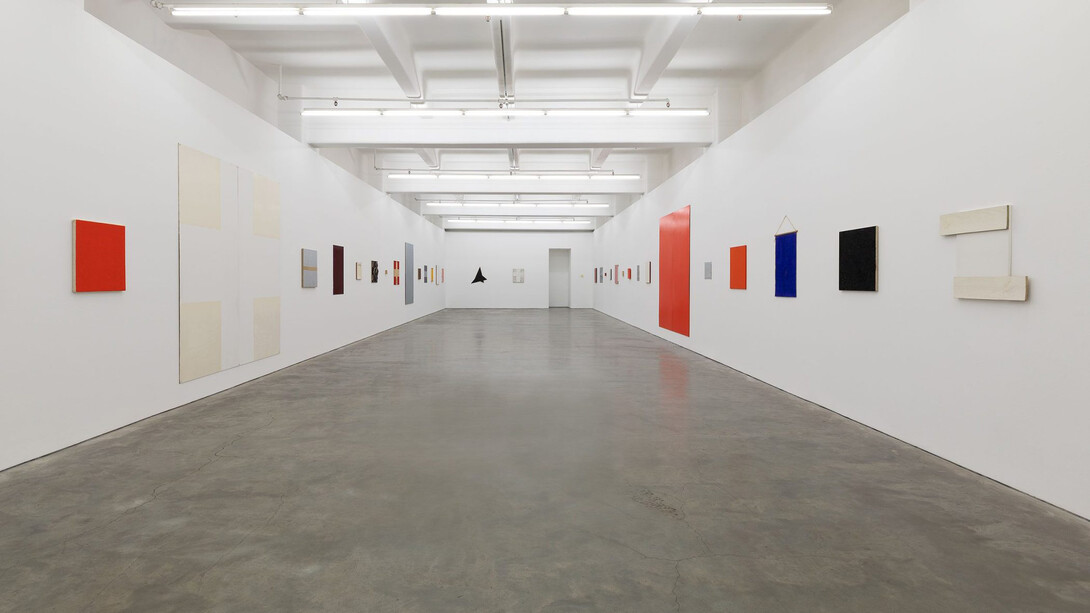
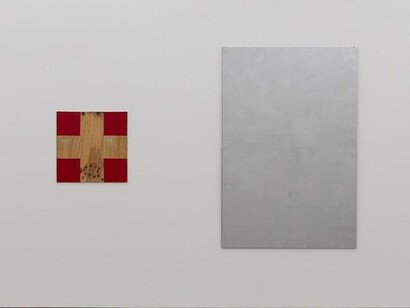
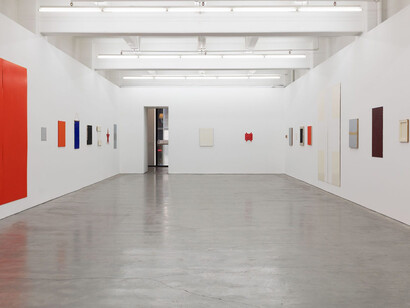
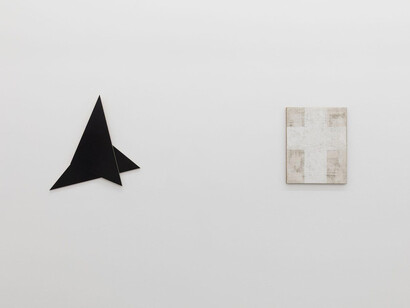
The title of this exhibition derives from a calling card offset printed by John in the 1990s, which states in plain Helvetica, black ink on white card: ‘John Nixon: Artist of the Monochrome’. With this simple yet profound description of himself, John affirms his strong sense of personal identification with this most fundamental of modernist archetypes — the epitome of non-objective abstraction. His lifelong investigation of the monochrome, in all its stark simplicity and nuanced complexity, is a continuous and vital aspect of his multifaceted oeuvre.
Nixon’s very first paintings from 1968 — the works he considered foundational to his practice — were monochromes: black Dulux enamel on canvas, raw canvas, and red or grey felt among other primary examples, scaled to just 9 × 9 × 4 cm. Their compact size and blocky shape gave rise to his term for them, Block Paintings. From that time onwards, John explored the monochrome at various scales and through the wide variety of quotidian materials characteristic of his oeuvre, returning repeatedly to one-colour painting as a generative touchstone or ‘zero point’ for his wide-ranging and exploratory practice.
By stripping art of the distractions of narrative and figuration, the monochrome became for him a means of concentrating on the essential question of art itself — its very nature and purpose — as he articulates with both rigour and poetry in his 1993 text, republished here, and through the diverse works on display in this exhibition.
(Text by Sue Cramer, 2025)