English
 Español
 Français
 Deutsch
 Italiano
 Português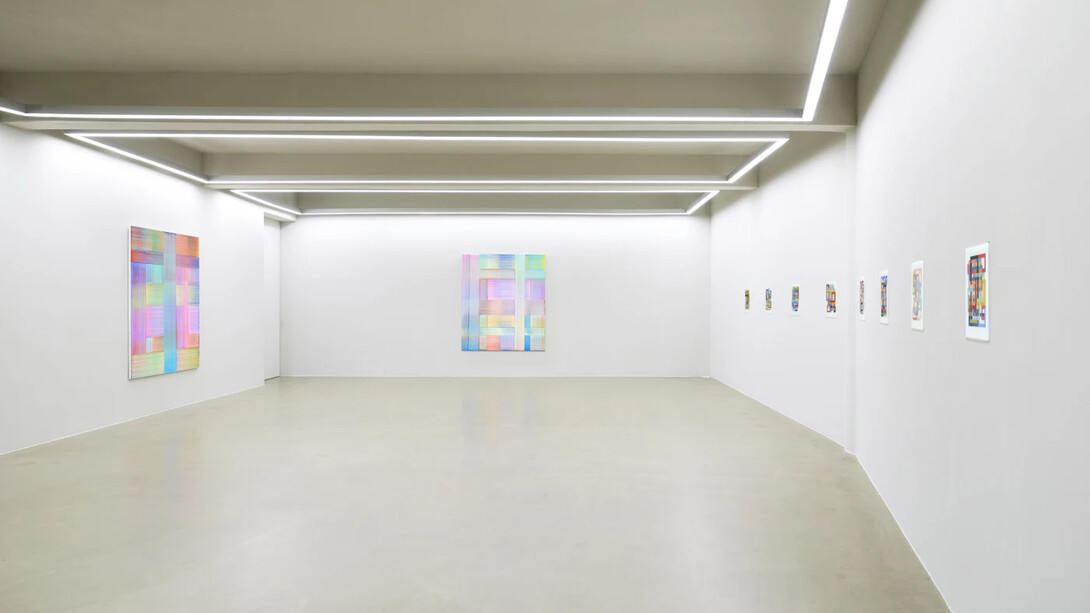
The exhibition The return foregrounds Bernard Frize's decades-long investigation into an experimental framework of minimal rules and contingency, exploring how painting continuously returns, each time transformed. For Frize, painting is a means of renewing its own role through the repetition of gestures. Intersecting layers of color, the recurring paths of the brush, and the vertical and horizontal grids that trace them create a choreography of iterative motion: deviating, restarting, never quite landing in the same place. This is the enduring role Frize has defined for painting: the reason it remains vital in contemporary art.
Born in Saint-Mandé, France, in 1949, Frize came of age during an era of intense social upheaval, experiencing the art schools of Aix-en-Provence and Montpellier. He abandoned painting for a time, disillusioned by the ideological conflicts of the post-1968 period that questioned the role of individual art in a politically charged world. When he returned to the brush in the late 1970s, it was with a new purpose: he redefined the painter's role, treating painting not as personal expression but as an act intertwined with social structures. For him, painting was neither an emotional expression nor a material testament to the artist's self. Unlike the improvisational gestures of the era's dominant Abstract Expressionism or the metaphysical self-consciousness of monochrome painting, he reconceived painting as iterative labor, guided by a set of rules and limitations. The technical elements that typically support painting—the movement of the brush, the viscosity of the paint, the constraints of time and tools—became, in his work, the very structure of the painting itself.
Using brush, color, and canvas, he repeats the same actions based on predetermined rules. The result, however, is always unpredictable. Throughout most of the process, he regards not choosing as a more humble and less creator-like stance, intentionally leaving open a point where order and chance entangle. That is to say, he avoids applying order to the world through the maker's will and lets the material reveal its own order. Thus, while his work appears as color field abstraction or gestural painting on the surface, it is a practice closer to an inquiry into the ethical actions the painter, as a maker, must adhere to.
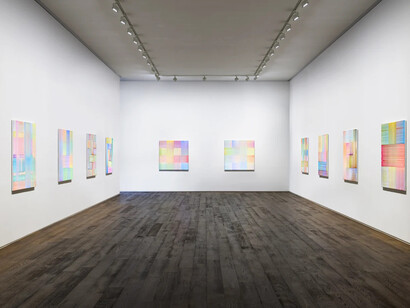
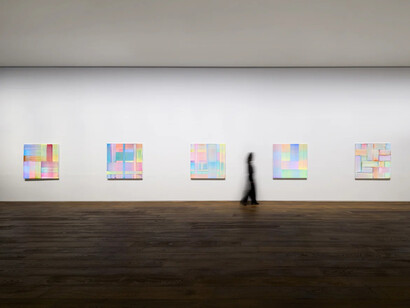
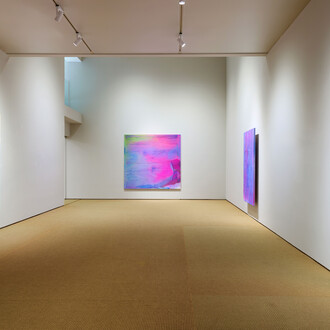
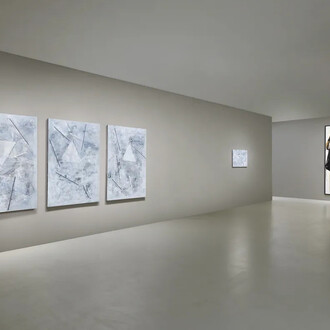
The return is a presentation of 24 new un-concluded experiments as a single, organic structure. First, the canvas works, painted with orthogonal applications of acrylic and resin, follow patterns that transform constantly even within minimal rules. Once Frize has selected a workable canvas size, he traverses the surface with a brush of a singular color, followed by repeated layers of other colors. The entire process plays out in a matter of minutes, forming a kind of automatic painting as the color layers constitute a picture plane, intruding upon or seeping transparently into one another.
What begins as the artist's intended action soon transitions into an arbitrary process carried on by the material's own order—presented in the most refined and condensed consummations in the four large-scale paintings—Lutes, Loca, Kaire, and Goita. The twelve new 120x120 cm works on canvas—Vesce, Traga, Seika, Roban, Nolle, Elio, Boyet, Bakeit, Arsin, Argue, Lalte, Shelt—on the other hand, are experimental exhaustions of a singular rule (like in the single-rule board game Continuo).
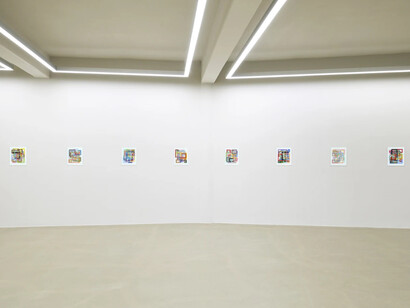
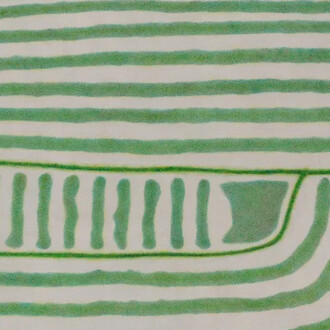
The eight serial works on glass and tempera further extends this painterly methodology. On the reverse side of transparent glass plate, continuous, color-shifting lines with tempera are painted, then backed by a white ground, and another layer of glass. The core instruction is simple: once a color completes a sequence of three lines, switch to the next color. Tempera's opaque yet blending properties reveal material interference as new lines cross previous ones. Like the canvas paintings, this series follows the latent and inherent flow of the material over the conscious, externalized will of the maker. As results are unpredictable at every point, this series experimentally expands on how painting can be generated through near-infinite variations.
What is ultimately important for Frize is this point of rupture where the existing order goes astray as it reflects a new one. In that gap, painting remains as the consequence of emergent events that happen anew every time, no longer as identical repetition (or representation). This approach reveals more than a process-oriented attitude; it is a practice that positions the painter as a kind of laborer. Yet, this is not labor in the conventional sense. Divorced from any aim of efficiency or a finished product, his painting continues for the simplest of reasons: because the capacity to act exists. This is an aesthetic of inefficiency, a self-determined stance that resists the logic of production by finding meaning in the act itself.
In the spirit of Arendt's action, his painting demonstrates the capacity to bring something new into the world, the human potential to reconstitute the world amidst repetition. He considers it the duty of painting to leave a finished action unaltered. Wherever that act might slip or slide, it remains the truthful record of a process already passed. Frize's practice is less about the freedom of what to express, and more about the responsibility to simply never stop expressing. It is an ethic made real: a testament that a painting existed, even before it became an object.
The return therefore presents a composition juxtaposing unrealized possibilities, like chapters in an unwritten book (and indeed, he has a future publication in mind). Intriguingly, the exhibition's title is admittedly a reflexive quip about the artist's return to Johyun Gallery for the first time in over a decade and not a direct reference to his methodology. Yet, this jest is more than simple wordplay; it works as an apt metaphor and testament to his painterly attitude: one that distances itself from figurative excess, rejects the myth of abstract expression, and seeks to construct the picture plane with only the bare minimum of rule and chance. Bernard Frize's paintings push aside convention, returning each time in an unfamiliar way to test the very ontological conditions of what painting can be. Ultimately, The return is a way of rewriting the present through repetition and is the very form of painting itself, endlessly varied and persistent.