English
 Español
 Français
 Deutsch
 Italiano
 Português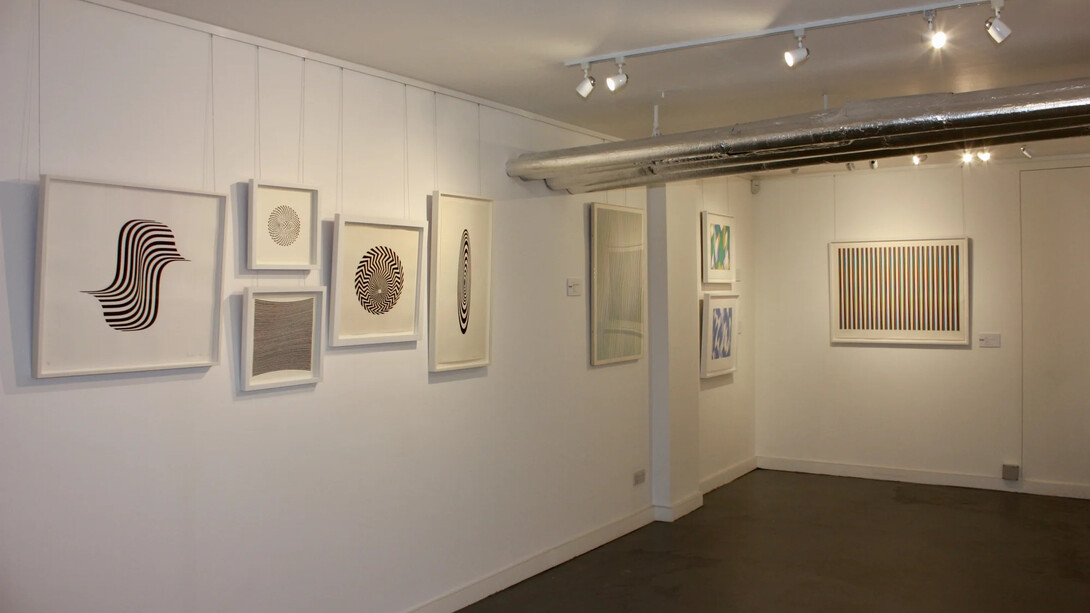
Bridget Riley is the world’s foremost painter of light. She reveals that colour emanates both from within and without, unlocking the mystery of illumination as a shared radiance between the viewer and the viewed.
(Phillip Blond. Gallery director)
Bridget Riley (b. 1931) is one of the leading figures of Op Art, a movement that emerged in the 1960s exploring optical perception through abstract geometric compositions. Her work investigates how colour, line, and spatial arrangement interact to produce dynamic visual experiences that appear to move, shimmer, or pulsate before the viewer’s eyes.
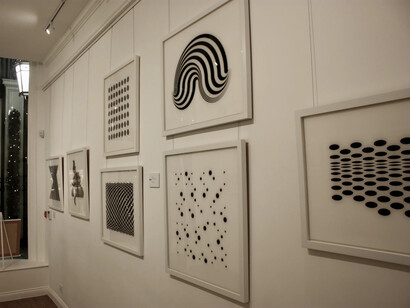
At the heart of Riley’s practice is a deep understanding of visual perception and how the human eye and brain process colour and spatial relationships. In her early black-and-white works, such as Movement in squares (1961), she relied on the manipulation of geometric forms and spatial rhythm to create sensations of tension and movement. The eye, confronted by alternating contrasts, experiences instability; the picture surface seems to expand and contract. Here, 'space' is not depicted but generated through optical vibration, a virtual space created in the viewer’s own act of seeing.
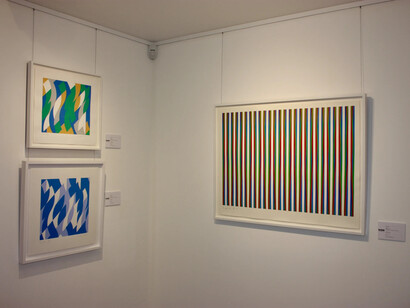
Riley’s later shift to colour marked a profound exploration of how chromatic interaction alone could generate similar sensations. Drawing inspiration from Seurat’s Divisionism and the colour theories of Chevreul and Albers, she discovered that colour relationships could suggest spatial depth, rhythm, and even light without any need for representational form. Works such as Cataract 3 (1967) and RA (1981) exemplify her precision: bands or curves of colour oscillate in intensity and proximity, causing the eye to perceive shifting planes of space. The canvas becomes a field of energy, where colour itself constructs spatial illusion.
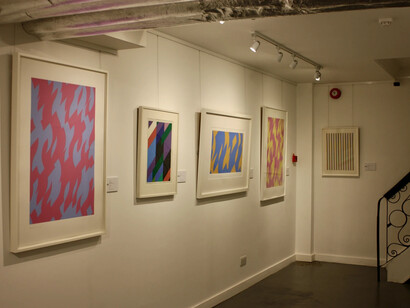
Spectrum brings together an exceptional retrospective of Bridget Riley’s work from 1962 to 2020, tracing the evolution of one of the most important figures in post-war British art. This landmark exhibition includes her rare gouache studies, the complete Fragment series from 1965, and every print on paper produced during the 1960s, a collection that has taken five years to assemble.
Riley’s practice is a sustained investigation into the perception of colour, form and spatial rhythm. From her early black-and-white abstractions of the early 1960s to her later chromatic compositions, she has continually sought to understand how visual experience can be shaped by the interaction of colour and space. Her works are not static objects but living fields of energy, activating the eye and transforming the act of seeing into a dynamic event.
The Fragment series marks a pivotal moment in Riley’s career, capturing her shift from monochrome to colour. Each composition explores how subtle variations in hue and interval create movement and depth within the picture plane. These works demonstrate Riley’s meticulous control over visual rhythm, producing sensations that seem to hover between order and flux.
The inclusion of her gouache studies offers a rare glimpse into her working process. These works on paper reveal the precision, experimentation and sensitivity that underpin her larger paintings. They highlight the artist’s rigorous approach to testing chromatic relationships and spatial tension before committing them to canvas.
Together, the works in Spectrum chart Riley’s lifelong pursuit of visual harmony and perceptual complexity. Across six decades, she has transformed colour into a language of pure sensation, where the interplay of line, tone and form opens new dimensions of space. This exhibition celebrates that vision and offers collectors and audiences alike an unparalleled opportunity to engage with the full scope of her optical mastery.