English
 Español
 Français
 Deutsch
 Italiano
 Português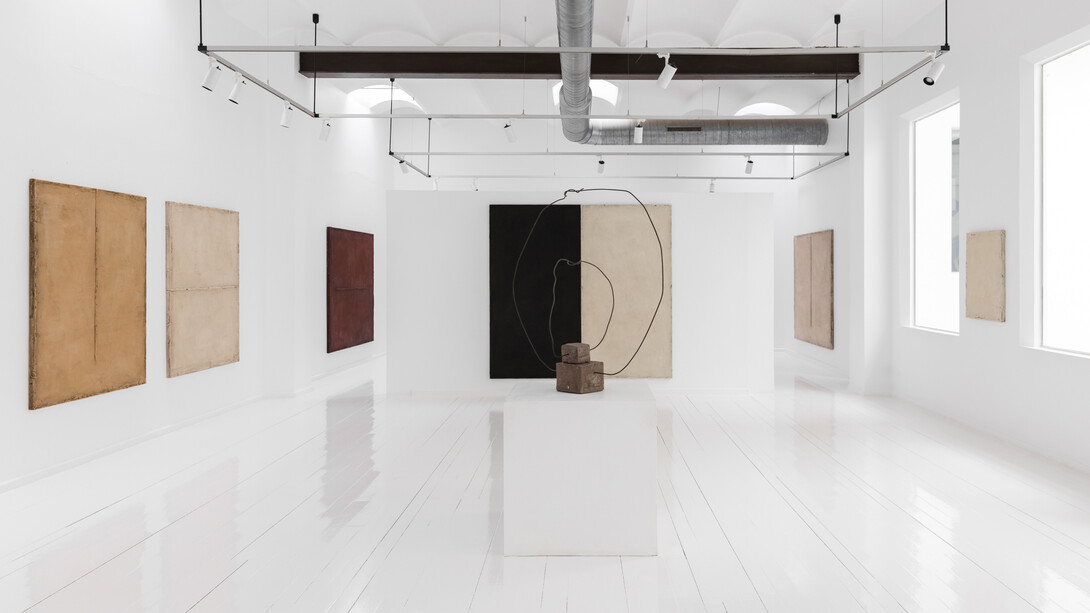
Alzueta Gallery is proud to present De óxido y hueso, an exhibition by Antonia Ferrer, opening at the Barcelona Séneca gallery on November 6.
Antonia Ferrer works at the intersection of painting, sculpture, and nature. Her practice is based on gesture, intuition, and the silent transformation of raw materials. With a minimalist approach and a profound sensitivity to texture and light, Ferrer constructs surfaces that appear both ancient and immediate. Her process begins with the material itself, not a blank canvas: sand, earth, dust, and oils create a textured base that functions as a living terrain. The outcome cannot be fully planned, but it is not entirely accidental either: it is a balance between control and surrender, a negotiation between matter and movement.
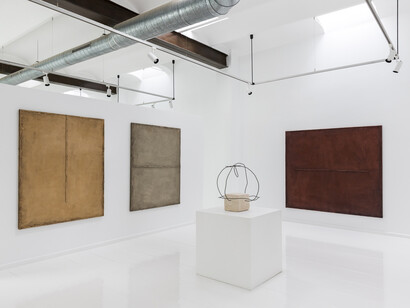
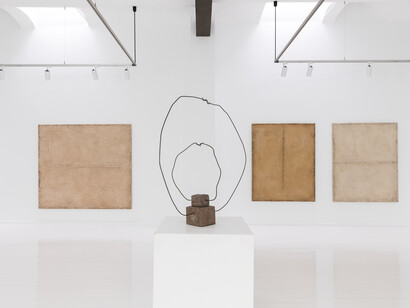
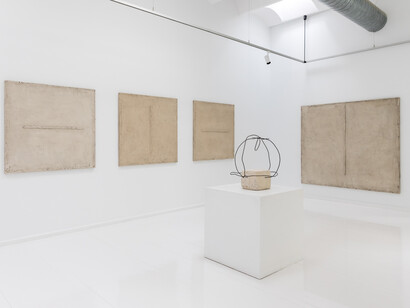
In De óxido y hueso, the artist continues her exploration of the essential, what remains when the superfluous is removed. Materiality is central to Ferrer’s work, and material inevitably perishes. For this exhibition, Ferrer combines a network of oil-on-wood paintings and cement and steel sculptures, exploring notions such as erosion, wear, and degradation. As viewers, we perceive in these works a sense of memory, a recollection of past lives. In the words of the artist: «I want those who observe them to be able to enter their space, traverse their scale, and perceive the density of the matter, the void it contains, and the calm it radiates.»
Her oil-on-wood paintings are crossed by cords that act as fissures or scars, altering the surface without breaking it. The colors suggest the passage of time or the remnants of a ritual: reddish rust, bone white, mineral gray, muted ochre, and deep brown permeate the sedimented texture, where the gesture is minimal but the presence is intense. Each work feels alive, breathing the memory of the material and the light that touches it.
Ferrer’s sculptures inhabit the intersection of space, material, and imperfection. They carry echoes of brutalism and the wabi-sabi philosophy, which, far from being opposed, engage here in a deeply poetic dialogue. The artist works aged steel by hand in a tactile meditation that reveals an intimate connection with the material. In this way, Ferrer embraces imperfection and flaw, recognizing in them the capacity to generate beauty.
In the simplicity of gesture, Antonia finds purity; and in wear and erosion, renewal. It may seem an easy exercise, but within this apparent simplicity lies the emotional and visual power of her work. Ferrer’s practice is not only a tribute to organic matter: it is a journey through time and transformation. De óxido y hueso is a reflection on memory through matter that changes yet never ceases to exist.