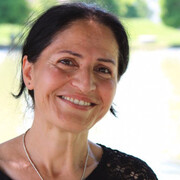
Tula Kandil is a Lebanese-born, Italy-based artist whose work emerges from lived experience, memory, and the quiet reconstruction of identity. Born in Lebanon, she left her homeland at seventeen during the civil war and settled in Italy—an early rupture that continues to resonate subtly within her artistic language.
Before dedicating herself fully to painting, Kandil built a life in the pharmaceutical field. Trained as a pharmacist, she later embraced a more holistic path, becoming a herbal pharmacist and opening two para-pharmacy and herbalist stores in Modena. Her work was rooted in care—listening, observing, understanding the delicate balance between body and nature. Yet alongside this structured profession, art remained a persistent inner necessity.
Nearly a decade ago, she chose to close her businesses and turn entirely toward painting. The decision was less a change of direction than a return to something long present. Art became the space where personal history, intuition, and reflection could take form.
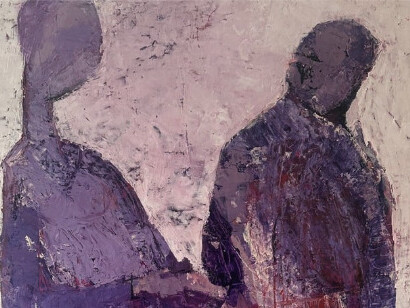
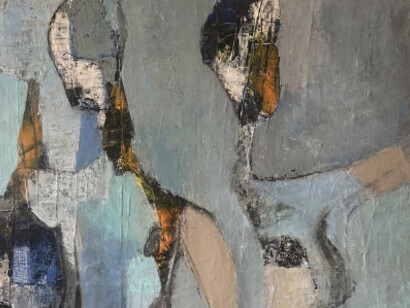
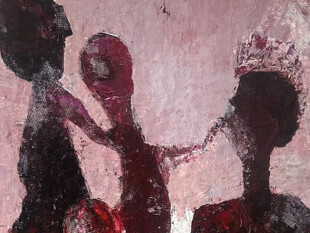
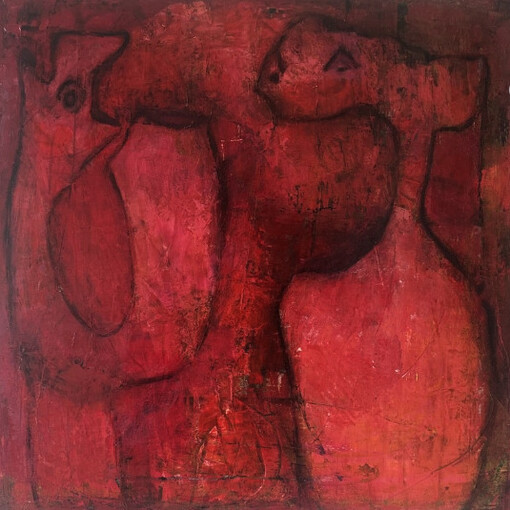
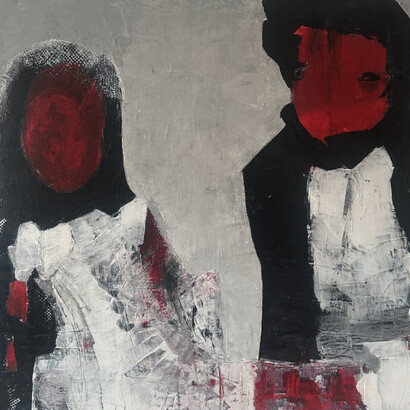
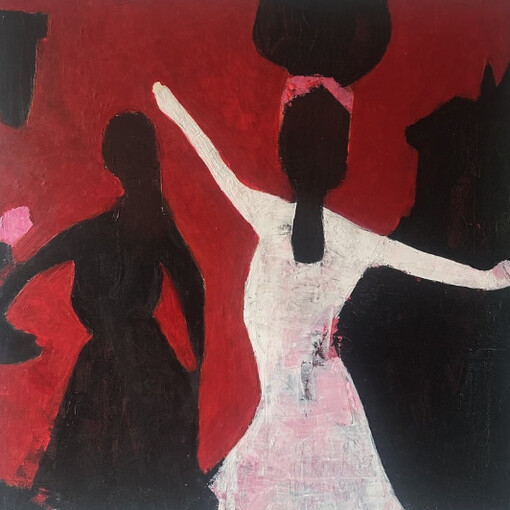
Kandil works primarily in mixed media, layering acrylic, gesso, and other materials to create textured surfaces that carry depth and quiet intensity. Her canvases are built gradually, through layering and subtle transformation. Marks remain visible; surfaces hold traces of what came before. The paintings feel constructed yet intimate, as though memory itself were embedded within the material.
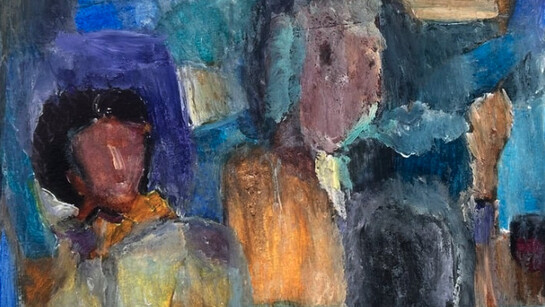
Her work moves between figuration and abstraction. Human figures appear frequently, yet they are not defined in detail. They emerge as shadows—elongated presences, softened silhouettes, forms that seem to hover between appearance and disappearance. These figures are not portraits of specific individuals; rather, they suggest emotional states, fragments of memory, or echoes of experience.
There is a sense of distance in her compositions, but also tenderness. Geometry intersects with fluid gesture. Structured lines coexist with dissolving contours. The figures often seem to inhabit spaces that are both architectural and undefined, as if memory were reconstructing its own environment. This interplay between structure and softness mirrors the experience of displacement—of building a life in a new place while carrying traces of another.
Memory in Kandil’s work is never literal. She does not recount events; she evokes atmospheres. The experience of leaving Lebanon, of adapting, of rebuilding, is present as an undercurrent rather than a subject. The shadowed forms that populate her canvases carry both absence and presence. They are familiar yet indistinct, inviting viewers to recognize something of their own histories within them.
Her years working closely with herbal medicine continue to influence her sensitivity to material and process. There is patience in her approach. Layers are allowed to settle; surfaces evolve over time. She works independently and often develops her practice in series, returning to similar figures and compositional structures as a way of deepening emotional inquiry. Each painting feels like part of a larger internal conversation.
Tula Kandil’s paintings unfold quietly. They do not impose themselves; they invite closeness. Within textured layers and shadowed silhouettes, she creates spaces where fragility and resilience coexist. Her work reflects an ongoing dialogue between past and present, loss and reconstruction, visibility and concealment.
Rooted in personal history yet open to shared interpretation, Kandil’s practice offers a contemplative and sensitive exploration of what remains with us—how memory lingers, how identity shifts, and how presence can be expressed even through shadow.

 English
 Español
 Français
 Deutsch
 Italiano
 Português