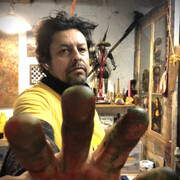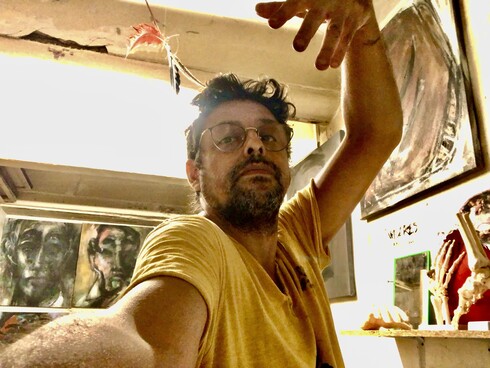
I was born in a small village in the south of Chile called Gorbea, in the far west of my country, as Neruda would describe our cold southern region. A few months after my birth, my family moved a few kilometres from there, to Temuco, its capital, which has been my home and hometown ever since. A young city, built on the territory of the Mapuche people, marked by a history of conquest, resistance, and domination.
I grew up in a place where rain and chimney smoke are part of the landscape, where the wind sets the rhythm of the days. My house was on the last street of the city; beyond it began the countryside. That condition lasted only a short time, because the city grew quickly, like a child who never stops growing. Even so, that growth did not take away from me the privilege of taking a few steps and finding myself in nature. I learned to read the sky, to recognize the arrival of rain, to move among trees and paths. That was my first learning, long before I knew I would become a painter.
I was a child in a complex time. I belong to the generation known as the children of Pinochet, raised amid silence, repression, and constant social tension. In that context, art was not an obvious possibility, and arriving at it was almost a coincidence, a kind of joke of destiny.
I began my artistic training at the art school in Temuco. There I met young people who looked at the world from another place, far from football, television, and traditional careers. It was in that corner of the south that I discovered painting, working directly with expression and materials, in a bohemian, rebellious, and deeply creative environment. That experience marked my relationship with art and society forever.
After completing the basic cycle, I moved to Santiago to continue my degree in painting at the Catholic University, one of the most important art schools in Chile. There I came into direct contact with official art and was a student of the great masters of Chilean painting, José Balmes and Gracia Barrios. From them I inherited my way of writing and understanding painting, and its connection to social reality.
My move to Santiago was my first experience of migration, something that later became a constant in my life. Very important was the support I received from the Juan Pablo II Foundation, which granted me a scholarship for academic excellence, allowing me to carry out my studies and to have a second family in that strange world that a city of millions of inhabitants represented for me.
At the end of my studies I received the first prize at the university’s International Art Biennial, which allowed me to travel to Paris invited by the Sorbonne. It was my first direct contact with the great European museums and with the universal dimension of art. The world opened up before me.
I then decided to continue my training in Europe. I settled in Italy in the year 2000 and studied scenography at the Accademia di Belle Arti in Bologna, specializing in large-format painting for opera. There I understood painting on another scale, through tradition and method, through the craft of the painter as that of a master alchemist of materials and forms of image construction: space, body, light, and movement as part of a single experience. I learned the value of collective work and technical rigour.
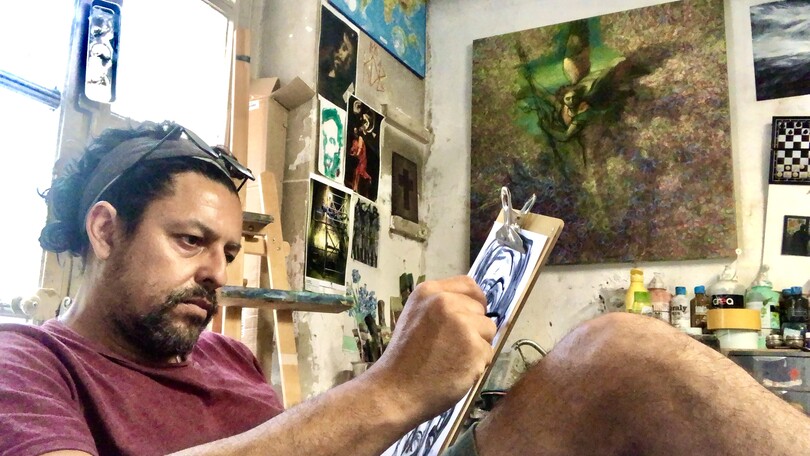
Since then, I have worked as a scenic painter on opera, theatre, and contemporary dance productions in various European countries, alongside my painting practice, collaborating with projects and institutions such as the Ballet National de Marseille, the collective (la) Horde, the Théâtre National de Chaillot, the Teatro Nazionale di Genova, the Grand Théâtre de Genève, and the Palais des Festivals de Cannes, to name some of the most significant. This experience constantly strengthens my discipline and my understanding of the craft, allowing me to develop my personal research in painting with full creative freedom.
It is at this point that my work begins to take on a more conscious form as research. I call this way of observing, walking, recording, and transforming direct experience into painting INM — Investigación Natural en Movimiento. Not as a closed theoretical system, but as a living practice, born from movement, contact with territories, and everyday life, nourishing the work through lived experience itself.
I remained in Italy for eight years, after which I returned to Chile for a brief period to be close to my family, later returning to Europe, this time to France, to continue my creative path, discovering new cultures and drawing inspiration from the skies of Provence and the multiculturalism of Marseille.
I am deeply marked by belonging to a generation of artists that built its own universe before the emergence of the Internet. This singular position, situated at the confluence of two eras, places me between a past in which creativity was rooted in direct experience and a present — and future — shaped by omnipresent technologies.
As a viewer and creator within this temporal framework, I perceive a fundamental opportunity. This condition allows me to reflect with distance and depth on the evolution of art and the human condition, seeking a balance between the legacy of the past and the perspectives opened by the future.
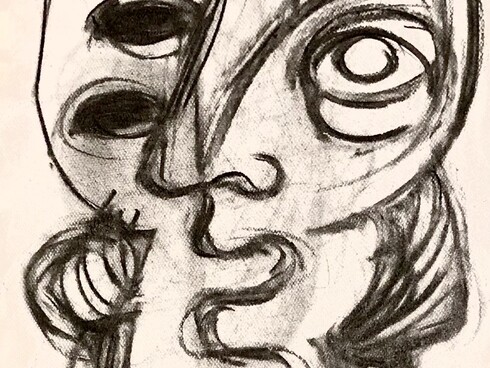
It is within this context that my series Los hijos del laberinto (2022–) takes shape, exploring an intuitive creative process aimed at delving as deeply as possible into the unconscious, far from the media and technological jungle that has become a new god. Through the creative act, I seek to restore an essential connection with the human, evoking a primordial dimension that precedes the saturation of images and stimuli of today.
I believe that painting remains a necessary tool for understanding the world. Imagination is an act of presence, a form of resistance. Returning to what is essential — to gesture, to the body, to nature — is today, more than ever, a contemporary and radically avant-garde act.
After my French experience of more than a decade, like a migratory bird in constant movement and curiosity, my wings brought me to Spain, to the lands of Miguel Hernández, Sorolla, Goya, and Picasso, and also of my teacher José Balmes, Chilean by adoption but Catalan by birth. In some way, I feel that his informalist legacy returns to its native land, closing and opening a cycle at the same time.
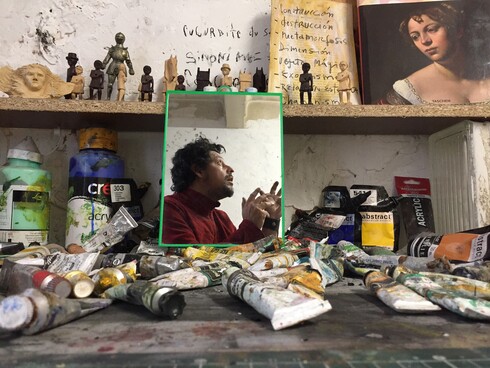
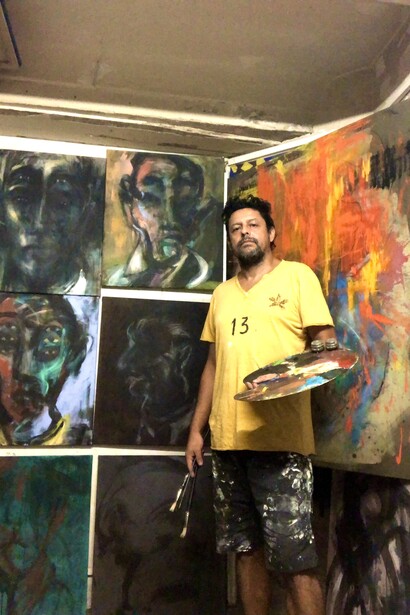
Here I have set up my studio as close as possible to village life, to orange groves and tomatoes, in order to walk the fields again on foot, behind my house, after a long journey. From there I continue, in the silence of my reflections, my large paintings and series: stories of characters, machines, and masked ghosts that cross paths between the past, the present, and the future.
As Antonin Artaud wrote: “Either we bring all the arts back to a central attitude and necessity, or we must stop painting, shouting, writing, or doing anything else.”

 English
 Español
 Français
 Deutsch
 Italiano
 Português