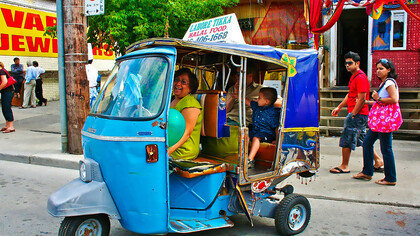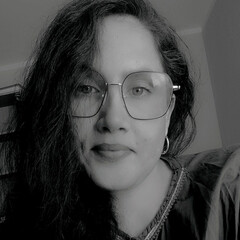
Ishrat Shaheen is an interdisciplinary artist, writer, and urban researcher whose work bridges architecture, storytelling, and socially engaged research. Originally from Pakistan and now based in Germany, she brings a transnational perspective to her projects, which focus on migration, borders, informality, and public spaces.
Currently, Ishrat works as a writer and cultural researcher, developing interdisciplinary projects that combine theory with creative practice. She recently completed her master’s in urban studies through the Estonian Academy of Arts and Bauhaus University in Germany. Her thesis, “Calculated Informality: Ananya Roy’s Concept Revisited,” investigates Bazar Miejski, a border market located between Frankfurt (Oder), Germany, and Słubice, Poland. Through this case, she examines how informal economies operate in the Global North, analyzing how state systems regulate, tolerate, and even rely on informality in ways that reflect patterns commonly associated with urbanism in the Global South.
Ishrat’s research interests center on how migration and borders shape public spaces and how informal practices challenge dominant urban governance. She believes borders are more than physical barriers; they are sites of tension, resilience, and creativity that deeply affect how people live and move.
In addition to her academic background, Ishrat has a strong foundation in the arts and cultural production. She has worked with various institutions, including Vent Space Gallery in Tallinn, where she contributed to curatorial programs and exhibition planning. She also worked with the Lahore Biennale Foundation, supporting large-scale public art events and fostering collaborations among artists, architects, and activists.
Ishrat was selected for a writing residency in Nanjing, a UNESCO City of Literature, where she contributed to the international anthology City as a Human Being. Her piece, “Aroma of Love in a Digital Window,” reflects on digital intimacy, displacement, and cross-cultural communication in post-pandemic cities. Her writing merges theory and emotion, often blurring the lines between research, personal narrative, and creative nonfiction.
In 2023, she co-produced the transnational storytelling project “Memory of Places” with the Bradford Literature Festival, which brought together voices from diasporic and displaced communities. The project centered on place-based memory, cross-border dialogue, and the emotional landscape of migration deeply aligned with her belief in storytelling as a powerful tool for healing and social change.
Ishrat also has extensive experience in theater, having worked with Pakistan’s renowned Ajoka Theatre for eight years. Through stage performances, she explored themes of gender, history, and resistance, which continue to inform her understanding of performative space and social critique.
Her approach is decolonial, feminist, and grounded in the idea that cities are not just built environments but lived experiences. She often incorporates painting, oral history, and visual storytelling into her work to reflect the layered realities of urban life.
When she is not writing or researching, Ishrat paints in oils, walks border towns, and collects stories from bazaar spaces she calls “living archives of the people.” She believes these marketplaces, whether in Lahore or Słubice, hold the pulse of urban life and the stories that rarely make it into formal records.
Ishrat continues to develop projects that center marginalized voices and challenge traditional hierarchies of knowledge. Her work asks, who gets to define the city? Who is remembered? And how can art and research work together to imagine more equitable futures?
In the coming years, she hopes to initiate community-based research labs and traveling exhibitions that bring together artists, migrants, and scholars. By cultivating spaces for shared authorship and cross-border dialogue, Ishrat seeks to foster radical empathy and collective memory. Her goal is to reshape how cities are documented—through lenses that are inclusive, imaginative, and grounded in lived experience. She envisions urban futures built not just on infrastructure, but on care, collaboration, and cultural memory.

 English
 Español
 Français
 Deutsch
 Italiano
 Português