English
 Español
 Français
 Deutsch
 Italiano
 Português
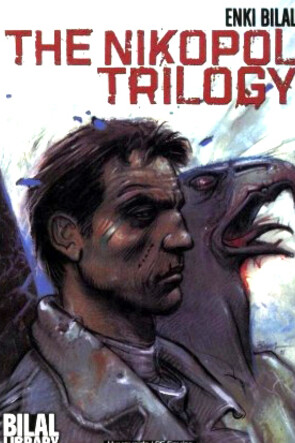
Adapting Enki Bilal’s renowned Nikopol Trilogy into a film presents a significant challenge due to its intricate art style, apocalyptic themes, and profound philosophical storytelling, with the complexity of these elements central to the graphic novel, making its translation to another medium a difficult task. With its complex narrative, Immortel is notable for keeping the source material relatively faithful to the original in terms of its visual style. The movie reflects Bilal’s unique artistic style, which harbors a distinct color palette, detailed visual narrative, and futuristic themes.
The movie fuses science fiction, political thriller, and drama to produce a novel storytelling. Adapting elements from the graphic novel inevitably entails changes, such as shifts in plot focus, character conflicts, the inclusion and removal of characters, and visual differences shaped by the medium. However, the most significant transformation occurs in the thematic content, as the adaptation shifts from a political critique to a depiction of corporatocratic technocracy.
While Bilal's graphic novel reflects his historical experiences—such as witnessing the breakup of Yugoslavia, the Cold War, and 9/11—in his film, Bilal shifts focus from past experiences to a warning about a future in which powerful technological corporations monopolize control over both society and government, leading to the widespread suffering of ordinary people due to unchecked power. His past experiences are also reflected visually in the film, as Bilal explains that the origin of his signature misty style stems from childhood memories of a ruined Belgrade during World War II.1
Immortel, exploring similar themes with other science fiction works such as genetic engineering, governmental corruption, authoritarianism, and the merging of mythology with science, tells the story of Nikopol and Jill Bioskop struggling with what it means to be human in a dystopian New York City in 2095, when humans coexist with genetically altered species and ancient Egyptian gods like Horus. The narration unfolds when Horus chooses Nikopol to locate a suitable human body to inhabit and bear children to sustain his life in some capacity. For this purpose, Horus sets off looking for Jill, a hybrid hominine being with a partly robotic nature and a mysterious past.
Content analysis
The plot
Everything audibly and visually evident in the movie in front of us is referred to as the plot.2 In most classical narratives, the whole chain of events constituting the story can be dissected into five stages. First of all, there is an introduction to the setting and the characters. In the second stage, a conflict arises to disrupt the pace of life. The hero is now challenged on how to react to this conflict. Along the way, the protagonist finds his/her mentor, allies, friends, and foes. In the third act, this conflict reaches the climax, a turning point for the hero. After facing the climax, the hero goes through its consequences and finally meets the resolution, where conflicts might be resolved, and the story has an end.
The plot in the graphic novel is more complex and multilayered. In the books, the subplots incorporate political satire and the dictatorship of Paris; meanwhile, in the movie, the plot includes body politics, and at the same time, it handles a criticism of the capitalism and technocracy of New York City. Since each volume of the three books builds upon the previous one, there is more space for more characters and layers of conflict. The movie, however, makes the plot more barren by focusing more on the interaction between Nikopol, Hours, and Jill and visual elements rather than the political and philosophical readings of the books.
Before analyzing the differences in the plot in both media, it is essential to reflect on the setting, as it provides critical context for the character’s actions and the development of the plot. The film is set in New York City in 2095, while the narrative of the graphic novel unfolds in Paris in 2023. This alteration in the adaptation may be attributed to the technological landscape of 2004, when the film was produced.
Given that 2023 was perceived as a near future for the emergence of advanced technologies, and considering the limited technological advancements available at the time, the director may have opted to project the setting further into the future to align more convincingly with the depicted technological innovations. It is not surprising that Bilal opted for New York City over Paris as a setting, given that NYC is one of the most recognizable cities in numerous sci-fi narratives that explore dystopia as a consequence of technology. Moreover, NYC is often portrayed as a forefront of innovation and technology, making it a fitting backdrop for stories involving advanced technologies, corporate power, and futuristic advancements.
Although the setting in the Nikopol Trilogy is closer in time to the present, it portrays a world fraught with socio-political conflict and authoritarianism, emphasizing the immediate implications of contemporary issues. Meanwhile, the futuristic context in the movie allows for the exploration of themes related to transhumanism, identity, and the consequences of technological advancement.
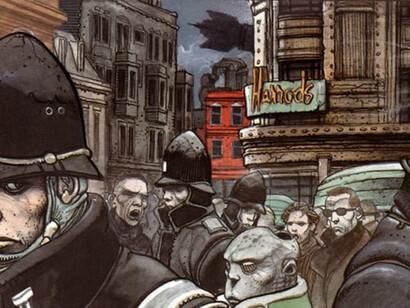
The graphic novel establishes its setting through a text effectively introducing the forthcoming world, providing a detailed account of the socio-political landscape:“...Nothing is likely to change in the politically autonomous and hopelessly fascist greater Paris. The city is divided into two completely unequal sectors... The first, the central city, is inhabited by a social elite, a massive standing army, and the ruling class. The second sector, surrounding the first and extending as far as the eye can see, has become the crossroads for all kinds of adventurers and extraterrestrials ever since a large astroport went into service.”
On the other hand, the film presents a setting in a futuristic city characterized by advanced technology blended with elements of ancient mythology (the hovering pyramid in the sky hosting the ancient Egyptian gods), suggesting the duality of the past and the future as well as the dichotomy of immortality and decay. The advanced technology conveys a sense of decay and neglect, depicted through images of deterioration and debris. The oppressive, gray sky suggests underlying problems, indicating a dystopian representation of the future. The urban landscape of NYC is characterized by rusty-colored, crumbling skyscrapers, giving a sense of oppression and isolation, scrappy flying cars, and flickering neon-colored holograms, contrasting the smoky, foggy, overcast weather reminiscent of Ridley Scott’s Blade Runner.
Although both mediums present a dystopian setting, they differ in time period, geographical focus, cultural context, and narrative implications. NYC in Immortel emphasizes a technologically advanced yet decaying future, while the Paris of the Nikopol Trilogy offers a critical reflection on socio-political issues in a near-future landscape. Within the framework of this setting, it is possible to see how the two media centered the plot on different themes from the beginning of both narratives.
The opening scenes of Immortel connote those of the opening scenes of Hulk (2003, directed by Ang Lee), sharing thematic similarities; both depict cellular formations that signal the films' science fiction genre and suggest post/transhuman elements. In Hulk, the green cells foreshadow the transformation of Bruce Banner into the Hulk, while in Immortel, the blue cells allude to Jill, an extraterrestrial character central to the narrative.
As the film combines elements from the first two books of the Nikopol Trilogy, it diverges in its introduction of Jill. The movie is introduced with Jill’s POV, finding herself among other aliens in a line, getting captured by a biotech company. This subtly conveys the impression that the biotech company holds a degree of control over nonhuman entities. In contrast, the graphic novel introduces Jill only in the second book, with the trilogy initially placing greater emphasis on Nikopol, his past, and his evolving relationship with Horus, beginning with the first book.
The very first page of Carnival of Immortals, the first book of the Nikopol Trilogy, begins with a quote from the antagonist, J.F. Choublanc: “Immortality is a form of dictatorship of life over death. Since I am a dictator and alive, all that remains for me is to become immortal. And this I will become! Even if it kills me!” This introduction sets the tone for a narrative centered on the pursuit of ultimate power, which is achievable through the iron grip of dictatorship within a political framework and the relentless quest for immortality within a biological one. Thus, the books associate post/transhumanist elements with political conflicts, whereas the movie foregrounds an existential exploration of the question, "What does it mean to be human?”
Beyond differences in the introduction of the plot, each medium presents the conflict distinctively. The characters in the movie pursue different interests and have end goals that diverge from those of the characters in the books. In the books, the conflict arises when Horus decides to use Nikopol as a vessel to pursue his ambition of reclaiming control and influence over the human world. This instigates a power struggle with both other Egyptian gods and the authoritarian governor of Paris, Choublanc. Nikopol’s primary conflict—the reason for his cryogenic suspension—stemmed from his opposition to Paris’s oppressive political system.
Upon his return, however, this external struggle transforms into a deeply internal one: he is alienated from a dystopian society that feels foreign after 30 years, and, compounding his disorientation, he loses his personal agency as he is compelled to host Horus, an egotistical, authoritarian god embodying the very ideals Nikopol once resisted. On the other hand, the film shifts the central conflict to a more existential issue. Rather than pursuing power to dominate, Horus seeks to secure his immortality, transforming his motivations from purely power-driven to deeply personal and entwined with his existence within the human world.
This internalized struggle makes his conflict less about dominance and more about survival and existential fulfillment. For Nikopol, the focus likewise shifts away from political rebellion to questions surrounding his identity and role in a surreal, technologically advanced society. His conflict centers more on adapting to his new reality and managing his relationship with the divine and extraterrestrial forces influencing him.
Jill’s role is also significantly expanded in the film, as her personal and existential conflicts around her alien identity add a further layer of complexity. She contends with her identity as an alien, her sense of humanity, and her growing connection with Nikopol, navigating what it means to exist as “other” in a human-dominated world. Her journey reflects themes of identity and transformation, as she struggles to reconcile her extraterrestrial nature with her emotional experiences, positioning her as a central figure in the story’s exploration of transhumanism.
While the central conflict in both media revolves around the pursuit of power, the motivations differ: in the books, power is sought for totalitarian control and domination, whereas in the film, the pursuit centers on immortality, giving the narrative a more existential dimension in which immortality itself is the ultimate power.
In storytelling, a character's goal serves as the driving force behind their actions, and these goals often intersect or clash with those of other characters, generating conflict within the narrative. Given that the Nikopol Trilogy encompasses three books, there is greater scope for developing additional characters, thereby enriching the depth of their interrelationships.
The conflict and character motivations are primarily established in the first volume of the trilogy, The Carnival of Immortals. In this volume, almost all characters, with the exception of Nikopol—who is portrayed as striving to reclaim his autonomy and survive the influence of Horus—are preoccupied with gaining power over Paris. While the movie completely disregards the intricate web of conflicts between the Egyptian gods, who require petrol as a resource for their pyramids, and Choublanc, who seeks immortality in exchange for access to this fuel, by establishing this conflict as the central focus, the graphic novel introduces additional conflicts that enhance the narrative's complexity.
To achieve his objective of immortality, Choublanc is willing to impose new taxes, declaring war on the wealthy but militarily vulnerable cities. However, he must also secure reelection as governor to maintain his negotiations with the gods. His brother, Théodule I, the head of the church, is likewise embroiled in these political machinations, viewing the Egyptian gods as an uncontrollable, irreverently pagan coalition of Satan worshippers.Théoduleispatches his alien cherubs under the pretense of safeguarding Choublanc; however, his underlying objective is to monitor his brother and maintain the church's enduring influence over the government.
In this tumultuous environment, where individual goals are often in conflict, Horus seeks to exploit the resulting power vacuum to gain influence and establish his presence among humans, viewing Nikopol as a useful vessel for manipulating human affairs. His goals are self-centered, often destructive, and aligned with broader themes of power and control.
Additionally, a secondary layer of conflict emerges between Horus and the other Egyptian gods, particularly Anubis. A parallel election is underway among the deities, with Horus attempting to usurp Anubis by procuring petrol from human sources. In response to Horus's intentions, the other Egyptian gods employ XB2, an android that entered hibernation alongside Nikopol, to run for the elections to control Paris.
What is represented as human in the graphic novel has more autonomy and is given more character depth compared to the movie. For instance, Nikopol and Choublanc are more politically driven, although they share different goals. Moreover, the aliens, such as the animal-headed gods with human bodies and cherubs, falling into the category of nonhuman according to Sherryl Vint’s classification3, have been given more time and space in the graphic novel. The degree of human autonomy shifts in the movie, while certain nonhuman characters are omitted.
In Immortel (Ad Vitam), although Nikopol—who lends his name to the trilogy— appears to be the main protagonist, he is, in fact, one of the characters with the least autonomy. His goals become increasingly intertwined with his relationship with Jill, while his fate ultimately rests in the hands of Horus.
Horus, on the other hand, is a more goal-driven character. Compared to the trilogy, his ambitions shifted toward a desire to survive and secure a legacy through a relationship with Jill. His aims appear less politically motivated and more connected to the broader questions of existence within a decaying, futuristic society. To procreate with Jill before facing eternal confinement at the hands of other Egyptian gods, he needs Nikopol's body as a vessel, as it is the only clean, healthy form compatible with his divine existence.
This analysis reveals a cultural posthumanist critique, as it centers on the distinction of human and non-human entities, exploring how the representation of the non-human—in this case, something perceived as unclean or unhealthy—reflects evolving attitudes toward the human body, identity, and technological interaction. By positioning aliens as second-class citizens, the work raises questions about posthumanism's intersections with issues of race, gender, and class, underscoring the need to examine how posthuman concepts both shape and are shaped by cultural narratives, ideologies, and structures of social power.
Consequently, Jill assumes a more significant role in the film despite having less agency over her own life. As an extraterrestrial being with a unique physiology capable of giving birth to divine offspring, her primary desire is to adapt to her new environment by becoming human. She seeks to erase her past by taking a red pill, which I believe is a reference to the red & blue pills in the movie The Matrix.
Unlike Neo in The Matrix, however, Jill does not have the option to choose between. Jill's significance, defined solely by her fertility, closely aligns with Sherryl Vint’s second category of posthumanism, which encompasses "new humans" who are marginalized or subordinated, including women, the economically disadvantaged, the colonized, the proletariat, and LGBTQ+ individuals. Jill’s character invites the audience to question how governmental and corporate control over bodies shapes the posthuman body within society.
Allgood, who represents Choublanc in the books, aspires to be selected as governor in order to further the interests of his eugenics company. He is particularly concerned about Nikopol’s exceptional memory, which contains substantial evidence concerning his late father’s financial dealings and his illegal experiments on alien populations. Thus, Allgood seeks to silently eliminate Nikopol, believing that “executing him would make him a hero, a martyr to the lousy revolution.”
Thus, through Allgood and his eugenics company, it’s possible to witness that human has more political enforcement over the nonhuman. For example, Allgood’s implementation of a divide-and-rule strategy fractures society into dichotomies such as men vs. women, human vs. nonhuman, and ‘us’ vs. ‘them,’ thereby fostering alienation and hostility. Allgood's role in the narrative can be interpreted through a libertarian transhumanist critique. Libertarian transhumanism advocates for individual autonomy in human enhancement, asserting that people should have the right to modify their bodies and minds without governmental interference.
However, the story illustrates how this freedom can be easily manipulated for personal gain and exploitation. Under the guise of offering enhancement, Allgood leverages this unregulated space to prioritize corporate interests and profit, ultimately benefiting the company rather than the individuals purportedly served. This perspective reveals the potential ethical pitfalls in unrestricted enhancement practices, highlighting the risks of corporate control within libertarian transhumanist ideals.
In The Nikopol Trilogy, character goals are more political and socially driven, reflecting themes of authoritarianism and rebellion. The narrative presents a critique of government, illustrating the consequences of a corrupted and dysfunctional democracy. This critique of democracy within a post/transhumanist dystopian context resonates with criticisms of democratic transhumanism. Democratic transhumanism advocates for the equitable distribution of enhancement technologies, ensuring these advancements benefit society as a whole rather than exclusively serving the wealthy or privileged.
In the story, the government’s failure to provide public access to life-extending and enhancement technologies, resulting in diminished social equality and individual rights, reinforces this critique, highlighting the ethical and societal implications of restricted access to transformative technologies. In contrast, in Immortel, the concept of immortality, central to posthuman interests, is more pronounced, with each character struggling with their identity and place in a world where humanity, divinity, and alienness intersect.
Despite these differences, both media draw attention to humanity’s limitations under oppressive rule. In this instance, an additional layer of critique emerges; rather than targeting the government, Enki critiques the corporatocratic technocratic regime, thereby introducing a libertarian transhumanist perspective.
Since the eugenics corporation controls both the government and access to human enhancement, the lack of governmental regulation allows corporate interests to dominate unchecked. Consequently, the free market principles central to libertarian transhumanism become susceptible to corruption through the monopolization of power. These narrative changes constitute evidence of how post/ ttranshumanistlements transition from political critique to corporatocratic technocracy.
The most distinguishable difference between the two media is the ending or the resolution. The trilogy’s conclusion is more vague and subject to interpretation as well, and provides an extension of the characters' personal and political narratives, particularly those of Nikopol and his son. The last book of the trilogy focuses on the father-son relationship (Nikopol and his son) and presents no solution for corruption or the failure of political systems. What dystopian stays dystopian? The movie, on the other hand, has a more closed ending with a resolution of the conflict between Nikopol and Horus; meanwhile, Jill is carrying Nikopol’s child, hinting at the start of a new beginning, a new generation.
The characters
Nikopol, as a protagonist, is different from the archetypal hero who triumphs over adversity to achieve a significant victory. While it is suggested that he was once a prominent figure in resisting totalitarian rule, his present narrative is marked by diminished autonomy, reflecting broader themes of subjugation and human struggle. His character symbolizes humanity's broader conflict with oppressive forces and existential limitations.
Moreover, his portrayal aligns with Deckard in Ridley Scott’s Blade Runner, where the protagonist similarly undergoes a journey of identity exploration with a lack of clear autonomy. Both Nikopol and Deckard challenge conventional heroism by emphasizing their vulnerability, complex motivations, and the blurred lines between human and posthuman existence.
The portrayal of Nikopol as a loner and outcast, depicted as one of the last unaltered humans—untainted by genetic modifications or enhancements —enriches the thematic complexity of the dystopian and post/transhumanist genre. This depiction shows his struggle with profound existential crises, suggesting that the core of his narrative transcends conventional notions of victory.
Instead, it pivots toward a journey of self-discovery and an exploration of human identity within a mechanized, dehumanizing society. By embodying the tension between unaltered humanity and a world dominated by technological and genetic advancements, the protagonist's experience invites critical examination of what it means to be human in an era increasingly defined by posthuman ideals.
Choublanc/Allgood, the main antagonist, is represented as the symbol of all this oppression, corruption, and fascism. The portrayal of him as an overweight person in both mediums suggests a critique of greed and the insatiable desire for power, aligning his character with broader themes of capitalist exploitation and moral corruption within the societal framework. Just like other fascist leaders leveraging power to enforce genetic hierarchies, he is ruthless and manipulative.
The world constructed in the Nikopol Trilogy mirrors that of former Yugoslavia, a multicultural society characterized by a rich tapestry of ethnicities and religions. In Yugoslavia, this delicate balance of cultural harmony was disrupted by ethnic conflicts. Similarly, in the Nikopol Trilogy, society comprises a diverse array of beings—humans, robots, aliens, ancient Egyptian gods, non-human entities, and genetically modified humans.
However, akin to the hierarchies imposed in fascist regimes, there exists a pervasive racial prejudice against all that is not considered fully human. This society is thus stratified along hierarchical lines, with rigid class divisions rooted in discrimination against non-human and hybrid entities.
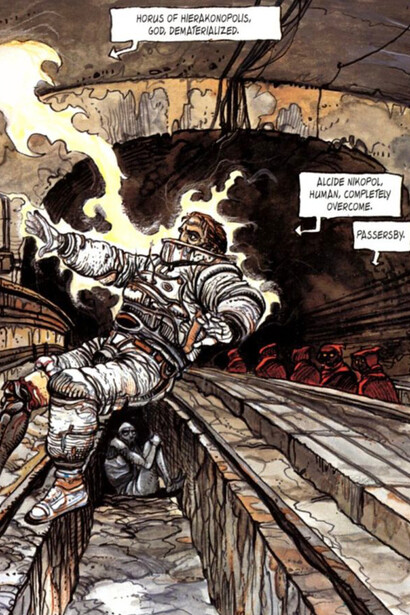
In the graphic novel, Choublanc’s election speech is notably derived from Mussolini's rhetoric, establishing a direct correlation between his character and fascist ideology. This connection is further emphasized by his military uniform, which features a black crusade cross, signifying authority and an aggressive posture within the political landscape. The use of phallic imagery in his makeup emphasizes his perceived power and virility, projecting an image of inflated ego and dominance, portraying him literally as a dickhead.

Figure 1: Choublanc’s election speech is notably derived from Mussolini's rhetoric.
In contrast, the film adaptation recontextualizes Choublanc's character from a militaristic figure to a corporate businessman, yet retains the representation of him as an oppressor and corruptor. This shift signifies a larger commentary on how post/transhuman narratives can reflect and respond to changing societal values and power structures, indicating a steer away from traditional political engagement toward an analysis of the implications of corporate dominance in technologically advanced society.
The transformation of Choublanc’s portrayal functions as an oppressor and corruptor. This shift signifies a larger commentary on how post/transhuman narratives can reflect and respond to changing societal values and power structures, indicating a steer away from traditional political engagement toward an analysis of the implications of corporate dominance in a technologically advanced society.
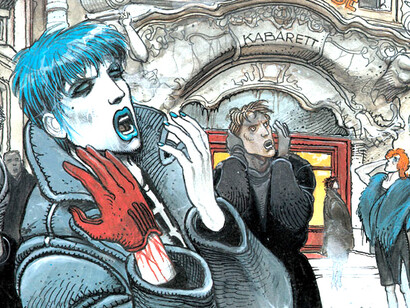
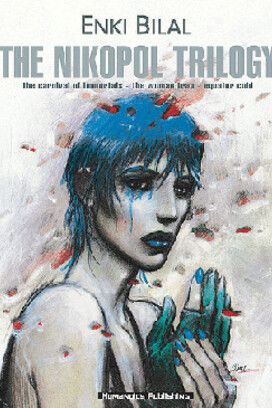
Jill is another character who serves a pivotal role within the narrative, especially in the film adaptation, where she symbolizes the bridge between humanity and the divine. In the graphic novel, on the other hand, she is portrayed as a journalist who is more politically charged and invested in the investigation of human corruption. The visual representation of her character—marked by her pale skin and blue-hued tears and blood— stresses extraterrestrial origins despite her human-like appearance. In the film, Jill’s extraterrestrial physiology bears significant implications regarding themes of fertility and politicizing her body, which raises critical questions about autonomy, agency, and body politics within a corporatocratic framework.
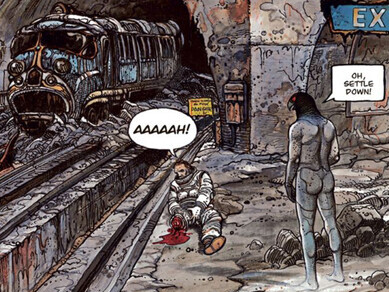
Horus, a falcon-headed ancient Egyptian god of the sun and the sky, represents divine intervention. His possession of Nikopol’s body raises questions about the autonomy and free will of the human. Thus, it creates a contrast between human frailty and divine authority. The fact that his portrayal in the film as a god stripped of his former glory and fallen into a human-dominated world refers to the decay of divine power and its susceptibility to human flaws.
Through Horus, the narrative points to the corrupting nature of power across all spectrums, as well as themes of autonomy and rebellion. The dynamic between Horus and Nikopol’s body in the film parallels the alien takeover depicted in Invasion of the Body Snatchers (1956). In both narratives, the theme centers on the covert replacement of human beings by an inhuman, alien entity. In Invasion of the Body Snatchers, alien plants fall from the sky, producing pods that gradually generate exact replicas of human bodies, ultimately replacing the original human hosts.
A key distinction between the authentic human and the alien-possessed duplicate lies in emotional capacity: humans retain a depth of feeling and individuality, whereas the alien entities lack these qualities, embodying a cold, emotionless otherness. Horus’s stance toward humanity is also characterized by cold indifference.
The theme
In a narrative, the theme refers to the underlying message, central idea, or critical commentary that the film conveys regarding life, society, or human nature. Both Immortel and The Nikopol Trilogy exhibit thematic parallels, notably in their engagement with post/transhumanism, identity and autonomy, corruption and power, alienation and isolation, and body politics with feminist nuances.
In comparing the portrayal of corruption and power dynamics across both mediums, it is evident that while each presents a society marked by oppression and systemic corruption, they differ in the specific mechanisms and instruments through which this oppression is exercised.
As mentioned before, through Choublanc/Allgood, Bilal asserts a critique of political and corporate structures that exploit genetic hierarchies and create oppressive, stratified societies. The societal structure changes from one characterized by fascist, sexist, and oppressive totalitarianism to a corporatocratic technocracy— one that is heavily reliant on technology and where corporate power exerts significant influence over governmental authority.
For example, Allgood’s dual role as both the eugenics company's owner and a candidate for gubernatorial reelection exemplifies the entanglement of corporate and political power, blurring the boundaries between state governance and private interests. His control over a major corporation implies that the corporate entity wields substantial political authority, illustrating a merger of capitalist motives with state mechanisms of control.
Since Allgood holds significant control over the bodies of New York City's citizens through his eugenics company, which provides enhancements for those who can afford them while experimenting on captured alien bodies, his other role in government grants him this extensive influence over "the management of life" itself.
This control is vividly depicted in the graphic novel, where Choublanc manipulates society by segregating women of reproductive age and confining them to the Holy Savior Maternity Center—an enormous, sterile underground clinic designed to accelerate birth rates. There, he designs the production of predominantly male offspring, nearly all of whom are destined for military conscription, highlighting a disturbing fusion of biopolitical control and militaristic agenda.
In the film adaptation, this theme of reproductivity shifts to focus on Jill, whose fertility is controlled, suggesting her reproductive role is essential to her existence and agency. This narrative intersects with feminist theory underlying the socio-political implications of bodily control within a corporatocratic framework.
Jill's lack of agency—resulting in her subjugation for the continuation of Horus’s lineage—illustrates the objectification and commodification of her body, a concept that aligns with feminist critiques on body politics within post/transhumanist contexts. This theme of enforced bodily control resonates with biopolitical theory, inviting further exploration into how societal and technological structures police women’s bodies, often stripping them of autonomy and subjecting them to systemic forms of exploitation.
Moreover, Horus’s control over not only Jill’s but also Nikopol’s body—manifesting in Nikopol's dependency on Horus to mobilize his metal leg—places Nikopol as another subject of biopolitical manipulation. Similar to Major Kusanagi in Ghost in the Shell, who eventually merges with the cybernetic entity she initially opposes, Nikopol’s body is used as a weapon and as a tool for Horus’s conflicts. This parallelism draws attention to the theme of biopolitics within The Nikopol Trilogy and Immortel, where corporeal autonomy is undermined by larger political, corporate, and technological forces that reconfigure individual identities as instruments within broader power structures.
Having laid out the theoretical foundations, the discussion now turns to the stylistic dimensions of adaptation, where the shift from still image to moving image reveals both the creative opportunities and the inherent constraints of the cinematic medium, highlighting the tension between fidelity to the source material and the demands of film as a visual and narrative art form.
References
1 Sampanikou, Evi D. “Chapter One Postmodernism, Posthumanism, and Transhumanism in Science Fiction: Graphic Novels. Enki Bilal and The Hatzfeld Tetralogy.” Audiovisual Posthumanism, Cambridge Scholars Publishing, 2017, pp. 194.
2 Bordwell, David, and Kristin Thompson. Film Art, 8th ed., McGraw-Hill,p 76–76.
3 Sherryl Vint 3 types of posthumanism: Vint, Sherryl. “Part 2 Chapter 11: Posthumanism and Speculative Fiction.” Palgrave Handbook of Critical Posthumanism, vol. 1, pp. 226–226.
4 Sherryl Vint 3 types of posthumanism: Vint, Sherryl. “Part 2 Chapter 11: Posthumanism and Speculative Fiction.” Palgrave Handbook of Critical Posthumanism, vol. 1, pp. 226–226.