English
 Español
 Français
 Deutsch
 Italiano
 Português
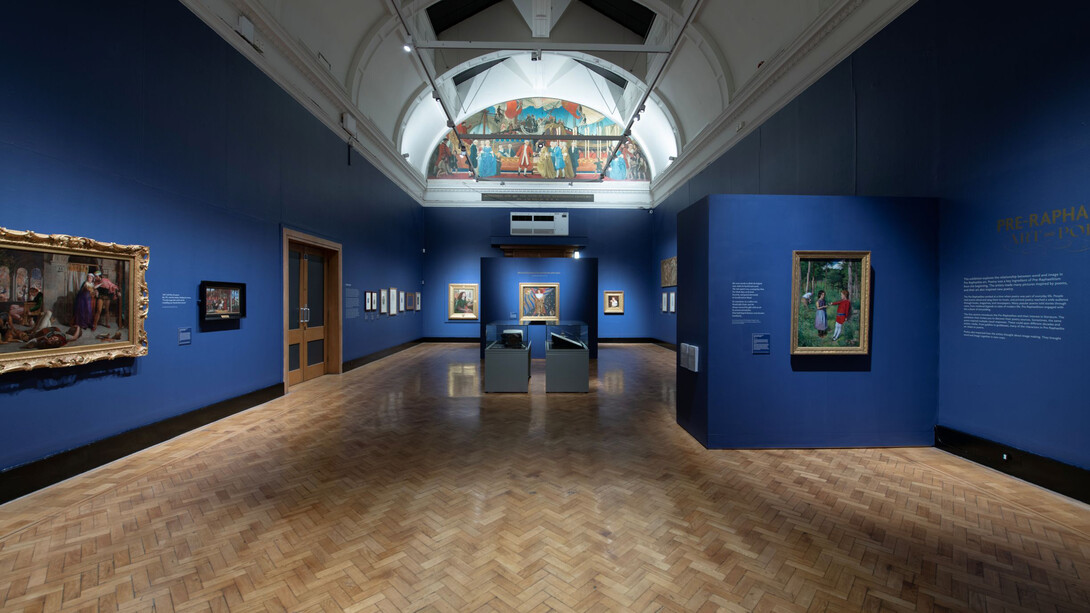
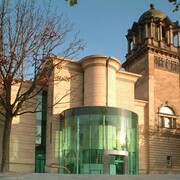
There are moments in the history of art when painting and literature seem to speak the same language, when images acquire the rhythm of poetry and words become almost tangible, taking shape in colour, texture and light. The Pre-Raphaelite movement was born out of precisely this desire to bring the visual and literary arts into closer relationship, rediscovering the imaginative power of storytelling and the expressive possibilities of nature, history and human experience. This creative exchange lies at the heart of Pre-Raphaelites: art and poetry, an exhibition at Newcastle's Laing Art Gallery that offers a fresh perspective on one of the most fascinating chapters in British cultural history.
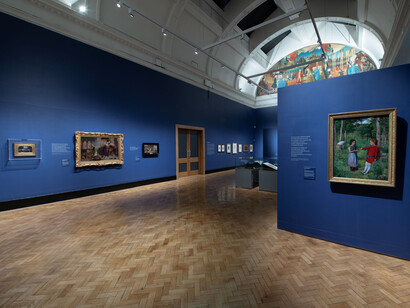
Bringing together more than 100 paintings, drawings and objects, the exhibition explores the connections between Pre-Raphaelite art and poetry, presenting the movement not simply as an artistic phenomenon but as a wider intellectual and literary experience. Its three thematic sections – Poems past, Romantic rhymes and Victorian visions – trace the evolution of this dialogue across different periods, revealing how painters and writers continually inspired and influenced one another.
The story begins in 1848, when John Everett Millais, William Holman Hunt and Dante Gabriel Rossetti founded the Pre-Raphaelite Brotherhood. Dissatisfied with the conventions of academic painting, they sought inspiration in medieval art and the early Renaissance, before Raphael. Their rebellion, however, extended beyond questions of style. Literature offered them a means of exploring emotional, moral and psychological complexity, while poetry provided a language through which beauty, desire, spirituality and tragedy could be translated into images.
In Poems Past, the exhibition examines the Brotherhood's engagement with classical, medieval and Renaissance literature. Dante Alighieri was a particularly important influence on Rossetti, whose fascination with the Italian poet was rooted in his father's scholarly interests and developed into a lifelong artistic preoccupation. Works such as Paolo and Francesca (1862), Dantis Amor (1860) and Beata Beatrix (1877) reveal how literary narratives became psychological landscapes.
In Beata Beatrix, inspired by Dante's idealised image of Beatrice Portinari, Rossetti transforms the poet's vision into an intensely introspective composition. Beatrice appears suspended between earthly existence and transcendence, while the symbolic presence of the poppy, the bird and the flowers evokes death, memory and spiritual transformation. The painting demonstrates how the Pre-Raphaelites moved beyond straightforward illustration, creating images that invite interpretation much as poetry does.
The works of Geoffrey Chaucer and Shakespeare also provided an enduring source of inspiration. Ford Madox Brown's The seeds and fruits of english poetry reflects the continuity of the English literary tradition, while Millais's The woodman's daughter (1851), inspired by Coventry Patmore's poem, illustrates how contemporary literature could become the starting point for an entirely new visual narrative.
Romantic rhymes turns to the poets whose writing shaped the nineteenth-century imagination, including John Keats, Lord Byron, Percy Bysshe Shelley and William Wordsworth. Their fascination with nature, beauty, mortality and emotional intensity resonated deeply with the Pre-Raphaelites' artistic ideals.
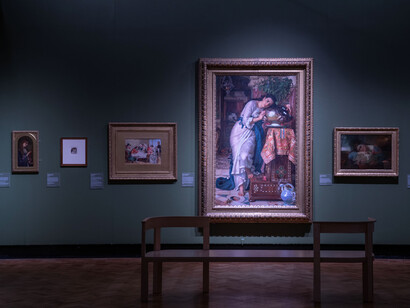
One of the exhibition's highlights is William Holman Hunt's Isabella and the pot of basil (1867), inspired by Keats's poem Isabella, or the pot of basil, itself derived from a story in Boccaccio's Decameron. The painting depicts Isabella following the murder of her beloved Lorenzo, whose head she conceals in a pot of basil. Hunt's extraordinary attention to detail transforms the domestic setting into a profoundly unsettling meditation on grief, devotion and memory. Textiles, plants, architectural features and everyday objects are rendered with meticulous precision, yet their descriptive richness is never merely decorative: each contributes to the emotional atmosphere of the scene.
The third section, Victorian Visions, explores the reciprocal relationship between visual art and the poetry of the artists' own time. Alfred, Lord Tennyson, Christina Rossetti, Algernon Charles Swinburne and William Morris emerge as essential figures in a cultural community where artistic disciplines were constantly overlapping.
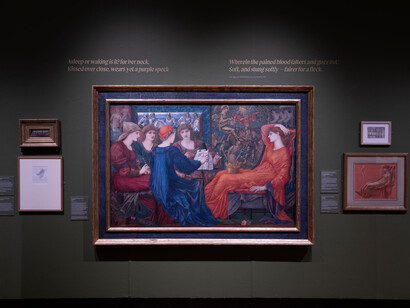
A particularly compelling example is Edward Burne-Jones's Laus veneris (1873–78), inspired by the medieval legend of Tannhäuser and also connected with Swinburne's poem of the same title. The story of the knight who encounters the enchanted realm of Venus becomes an elaborate visual meditation on desire, temptation and spiritual conflict. Burne-Jones's figures seem suspended in dreamlike stillness, surrounded by richly patterned details that intensify the atmosphere of melancholy and enchantment.
The exhibition also brings deserved attention to the women who participated in and helped shape the Pre-Raphaelite imagination. Elizabeth Siddal, often remembered primarily as Rossetti's model and companion, was also an accomplished artist and poet. Her creative work offers an alternative perspective on the movement, while Kate Bunce demonstrates the continuing influence of medievalism and symbolism on later generations. Julia Margaret Cameron's literary-inspired photography further reveals how Pre-Raphaelite aesthetics extended beyond painting. Christina Rossetti, meanwhile, was not simply connected to the Brotherhood through family ties: she was one of the most significant Victorian poets and contributed to its early publication, The germ, which brought together poetry, prose and visual art.
Another important dimension of the exhibition is its exploration of the decorative arts. Embroidery, metalwork, stained glass, tapestry, illuminated manuscripts and books demonstrate how the Pre-Raphaelite approach extended beyond the traditional boundaries of fine art. William Morris's commitment to craftsmanship and the integration of beauty into everyday life was a natural extension of this vision. Works such as the Forest tapestry (1887) reveal how literary imagination could inform not only the subject of an artwork but also its material construction and decorative language.
This interdisciplinary perspective is among the exhibition's greatest strengths. By placing paintings alongside literary sources, books and decorative objects, the Laing Art Gallery encourages visitors to follow the transformation of ideas as they move between different creative forms. The selection, which includes loans from major British institutions such as Tate, the Victoria and Albert Museum, Birmingham Museums, the Ashmolean Museum and the Fitzwilliam Museum, also brings together works that are rarely encountered in such a context.
Ultimately, Pre-Raphaelites: art and poetry invites us to reconsider the movement beyond its familiar visual characteristics: brilliant colours, intricate surfaces, medieval settings and expressive figures. It reveals the literary imagination underpinning these images and the complex network of relationships that shaped Victorian artistic culture.
There is something profoundly contemporary about this dialogue. At a time when creative disciplines are often discussed in isolation, the exhibition reminds us that artistic innovation thrives through exchange and the freedom to move between different forms of expression. The Pre-Raphaelites understood that a painting could continue a conversation begun in a poem, just as poetry could discover new meanings through the encounter with an image. At Newcastle's Laing Art Gallery, this enduring relationship becomes an invitation to look more closely, read more attentively and rediscover the imaginative possibilities that emerge when art and literature meet.