English
 Español
 Français
 Deutsch
 Italiano
 Português
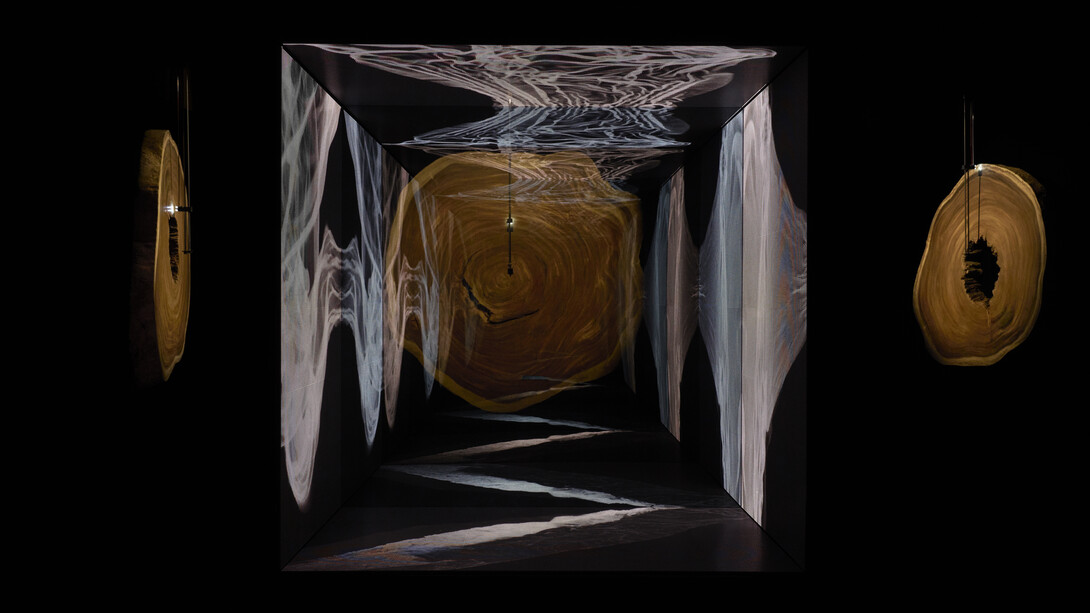
Espacio El Dorado presents an exhibition by Colombian artist Felipe Macía. The exhibition will be open to the public from September 19, 2026, through February 13, 2027.
Time manifests itself in different ways: in trees, it becomes visible in the grain of the wood that forms as they grow; in the atmosphere, we perceive it in the clouds, the rain, changes in light, the wind, the heat, the humidity, lightning, and thunder. Thus, between the air and the wood, two ways of experiencing time emerge: one in the atmosphere, which is constantly changing; the other in the wood, which grows and accumulates traces over the years.
Throughout their lives, trees form layers of tissue known as growth rings. In many species, these rings correspond to a single year, and their thickness can vary depending on the availability of water, light, temperature, and disturbances. The rings are, therefore, biological archives of time: they preserve traces that reveal part of the history of the tree and its environment. Thus, part of the landscape’s memory is inscribed in the organisms that inhabit it; their bodies preserve traces of their relationship with the environment.
In the atmosphere, large flows of water vapor—known as atmospheric rivers—travel across and connect regions, transporting moisture. Trees are part of these exchanges, continuously moving water, carbon, and energy between the ground and the atmosphere. The works brought together in Forms of Time explore this interaction. In some works, this is achieved through sensors that scan sections of wood and transform their variations into sound and movement; in others, it is based on data about air and water vapor that are converted into images and kinetic forms. In this way, the exhibition makes visible and audible the processes that connect atmospheric time, trees, and territories. These works invite us to think of time as a spiral: water circulates and returns, but never under the same conditions; a tree may remain before our eyes for decades, continually changing as it grows. What appears to be the same is always transforming.
In Rivers in the Atmosphere (2025), Macía explores the phenomenon of atmospheric rivers—corridors of water vapor that move with the winds and transport enormous amounts of moisture through the atmosphere. Although they are invisible—unlike rivers that flow at ground level—they can turn into rain when they encounter mountainous areas that cause the moist air to rise; as it cools, it generates precipitation.
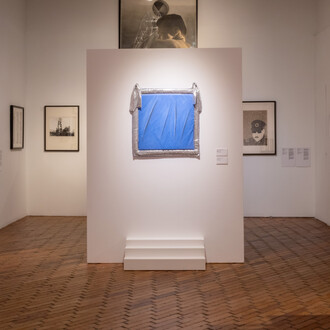
The installation functions as a digital membrane that tightens and loosens in response to increases or decreases in the volume of water vapor traveling from the Amazon to the Cordillera Central. This work draws on 25 years of Integrated Water Vapor (IWV) archives created by the U.S. National Oceanic and Atmospheric Administration (NOAA). Variations in humidity levels alter both the movement of the membrane and the topography of the mountain range, making atmospheric processes perceptible that normally escape our notice—processes that suggest the capacity of atmospheric rivers to even sculpt a mountain. Through a set of mirrors, the installation generates an infinite multiplication of a reflection that evokes the spiral nature of hydrological cycles: it is thanks to the atmosphere that this planet can capture the water that atmospheric rivers carry. Although water undergoes cyclical processes continuously, it never returns exactly the same.
In the early 20th century, astronomer Andrew Ellicott Douglass wondered about the trail left by the stars on our planet and, in particular, sought to understand whether variations in solar activity could leave a discernible mark on trees. Thus, what began as an astronomical question ultimately gave rise to dendrochronology: the science dedicated to dating and interpreting tree growth rings. Since then, these rings have helped us understand how tree wood preserves a record of the environmental conditions they experienced.
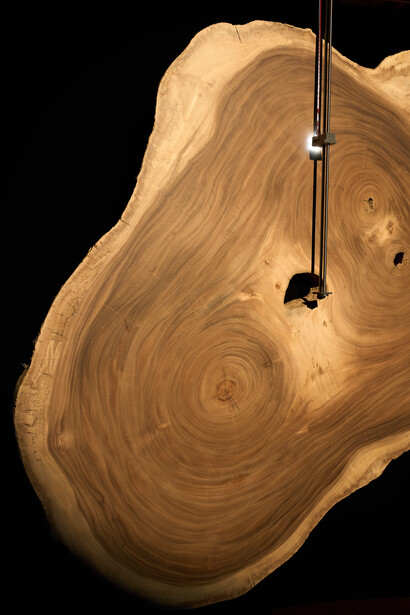
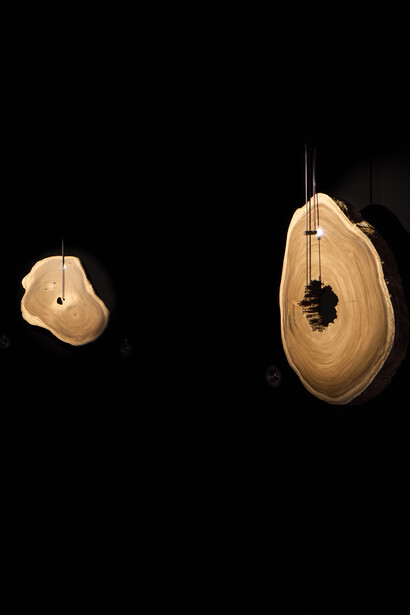
The series of sound sculptures Archaeology of the Sky (2024–2026) is part of a body of work that emerges from listening to the passage of time in trees. In the gallery, large cross sections of reclaimed wood—sourced from samane trees in the foothills of the Magdalena Medio region—are suspended and in constant rotation, evoking vinyl records or the hands of a clock. A light sensor scans the surface of each tree and records the color variations in the trees’ growth rings. Through software developed by the artist, these chromatic variations in the wood create a real-time melody that makes audible the passage of time and the environmental transformations these trees experienced during their lives.
The sculptures, set against a wall painted a shade of black that absorbs light intensely, invite us to reflect on the fact that there is never absolute silence or absence. Against this backdrop—which prevents the scattering of light and, consequently, the formation of images—a distant ambient sound can be heard. The tree trunks, rotating on their own axes, gradually reveal the spiral-like passage of time within the tree; when translated into sounds, this reminds us of the persistence of the vital pulse sustained by these trees even beyond the end of their lives.
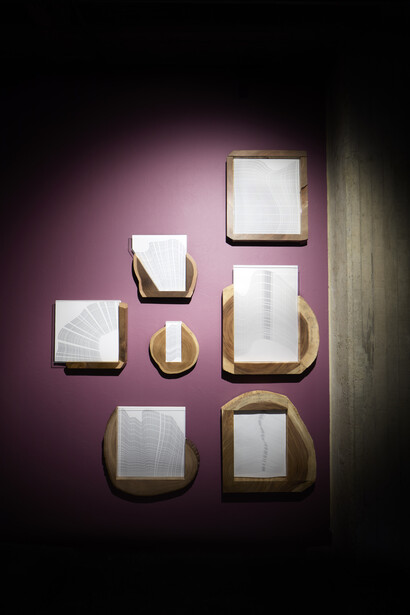
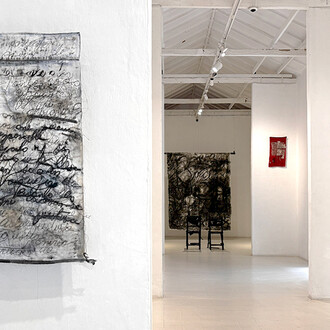
In the series Climatic Frames (2025–2026), the artist transforms the frame into the central element of the work. Constructed from various species of tropical wood, these frames incorporate sections of trees whose central growth rings have been extracted and translated into a set of lines of text that fill the void left in the tree. In this way, Macía creates poems with a kinetic quality, incorporating fragments of growth rings, climate data, and solar activity, based on the research of Jorge Andrés Giraldo (also the author of this text), who has studied numerous species capable of providing reliable chronologies to establish the relationship between climate and tree growth in tropical forests. In this way, the work succeeds in articulating the record of growth through formal transitions between matter, drawing, and the word.
In these pieces, wood ceases to be merely the material surrounding the work, transforming the frame into an archive, an image, and a narrative—a narrative that highlights environmental conditions as fundamental vectors in the relationships that accompany and transform the lives of trees.
(Text by Jorge Giraldo and Juliana Steiner Fraser)