English
 Español
 Français
 Deutsch
 Italiano
 Português
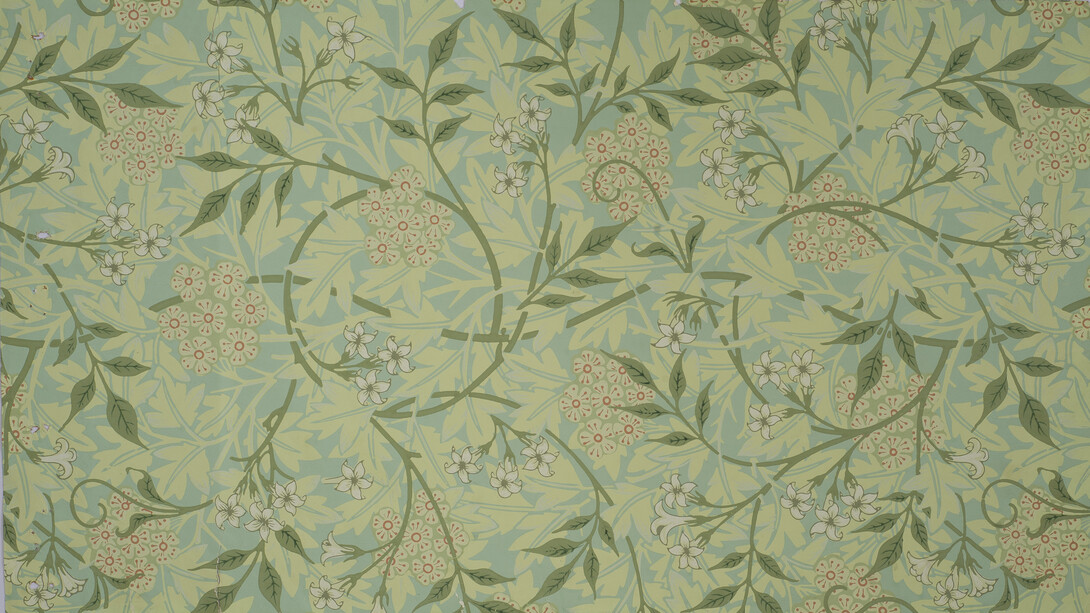
At a time when the language of sustainability, ethical production and ecological responsibility has become central to contemporary cultural debate, A call to art: William Morris and the Pre-Raphaelites arrives at the Fitzwilliam Museum in Cambridge with an almost uncanny sense of relevance. Yet this is not an exhibition that simply attempts to make nineteenth-century art speak to the present. Its greater achievement lies in showing that the questions we consider urgent today were already being articulated, with remarkable intensity, by William Morris and the artistic circle around him.
Running from 23 October 2026 to 3 May 2027, the exhibition brings together paintings, drawings, textiles, ceramics and books, including rarely seen works from the Fitzwilliam's own collection. More importantly, however, it proposes a reconsideration of Morris not merely as a designer of instantly recognisable patterns, but as a radical thinker who regarded art as a potential instrument for changing the conditions of everyday life.
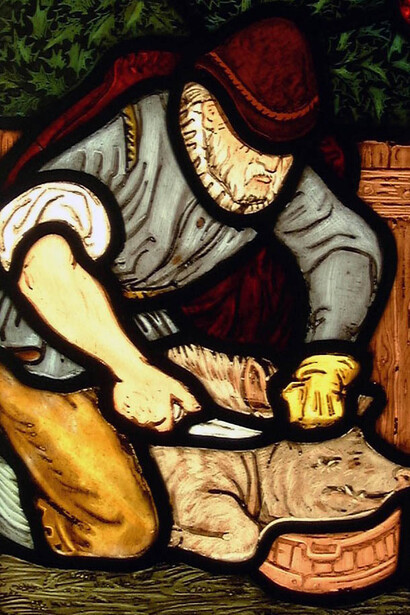
The title, A call to art, is therefore deliberately active. It does not describe art as something to be contemplated from a distance, but as a summons: an invitation to reconsider how we live, make, consume and inhabit the world. This is perhaps the most compelling aspect of the exhibition. Morris's flowers, vines, medieval figures and elaborate surfaces are not presented as decorative solutions detached from history. They become the visible expression of a much larger intellectual and political project.
The exhibition opens the door to that project by placing Morris within a constellation of artists and makers that includes Dante Gabriel Rossetti, Edward Burne-Jones, Elizabeth Siddal, Kate Faulkner and Morris's daughter May Morris. The effect is significant. Rather than constructing the familiar story of the solitary Victorian genius, the Fitzwilliam emphasises collaboration, exchange and collective imagination.
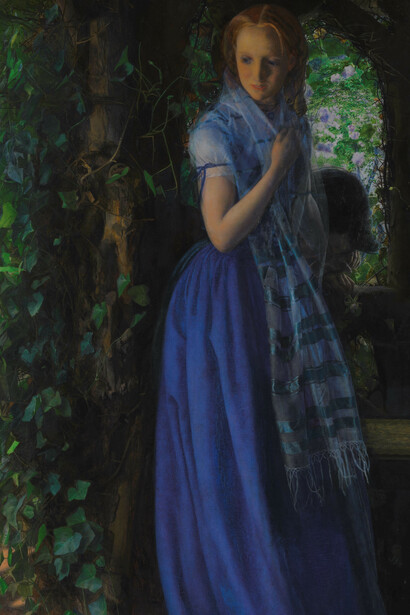
This approach is particularly valuable in the case of the Pre-Raphaelites, whose work has too often been reduced to an aesthetic vocabulary of beautiful women, medieval narratives, luxuriant hair, flowers and saturated colour. The exhibition does not deny the extraordinary visual appeal of this world; instead, it asks us to look through it. Beauty becomes a language through which larger questions can be addressed.
William Morris's La belle iseult of 1858 offers an especially revealing point of departure. The figure's richly patterned clothing, intimate interior and concentrated gaze immediately recall the romantic and medievalising imagination associated with Morris and his circle. Yet the painting also points towards something more personal and psychologically complex: an understanding of beauty as an environment rather than merely an image.
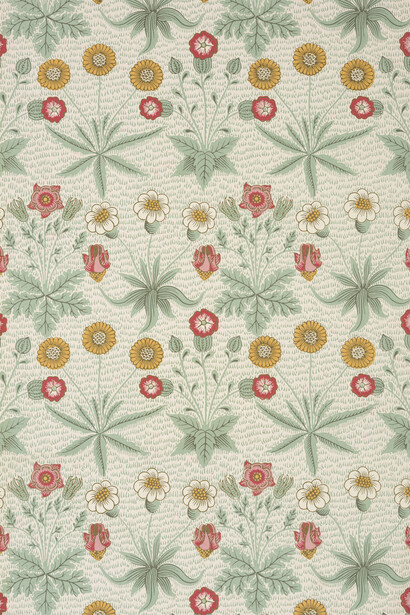
This idea of environment is crucial. Morris's revolution was never confined to the canvas. He wanted art to enter domestic life, to transform the objects people touched, the rooms they inhabited and the rhythms of their everyday existence. Wallpaper, textiles, furniture, books and ceramics could all become vehicles for an alternative aesthetic philosophy. The famous Morris pattern is therefore not simply a motif; it is part of an attempt to abolish the hierarchy between "high" and "low" art.
The presence of May Morris is consequently particularly important. Her work and contribution complicate the conventional Morris narrative and remind us that the Arts and Crafts movement was sustained by a much broader network of designers and makers. Her Honeysuckle wallpaper, designed in 1883, demonstrates how botanical forms could be transformed into an ornamental language that is at once disciplined and exuberant.
Nature, throughout the exhibition, is never merely picturesque. It represents an alternative system of values. Against industrialisation, pollution and mass production, Morris imagined a world in which making could once again be connected to human pleasure, craftsmanship and the rhythms of the natural environment. The Fitzwilliam makes clear that this was not nostalgia for an idealised medieval past. The past functioned instead as a resource with which to imagine a different future.
That distinction is fundamental. Morris's medievalism was visionary precisely because it was selective and constructive. The Middle Ages he invoked were not necessarily historical realities but an imaginative counter-model to the industrial present. Medieval manuscripts, craftsmanship and communal forms of production offered him a way of questioning the social and economic structures of his own time.
The inclusion of the Pabenham-Clifford hours, an illuminated manuscript dating from around 1315–1320, is therefore especially suggestive. Its presence establishes a dialogue between Morris's nineteenth-century revival of medieval aesthetics and the historical objects that inspired it. The medieval past becomes not an endpoint but a conversation partner.
The same principle operates in the works of Rossetti and Burne-Jones. Rossetti's Helen of Troy (1863), with its intense concentration on the female figure, belongs unmistakably to the Pre-Raphaelite visual universe, while Burne-Jones's Theseus and Ariadne reveals the movement's fascination with myth, narrative and the poetic possibilities of the image. Yet within the exhibition these works acquire a significance that exceeds their individual narratives. They participate in a broader attempt to construct an alternative imaginative world.
This is where A call to art becomes particularly persuasive. It does not ask us to admire the Pre-Raphaelites simply because their art remains beautiful. It asks what beauty might do.
Can beauty challenge industrial logic? Can craftsmanship resist standardisation? Can the objects surrounding us alter our understanding of what a good life might be? Can art contribute to social change?
Morris believed that the answer to these questions could be yes. His famous commitment to art for all was inseparable from his dissatisfaction with a society in which industrial production had separated makers from their work and consumers from the conditions under which objects were produced. The exhibition makes this ethical dimension impossible to overlook.
There is, inevitably, a tension here. Morris's vision of an integrated artistic life was radical, but the exquisite objects associated with him have also become highly desirable commodities. His patterns circulate globally today, often detached from the political convictions that originally animated them. A Call to Art is at its strongest when it encourages visitors to confront precisely this contradiction: what happens when a critique of mass production becomes itself part of the luxury market?
Rather than resolving the paradox, the exhibition leaves it productively open. This is also why the inclusion of Morris's News from nowhere, printed at the Kelmscott Press in 1892, is so important. The book embodies the convergence of literature, typography, illustration and craft that Morris regarded as essential to a complete artistic experience. Art does not occupy a separate category here. It becomes part of a total vision of life.
In this respect, the exhibition offers a surprisingly contemporary proposition. We increasingly speak of interdisciplinarity, immersive experience, sustainable design and the relationship between artistic practice and social responsibility. Morris was already thinking across these boundaries. His achievement was not simply to create beautiful things, but to challenge the assumption that beauty and utility, art and politics, individual pleasure and collective responsibility belonged to separate worlds.
The Fitzwilliam's curatorial strategy succeeds because it restores this complexity without sacrificing visual pleasure. There is plenty here to admire: the colour, craftsmanship, ornament and dreamlike intensity of the Pre-Raphaelite imagination. But the exhibition refuses to let beauty become an alibi for disengagement. Instead, beauty is treated as a form of intellectual provocation.
Perhaps that is the exhibition's most important lesson. Morris's legacy does not require us to reproduce his medieval fantasies or his particular aesthetic vocabulary. What remains provocative is his conviction that the way we make things is inseparable from the way we imagine society. The objects around us are never neutral. They express values, economic systems, relationships with nature and ideas about human dignity.
A call to art ultimately asks visitors to reconsider what art is for. Its answer is ambitious: art can make us see differently, and seeing differently can become the beginning of living differently. The call is still being made.