English
 Español
 Français
 Deutsch
 Italiano
 Português
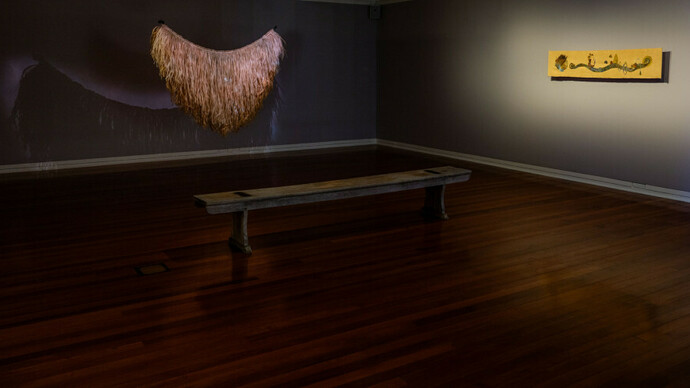
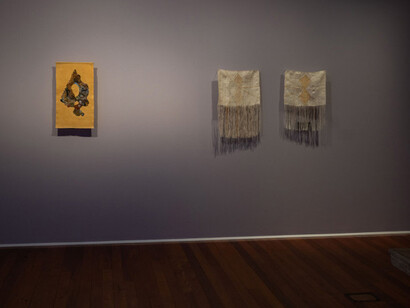
Every thread, fibre and stitch in this gallery is a gesture of love and of resistance. Hand-woven textiles have been dyed with whenua pigments to create the kaupapa, or base, for embroidered compositions. Works made from muka and houhere centre traditional materials valued for both strength and beauty, with Georgina May Young (Te Ūpokorehe, Te Whakatōhea, Irish, Scottish) bringing her own form and expression to mātauranga that has been passed down and cared for through generations. Across I rongo i tō tohu – Heard your message, Young employs materials and processes that depend on connections to flourish, including gathering mānono with her tama and the koha of pounamu collected and carved by her partner. Weaving, embroidery and raranga are all practices that rely on people sharing time, knowledge and experience in order to build a strong foundation. Young is interested in how these reciprocal processes create spaces for community, while resisting current social and economic systems that cultivate disconnection. She has described her approach as one of defiance that arrives softly, ‘A refusal of greed that takes without returning. A commitment to gentleness as a form of strength, to attentiveness as a form of care, to love as a practice of protection.’
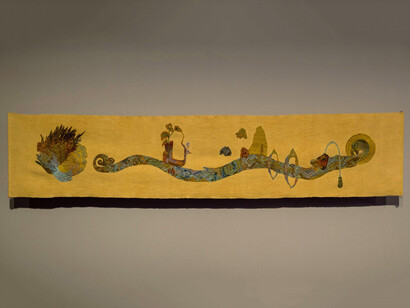
Young was born in Ōpōtiki in the Eastern Bay of Plenty. This is her turangawaewae, the ancestral home of her Te Ūpokorehe and Whakatōhea tūpuna, and the place to which her Irish ancestors settled. In I rongo i tō tohu this whenua is literally embedded into works through uku, the clay used to dye some of Young’s handwoven textiles, which she collected from Ōhiwa, near Ōpōtiki, with her father. Her whakapapa and that of her family is threaded into the stitches of Paringa - the incoming tide (2026). This work unfolds as a whānau portrait that travels across time and place, stretching from the East Coast of Te Ika a Māui to Te Tai Poutini, the turangawaewae of her tau o te ate (darling), to finally land here on Te Tai o Āraiteuru and her home of Ōtepoti Dunedin. Waharua (2026) presents another exchange, the aho and whatu coming together into rhythms and tohu that echo the flow of conversations through time shared while busy hands are working.
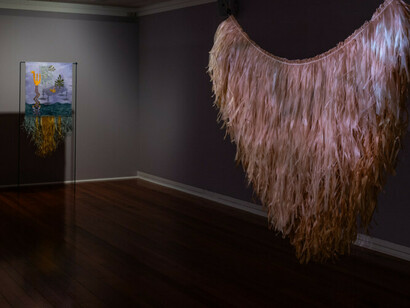
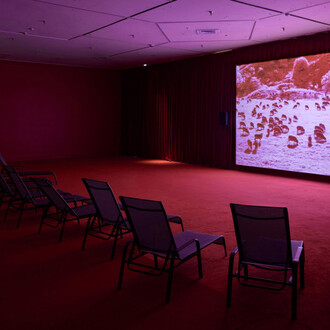
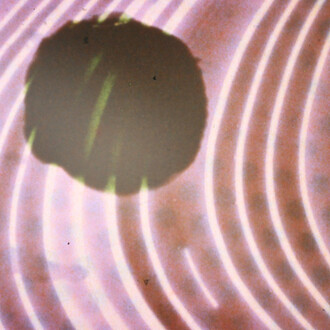
I rongo i tō tohu celebrates the relationships between ecosystems, people and the seen and unseen forces that sustain life. Kārohirohi – meet you at the awa (2026) and Ara Manawa (2025) layer together taonga materials such as houhere, muka, and mānono, all of which require specialist understanding of cycles of growth and harvesting to prepare for weaving. Sound and moving image of glistening wai create an immersive encounter, gently breaking down the separation between the gallery and te taiao. As Young reflects, ‘working with my whānau, seasons, and the maramataka offers a different relationship to time; a slowing that resists the demands of haste, extraction, and endless productivity.’ Her deepening understanding brings appreciation for the capacities of these materials, which ranges from rongoā and medicinal uses, to practical bindings and lashings, to fine adornments. Young’s works in this exhibition attend to both the softness and strength of her materials, and whānau pūrākau. They are a reflection of her commitment to the taonga that have been passed to her, which she in-turn upholds for those who will follow.