English
 Español
 Français
 Deutsch
 Italiano
 Português
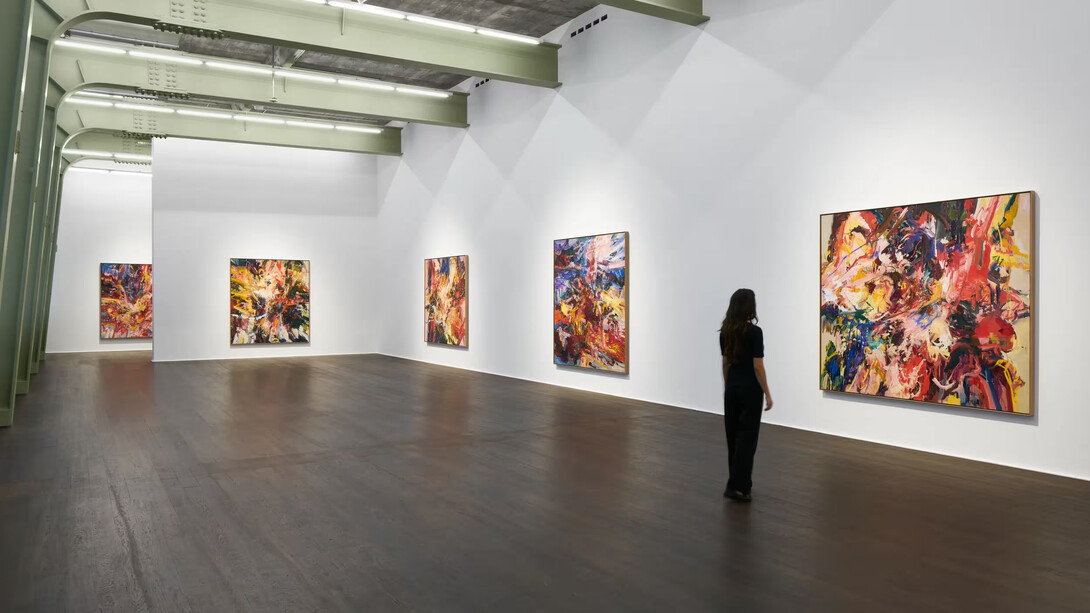
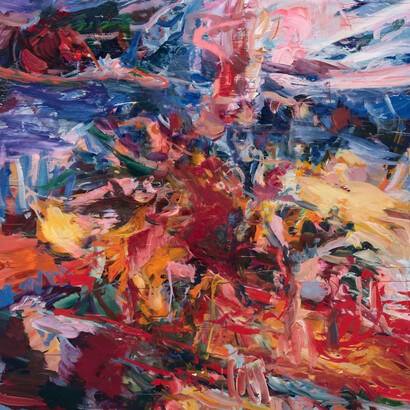
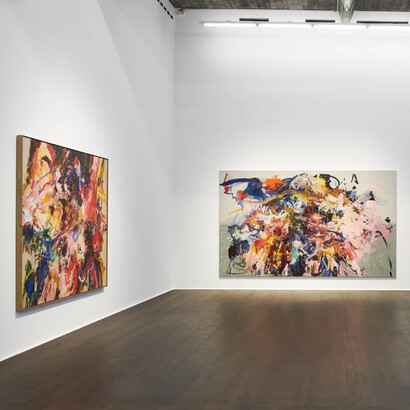
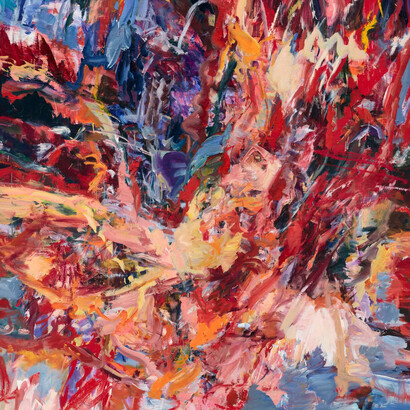
For more than four decades, Catherine Goodman CBE has developed a unique visual language that communicates a powerful visionary response to her lived experience and memory. In this new body of work, presented in the exhibition The colour of a quiet mind…, Goodman combines strongly pigmented oil paint, expressive brushwork, oil sticks, drips and washes to create immersive abstract paintings. At the heart of this new body of work lies an exploration of paradox: how painting can hold both quietness and turbulence. Created during a period marked by profound personal loss and illness, as well as a wider backdrop of war and political instability, the paintings reflect Goodman’s search for enduring, memorable images that acknowledge the fragility of the world while remaining open to joy, kindness and renewal.
Long associated with figurative painting, Goodman has in recent years embraced abstraction as a way of exploring memory, perception and experience. Her paintings emerge from a wellspring of resources: fragments of conversation, fleeting observations, landscapes, changing seasons and a broad spectrum of artistic and cultural influences across art history, film and music. References to birds, horses, portraits and landscapes surface throughout the exhibition, moving between the emotional terrain of the artist’s childhood and the realities of the present moment. Central to the exhibition is the new large-scale diptych Jokerman (2026) named after the artist’s favourite Bob Dylan’s song of the same title, an omnipresent and disruptive presence that emerges against quieter themes. The Jokerman embodies the unpredictability that Goodman has encountered both in life and in the studio, while the works affirm painting as a means of navigating uncertainty and finding moments of stillness within upheaval.
Poetry has long played a vital role in Goodman’s creative process. The artist often begins each day by reading a poem, describing poetry as a ‘visual portal’ that opens the imagination and allows her to encounter a subject afresh: ‘[Rainer Maria] Rilke takes me into the landscape I am working from as though I were seeing it for the first time.’ Two paintings, Say to the silent Earth: I flow (2026) and To the rushing water, speak: I am (2026) take their titles from the concluding lines of Rilke’s poem Let this darkness be a bell tower, a meditation on transforming suffering into resilience and meaning. A further suite of four paintings draws upon the writings of the 13th-century Dominican theologian and philosopher Meister Eckhart, whose reflections on mystical simplicity have long been a touchstone for the artist.
Through abstraction Goodman reflects a growing interest in uncertainty. As she explains, ‘Abstraction allows me to explore more freely and intuitively without having to come back to an image that needs to be recognisable. It’s how we interact with the world, with our interior and exterior lives, and how memory affects perception.’ The colour of a quiet mind… reveals an artist continually expanding the possibilities of what a painting can hold and the paradoxes within: memory and presence, disorder and calm, vulnerability and hope.