English
 Español
 Français
 Deutsch
 Italiano
 Português
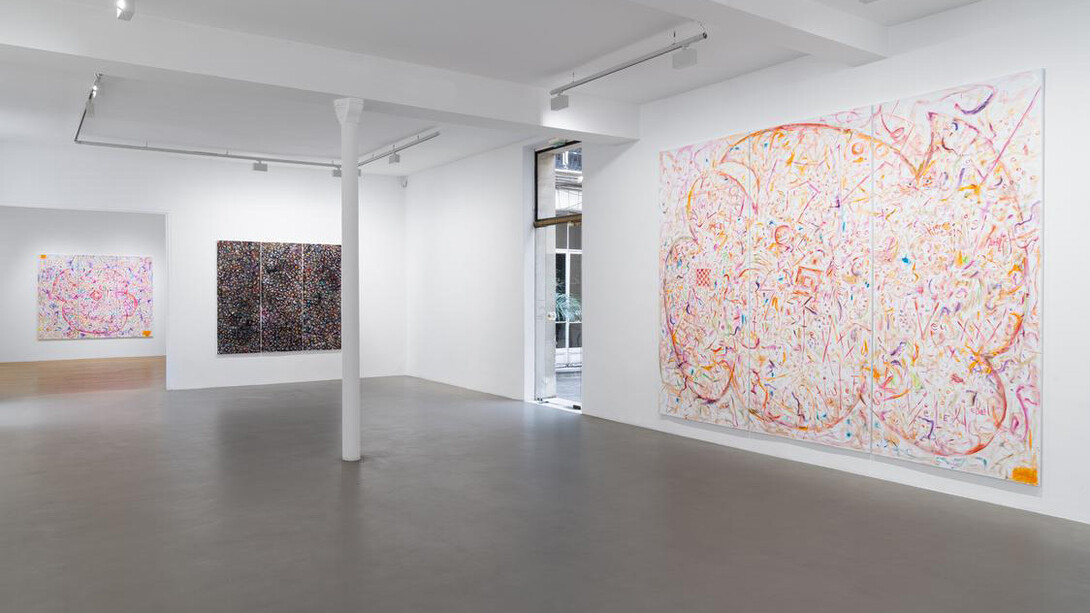
ŒuVreS réCEnteS is Jutta Koether’s first solo exhibition at Galerie Chantal Crousel. Bringing together a new body of work, the exhibition marks a return to Paris, where she lived for a few months in the early 1990s, and revisits some of the artistic and literary references that have shaped her practice.
Throughout her practice, Jutta Koether draws on a wide range of references from the history of painting, revisiting the work of artists such as Cy Twombly, Frank Auerbach, Cézanne, and Alberto Giacometti, among others. Appropriation is not simply a quotation or an homage to the past, but a strategy through which images from different periods and seemingly incompatible sources are brought into contact. Through this process, the history of painting is conceived not as a fixed legacy to be preserved, but as a living field that can be questioned, transformed, and expanded.
Created to be experienced in person, the works reveal themselves gradually. The eye wanders across their surfaces, catches a fragment of writing, follows a detail, and makes unexpected connections. Literary references, musical associations, and photographic images emerge and intertwine, creating multiple paths through the paintings. Looking becomes, in the artist’s words, a sort of “Spiritual Hunt,” echoing the title of an apocryphal text attributed to Rimbaud. The diptych and triptych formats allow these relationships to unfold like a musical composition, with images resonating from one panel to the next.
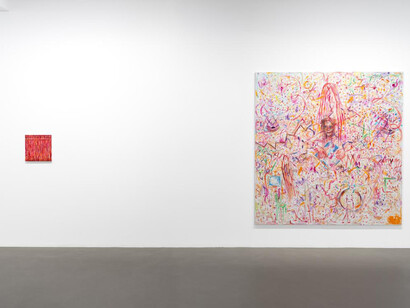
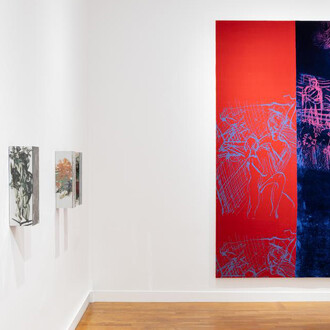
WiCkeD ChArM, the large painting that welcomes visitors at the entrance, brings together many of these concerns, functioning as a kind of methodological manifesto. An androgynous figure with blue eyes emerges from an intricate field of gestures, red and pink hues, fragments of writing, ribbons, apples, and flowers. The painting brings two seemingly distant images into contact: a self-portrait by Francesca Woodman, in which the artist sits on a chair with her face hidden beneath her long hair and a mirror between her legs, and a portrait of Arthur Rimbaud by Frank Auerbach. Neither remains fully recognisable; both persist beneath the layers of paint and writing, transformed yet still perceptible. Nearby, the painting HoLDiNg featuring a red curtain—a recurring motif in Koether’s work since 1987—introduces another dimension to this exploration of painting, evoking the conditions of painting itself: a surface that both reveals and conceals, opening onto the possibility of an image while withholding its full disclosure.
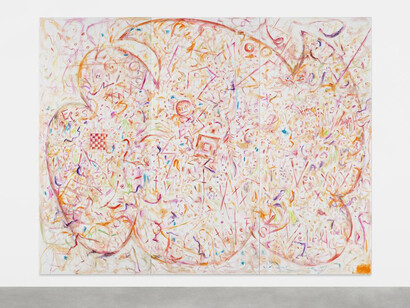
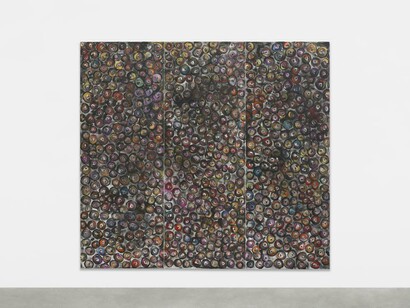
The inscription “Chair de fleur,” which appears in WiCkeD ChArM and other works, evokes Rimbaud’s intertwining of nature, sensuality, and the body, notably in Soleil et chair and Les réparties de Nina. Throughout the exhibition, desire takes shape through the interplay of bodies, words and colors. The recurring reds and pinks intensify this sensuous atmosphere, while flowers become a central motif in the large triptychs ChAiR dE fLEuR and NoURiR sA ViE, both dominated by the form of a gigantic bloom. Sensual and almost overwhelming, they turn desire into a force that expands across the canvas without ever settling into a fixed form. Their exuberance is counterpointed by a small, black, flower-shaped painting, whose densely layered and shining surface extends Koether’s exploration of black as an expressive force, developed across a broader body of work over the years. Rather than suggesting an absence, black becomes a space of intensity, drawing attention to the material presence of the work and to the physical act of painting itself. The apple is another recurring motif, associated with desire and temptation. In the exhibition, apples multiply across the triptych trAnSBoRDeUSeS. Drawing on art-historical references, including Cézanne’s still lifes and an early painting by Alberto Giacometti depicting apples arranged on a stool, the fruit shifts from an isolated object into a recurring pictorial element. The “Pink Lady” becomes a point around which meanings accumulate and disperse; repeated across the surface, the apple takes on a rhythmic quality, almost like a musical note.
The fruit of temptation reappears in AmOuR dE loiN, punctuating the curtain that hangs above an elongated male figure reclining in repose. The painting draws on a photograph of Pierre Bonnard posing as an odalisque in Henri Matisse’s studio in Nice in 1929. By reworking this image, the painting shifts the gender conventions of the female odalisque, a figure long associated with the Orientalist tradition in Western art. The reclining figure, which also evokes the iconography of the Deposition, introduces a note of vulnerability into this sensual scene.
Words recur across the surfaces of the paintings, functioning simultaneously as carriers of meaning and as visual gestures. “Art Lives On,” an inscription appearing in another painting, refers to the slogan that greets visitors at the entrance to the Metropolitan Museum of Art, which Jutta Koether has visited week after week over the years, encountering the same paintings from ever-changing perspectives. In ŒuVreS réCEnteS, the phrase becomes an affirmation of the capacity of images to outlive their makers, travel across periods and contexts, and return in transformed forms. The history of art remains open, changing with every encounter and every new way of looking. Perhaps this is what these paintings ultimately ask of us: not to decipher them, but to keep moving, following unexpected connections and allowing meanings to emerge along the way.