English
 Español
 Français
 Deutsch
 Italiano
 Português
Galerie Max Hetzler, Paris, is pleased to present Les fous d’en face, a new exhibition by Elmgreen & Dragset. Coinciding with Art Basel Paris, this is the artist duo’s second solo exhibition with the gallery, and their first in the Paris space.
For Les fous d’en face, Elmgreen & Dragset occupy Galerie Max Hetzler’s two spaces at 46 & 57 rue du Temple. Translating to The fools on the other side, the exhibition presents three new installations which build on some of the central elements in the artists’ practice, from absurdist humour and spatial subversion to open-ended narratives. The exhibition is in part underpinned by reflections on the artists’ own past. Through displacement, the objects on display draw attention to agencies embedded in situations and memories that both define the extraordinary and the familiar, the extreme and the mundane.
Les fous d’en face brings together three distinct approaches to sculpture which are integral to Elmgreen & Dragset’s working method: the hyperreal, the recontextualised, and the readymade. Their first installation, How to become an artist, presents a red-gloved, young skinny boxer in a full-scale boxing ring. Lit by a circular spotlight, as if he were a solo actor on a theatre stage, he leans on the ring ropes in a state of exhaustion. His opponent is nowhere to be seen. The hyperrealistic figure offers a depiction of Michael Elmgreen as a young man, instilling this staged scene with a highly personal dimension. Presented in this light, the lonely, weary boxer calls into question what kind of fight he might have had and with whom, if any counterpart at all. The viewer is left to contemplate this fragile moment of existential uncertainty.
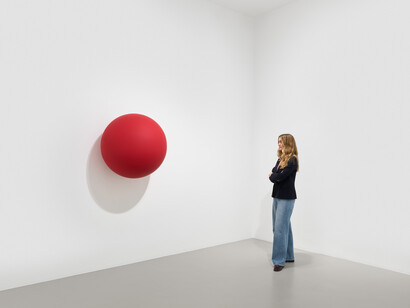
For their second installation, Elmgreen & Dragset present The optimist, a large, red sphere, centrally positioned on the white gallery wall. With its sleek, minimalist structure, the object is in fact an oversized replica of a clown nose, cast in steel. Undercut by an audio clip of applause emanating from an old radio, the white wall itself seems to become the colossal face of a clown. Since the 1990s, Elmgreen & Dragset have used the white cube as a sculptural element, exemplified by their ‘Powerless structures’ series. However, this work again interweaves an element of self-portraiture: Ingar Dragset, before becoming a visual artist, attended The Commedia School in Copenhagen in the early ’90s, where clown studies were a formative part of the curriculum.
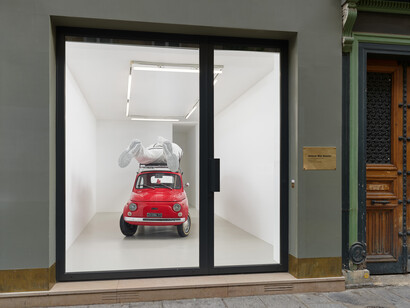
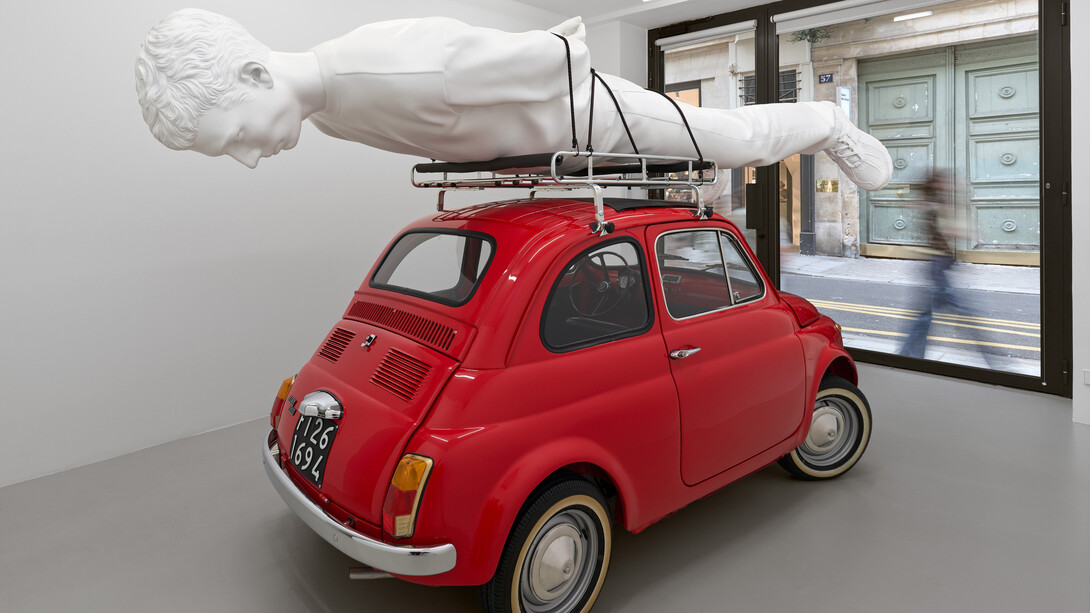
The final installation, titled Il mio giardino, features a monumental, monochrome figurative sculpture strapped onto the roof of an old-school Fiat 500. Comically large, the white sculpture looms over the red vintage car, creating a surreal, physical tension between the two representations – human versus machine. The forcefully reclining male figure is rendered bound and helpless despite its imposing scale. Two miniature red boxing gloves dangle from the rear-view mirror, evoking the boxer across the street. Much like the figure itself, the narrative remains in suspension, inviting speculation on the unknown ‘before’ and ‘after’ of the scene. Is the sculpture being delivered somewhere, or is this perhaps a heist? Across all three installations, the viewer becomes an active and integral participant, left to decipher who, exactly, Les fous d’en face might be.