English
 Español
 Français
 Deutsch
 Italiano
 Português
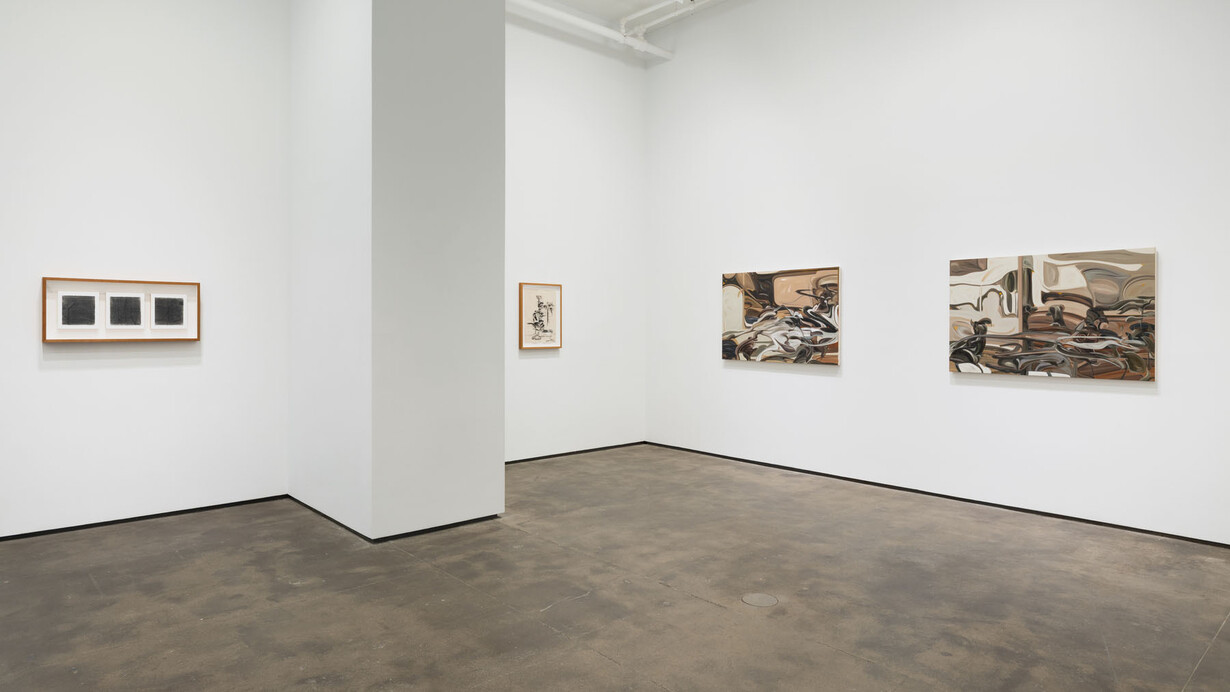
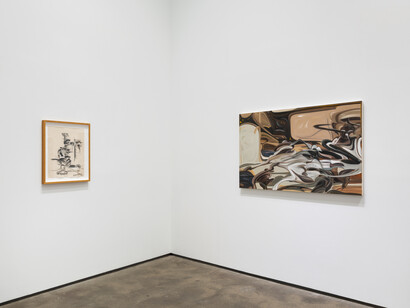
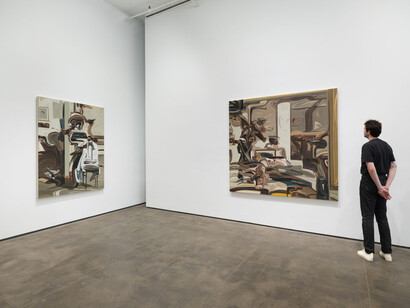
Sean Kelly is delighted to present When the center holds, Nigerian artist Luke Agada’s first solo exhibition with the gallery. Bringing together a new body of paintings and drawings, the exhibition explores how meaning and belonging persist during periods of profound historical and cultural transformation.
I’m not necessarily reffering to a fixed political, geographical, or institutional center, rather thinking about something more relational, and the things that make the center to endure can be things that help us to make meaning in periods of instability or when the structures around us have become unstable.
(Luke Agada)
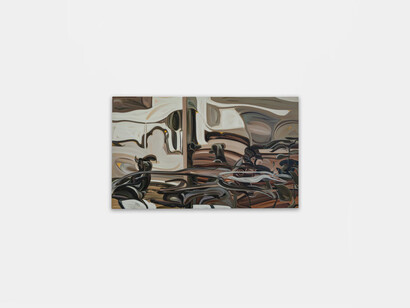
Agada’s practice investigates the changing nature of contemporary identity through the lens of globalization, migration, and postcolonial thought. His enigmatic compositions feature incorporeal figures, fragmented architectures, and biomorphic forms that inhabit dreamlike landscapes untethered to a fixed geography. Existing between memory and imagination, these hybrid forms embody identities continually shaped through movement across histories, cultures, and systems of power.
I find ways to collaborate with the material of paint itself and consider what’s going on between the figure and the space around it. I begin by using recognizable elements and gradually allow it to transform, to stretch, to metamorphose and to overlap one another until meaning becomes more complex.
(Luke Agada)
Playing off William Butler Yeats’ poem, The second coming, which contains the phrase, “the center will not hold,” Agada reimagines the darkness of that text in a more optimistic light. Rather than understanding the center as a site of fixed authority, Agada proposes it as a continually negotiated space where memory resists erasure, identity survives translation, and belonging is sustained despite displacement. His paintings occupy the intervals in which transformation unfolds, presenting suspension not as paralysis but as a condition of becoming.
Bodies dissolve into fluid architectures and landscapes that resist permanence. Fragmented forms merge and separate, suggesting that identity is not recovered, but continually composed through adaptation and relation. These psychologically charged environments resist fixed interpretation, instead inhabiting ambiguity as a space where continuity is actively constructed rather than inherited.
When the center holds reflects on quieter forms of endurance. The exhibition proposes that coherence is not a given, but something continually assembled through memory, imagination, and connection. In Agada’s work, painting becomes a space where uncertainty is neither resolved, nor escaped, but inhabited with openness and resilience, offering a timely meditation on how we sustain meaning in an increasingly fractured world.
We retain the capacity to remember, and to imagine, and to relate to one another, to continually compose new forms of meaning and belonging.
(Luke Agada)