English
 Español
 Français
 Deutsch
 Italiano
 Português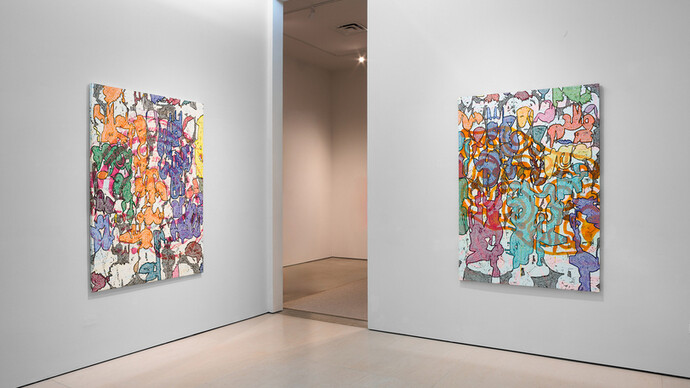
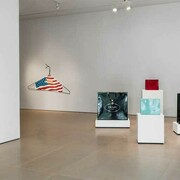
McClain Gallery is pleased to present our fifth solo exhibition with New York-based artist Bo Joseph titled Daedalus ciphers, featuring a new body of paintings of the same name. Throughout his career, Joseph has drawn from the structures embedded in cultural imagery such as African ritual objects, Islamic ornament, and European antiquities, among others. Daedalus ciphers introduces a source into the artist's work—the labyrinth—to extend a line of inquiry that has run through his practice for over two decades: how cultural imagery encodes power, and how that encoding can be dismantled, layered, and reconciled through process-based abstraction.
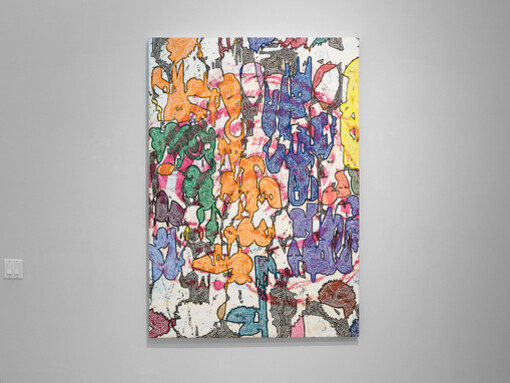
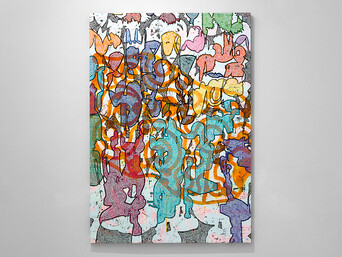
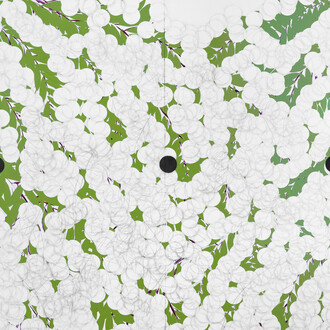
Daedalus ciphers reflects both the making and the encrypting of the labyrinth. As the artist explains, "the title carries this duality. Daedalus, in Greek mythology, was the designer of the labyrinth. The cipher names what a labyrinth actually does: it encodes." Joseph entices and lures the viewer into these cryptic passages with a deliberately rollicking palette. The artist layers radiating, concentric oil-stick lines on top of a washed tempera ground, lending a pastel tone to the background. The labyrinth is novel in concept but also in its medium. Joseph renders it by applying acrylic in wet layers, thick brushstrokes, and marbled drips of paint. The interplay between media is clearest in Daedalus cipher no. 3, where remnants of a yellow-hued structure peek out from behind a marigold-colored maze. That charged undercurrent interacts with the figures and forms in the foreground, leading viewers to lose touch with depth and distance as the garden grows rhythmically. "The two registers function as a counterpoint to each other," the artist notes, a combination he describes as "a dark premise carried by a carnivalesque tease, drawing the viewer into the encoded space."
Bo Joseph has always acknowledged the role that found imagery plays in his process-based abstraction. The labyrinth forms in these paintings originate in 17th century French and English landscape plans found in vintage books on garden design. When layered beneath the skein of interwoven mask-like forms, the labyrinths begin to evoke other traditions: the scrolling vines of Islamic tile and pottery, the inlaid vine work of Indian marble, the historical Tree of Life textiles that appear from Medieval Europe to Safavid Persia.
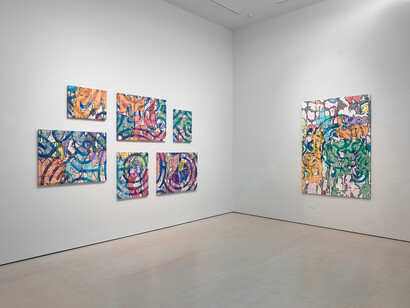
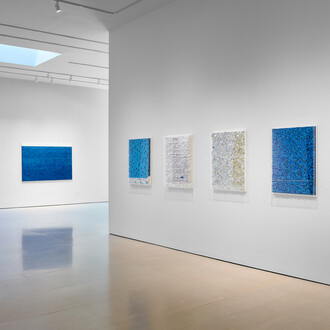
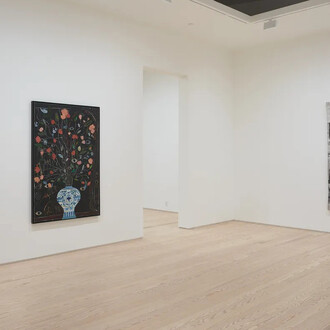
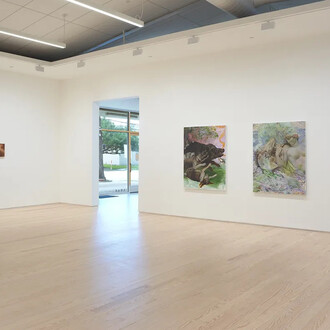
The nine paintings in this grouping form a cohesive statement with each work meant to interact with the next, amplifying the intricacy and intensity of the one beside it. The six smaller works in the show reference the historical academies of Europe with a salon-style arrangement and correlate with each other with a composition that extends across the group. In the same way, Joseph hopes to open the formal garden and the labyrinth, as artifacts, "to a wider visual lineage," embracing the possibilities of fragmentation. Hung together, the nine paintings cohere without hardening—a labyrinth seen from above, whole and fragmentary at once; or in Joseph's words, "material to be eroded and reconciled rather than erased."