English
 Español
 Français
 Deutsch
 Italiano
 Português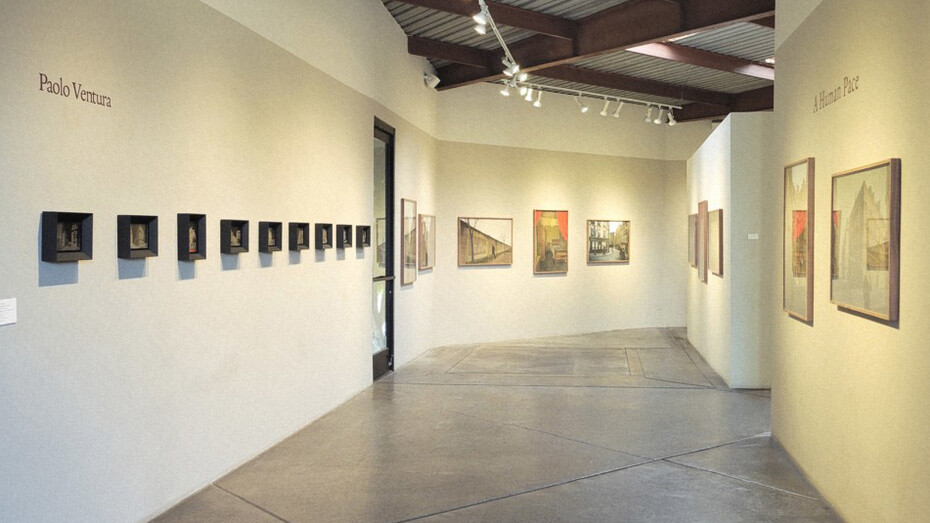
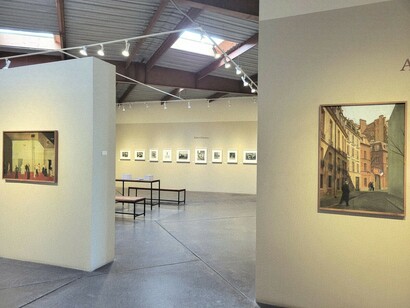
Galerie XII is honored to present this show marking the launch of a collaboration with Peter Fetterman Gallery.
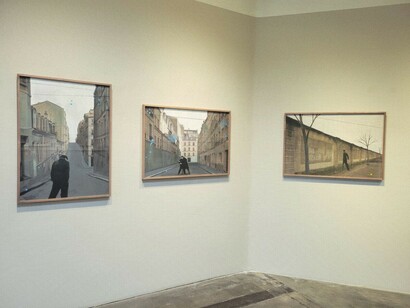
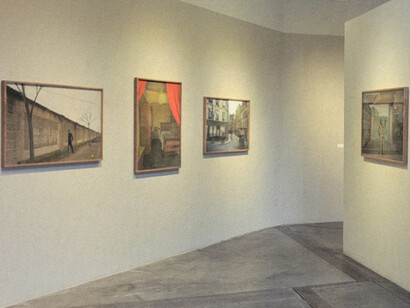
Paolo Ventura envisions Paris as a city suspended between reality and fiction, memory and dream. His Paris is timeless and melancholic: a stage of deserted streets, shadowy figures, secret lives, and chance encounters, where the ordinary becomes magical and the night opens the door to imagination.
Le passe-muraille is perhaps Ventura's most explicitly Parisian project because it uses Marcel Aymé's beloved 1943 story as a gateway into the city's mythology. Rather than illustrating the text literally, Ventura recreates a Paris of memory and imagination, centered on Montmartre and the figure of a modest man endowed with the supernatural ability to walk through walls. What fascinates Ventura is not so much the fantasy itself as the perspective it offers on the city.
In visual terms, Ventura reconstructs a mid-century Paris that feels familiar yet unreal. Through a combination of photography, painting, collage, drawing, paper models, and theatrical staging, he creates what he often calls invented worlds. The result is not documentary Paris but a psychological Paris, suspended outside time, where memory is more important than historical accuracy.
A key aspect of the series is its atmosphere. The Passe-Muraille is a dreamer who traverses the city unnoticed. Ventura's Paris is seen through the eyes of someone who wanders at night, gazing into illuminated windows and imagining the lives unfolding behind them. This transforms the city into a theater of possibilities where every façade conceals a story.
Initially inspired by a project to be exhibited at the Rotonde Balzac in Paris, Promenades de nuit follows up Milano proiezioni astratte.
Architecture itself becomes the protagonist. Empty streets, apartment buildings, and geometric urban forms evoke the same sense of silence and introspection found in Le PasseMuraille, but through space rather than narrative.
By using the nineteenth-century tintype process, Paolo Ventura infuses Promenades de nuit with a sense of timelessness. The unique metal plates, marked by subtle imperfections and rich tonal depth, transform his visions of Paris into fragile apparitions suspended between photography, memory, and dream.
Robert Doisneau possessed a remarkable gift for finding poetry in ordinary life. With warmth, wit, and endless curiosity, he wandered the streets of Paris for more than five decades, discovering moments that revealed the humor, tenderness, and humanity of everyday existence. His photographs remind us that life’s greatest moments are often the ones we never expect.
As Doisneau once remarked, “The marvels of daily life are exciting; no movie director can arrange the unexpected that you find in the street.” That openness to chance be-came the defining characteristic of his work. Although many know him for a handful of iconic photographs, it is the consistency of his vision and his remarkable ability to recognize beauty, humor, and grace in the seemingly ordinary, that established him as one of the twentieth century’s most beloved photographers.
This exhibition brings together a broad selection of photographs spanning Doisneau’s extraordinary career. Lovers embrace on rainy Parisian streets, children transform sidewalks into playgrounds, loyal dogs patiently accompany their owners, and work-ers, musicians, artists, and strangers all find their place in his unmistakable vision of the world. Together, these photographs reveal an artist whose compassion for humanity was every bit as important as his mastery of the camera.
As Doisneau once remarked, “The marvels of daily life are exciting; no movie director can arrange the unexpected that you find in the street.” That openness to chance became the defining characteristic of his work. Although many know him for a handful of iconic photographs, it is the consistency of his vision and his remarkable ability to recognize beauty, humor, and grace in the seemingly ordinary, that established him as one of the twentieth century’s most beloved photographers.
It is precisely this humanity that makes these photographs feel even more profound today. They were made in a world that moved at a human pace, where curiosity mat-tered more than convenience and the unexpected was welcomed rather than hurried past. While the world has changed, the joy, humor, romance, and generosity of spirit that fill Doisneau’s photographs have not. In an age increasingly shaped by speed and distraction, his work reminds us that the richest moments in life cannot be planned or manufactured. They reveal themselves only to those willing to look.