English
 Español
 Français
 Deutsch
 Italiano
 Português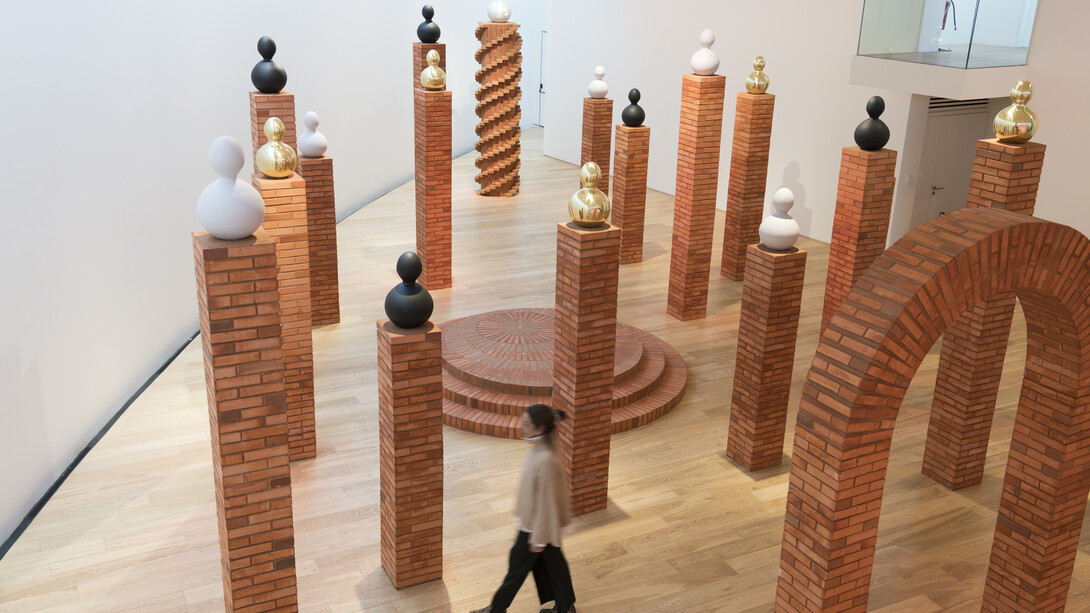
Might it point to an artistic vocation? A rose is a flower but not just any flower, it is synonymous with love and beauty. And when it wilts, with tenderness. Even with its thorns it fills the universe with its scent. And the moon! Hasn’t she been the subject of thousands of poems expressing love? Is there anything lovelier than candombe? Than Carnivale? Than our country?
(Rosa Luna)
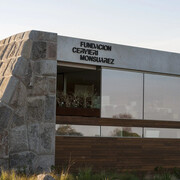
Mônica Ventura approaches this exhibition at the Fundación Cervieri Monsuárez as a crossroads; a point where different aspects of her practice, and perhaps her personality, converge: the history of African diasporas, vernacular construction materials, ritual and spiritual spaces, and the role of black women in society. In the land known as Uruguay, being in one place but coming from another with a different history, Ventura asks the question: does an Afro-Uruguayan community exist? Having received an immediate response in the affirmative, the process of Rosa Luna begins.
The real first step comes with researching the history: the tradition of the carnaval, the construction and subsequent demolition of the Mediomundo slums, the continuous displacements and forced uprootings of the African communities, their prominent place in the local imaginary and how this contrasts with the harrowing reality of historical social erasure. Ventura builds on these foundations to seek out her ancestors; the black women leaders who have been role models in the Afro-Uruguayan community and beyond.
This is where the figure of Rosa Luna; a candombera born in Mediomundo in 1937, emerges. The body-installation that Ventura calls body-architecture pays homage to this iconic carnaval artist who was fundamental in promoting and performing musical traditions and dances of African origin. There is a common denominator between the practices of Rosa Luna and Ventura: to recover their roots, they both found it necessary to create new rituals.
In recent years, Ventura has made large installations at institutions such as Instituto Inhotim (Belo Horizonte) and the Pinacoteca de São Paulo that act as ritual spaces based on vernacular constructions – including compressed earth – presenting viewers with monumental, spiritual encounters. These are the kind of constructions and experiences referred to by other artists from these latitudes such as Joaquín Torres García and Eladio Dieste when they described universal values capable of infusing matter with spirituality: building without forgetting nature and finding in that balance the only legitimate form of permanence.
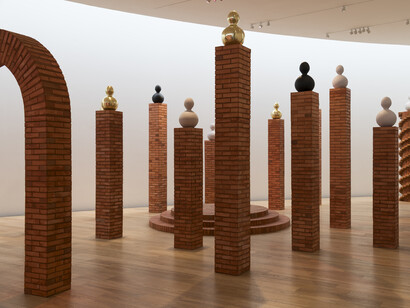
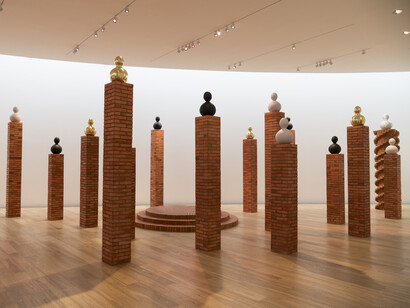
It was after a visit to the Church of Cristo Obrero in Atlántida – Dieste’s largest work – that brick came to be a part of the installation as a construction material from the Uruguayan vernacular. As Dieste put it, “What we do needs to have something that we might call a cosmic economy, being in harmony with the deeper order of the world and only then will it have the authority that so surprises us in the great works of the past.”1 Somewhere between “cosmic economy” and the figure of Rosa Luna, this temple dedicated to the role of black women in Uruguayan society was conceived.
Each of the supporting pillars in the installation represents a woman. The concept is a return to the themes explored in Ventura’s 2022 engraving Pilar in which the figure of the pillar is a metaphor for support and the body. On its capitals – their heads – are placed imaginary squashes. The squash, also known as cuia, igbá or porongo, runs throughout the exhibition as a formal and symbolic thread. Present in different Afro-Indigenous cosmologies as an essential form, in the artworks it is used as a womb, a vessel and a seed.
The sculptures feature clay and metal squashes that lend an intrinsic symbolic value to the themes of the artwork. Throughout history, the squash has accumulated multiple uses and meanings: it is a food but is also used in rituals in African-heritage communities in the Americas. In these ceremonial and devotional practices, it acts as a medicinal vessel, a fertility symbol and a representation of vital mysteries. Known as the “pot of life”, it is believed that they contain the secrets to healing, life and death. In certain spiritual traditions, each person has their own squash which symbolizes their individuality and also acts as their spirit guide.
The squash is also a “container” in the sense used by the writer Ursula K. Le Guin2: a tool with which to string tales together and return energy to the home. The stories that, according to Le Guin, need to be told and celebrated are those that place the focus on the exchange of energy through daily acts of care. We hope that you will find them here.
In the displaced center of the gallery, Ventura has built a space that invites the viewer to observe the greatness of these women/pillars that support us: to feel that universal monumentality, the energy brought home. Contemplation generates an immediate attitude of gratitude and sublimation and also evokes the definition of love as suggested by the cultural critic bell hooks3: the extension of ourselves in order to nourish one’s own spiritual growth or that of another person.
Toward the end of the ritual space is a turned pillar, an unusual figure that acts as a portrait of Rosa Luna. It rises up gleaming over us, giving off an aesthetic power that celebrates her legacy to future generations.
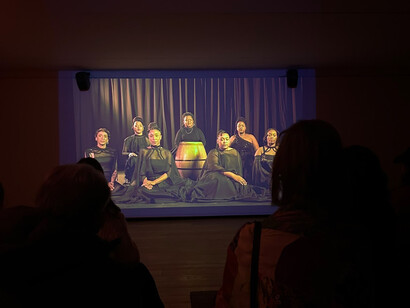
In the Foundation’s second gallery, the exhibition is completed with the video performance piece: Aguas que susurran (Whispering waters, 2026) made by Mônica Ventura in collaboration with Hermosa Intervención – a collective of Afro and indigenous women artists and activists – with the involvement of the activist and singer Chabela Ramírez. The work is also a bridge: an act of connection between the artist from Brazil and the local Afro community. It celebrates song and dance and invokes new rituals that unite the artists with their ancestors and erased histories.
As a whole, the exhibition Rosa Luna establishes a dialogue with the thinking of the Brazilian philosopher Denise Ferreira da Silva and especially her theory of considering difference without separability. Drawing on notions from quantum physics such as no-locality and entanglement, Ferreira da Silva questions the idea of autonomous existence and suggests that we should imagine the world as a network of profound, inseparable relationships. It is from that perspective that Rosa Luna invites us to inhabit the world: recognizing that each body, each story, each material and memory are part of a shared fabric in which supporting and being supported are essentially the same gesture.
(Text by Roxana Fabius)
Notes
1 Dieste, Eladio. “Arquitectura y construcción”
(Architecture and Construction), Eladio Dieste
1943-1996. Métodos de cálculo - Calculation methods,
2001, Consejería de Obras Públicas y Transportes /
Dirección General de Arquitectura y Vivienda /
Junta de Andalucía, p. 232.
2 Le Guin, Ursula K. The carrier bag theory of fiction,
1986.
3 Hooks, bell. 2025. All about love: the deluxe
collector’s edition: new visions. New York: William
Morrow. p. 4.