English
 Español
 Français
 Deutsch
 Italiano
 Português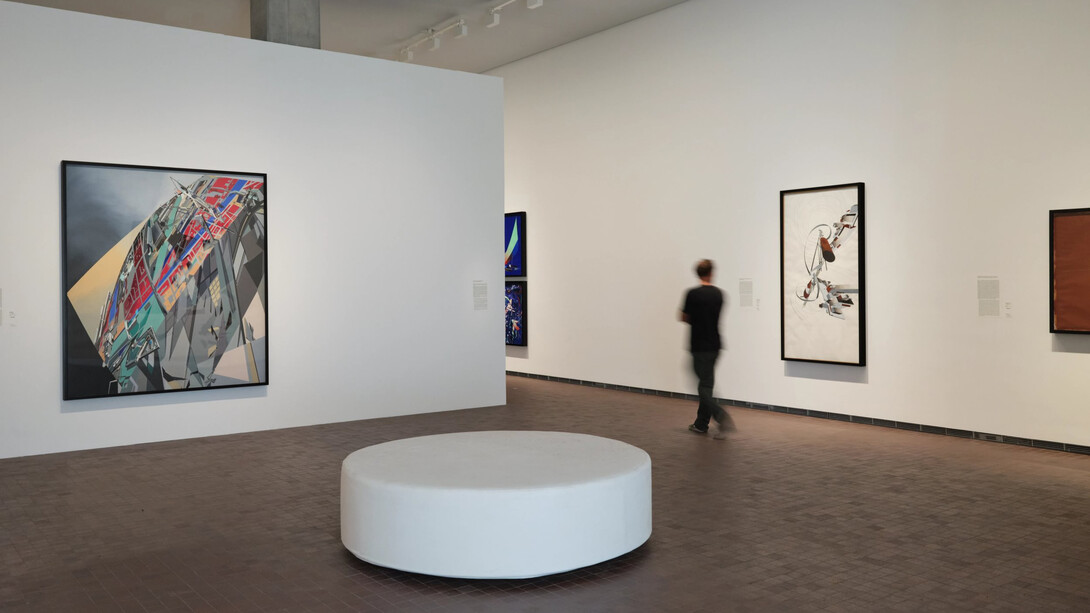
The sixth chapter of the Hans Ulrich Obrist Archives marks the tenth anniversary of Dame Zaha Hadid’s passing (b. October 31, 1950, Baghdad, Iraq–d. March 31, 2016, Miami, Florida).
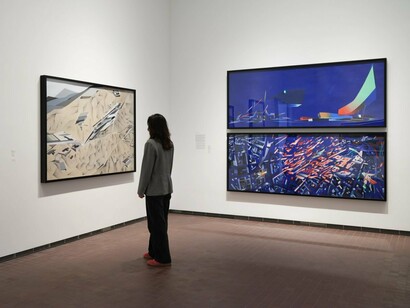
It honors a visionary architect who alters the horizon of contemporary architecture by using abstract painting as a method of spatial invention. Born into a liberal, secular Iraqi family, Hadid studies mathematics at the American University of Beirut before relocating to London to attend the Architectural Association (AA) in 1972. There, in the orbit of Rem Koolhaas and Elia Zenghelis, she explores the aborted, unrealized, or insufficiently tested experiments of Modernism and the Russian avant-garde. Through axonometric projection, multi-perspectival viewpoints, calligraphic line, and acrylic layering, she pushes architecture beyond the inertia of Euclidean geometry long before advanced software can help coordinate such complexity.
This exhibition revisits the long conversation between the curator and the legendary architect, which begins in the late 1990s when Obrist invites Hadid to realize Meshworks within the cycle La ville, le jardin, la mémoire [The city, the garden, the memory] at the Villa Medici in 2000. Across encounters in London, Basel, Munich, and Paris in the early 2000s, that exchange becomes a sustained inquiry into the city, the museum, and the unfinished horizon of twenty-first-century urbanism. Hadid serves as a trustee of the Serpentine from 1996, and she designs its inaugural Pavilion in 2000 upon the invitation of Julia Peyton-Jones. Following Obrist’s appointment at the Serpentine in 2006, she participates in several of its Marathons, returns with her Lilas installation, inaugurated during the 2007 Summer Party, and later Zaha Hadid Architects completes the Serpentine North Gallery and The Magazine, its restaurant (2009–2013).
Among the many awards and honors she receives for expanding the disciplinary language of architecture, from becoming the first woman to win the Pritzker Architecture Prize in 2004 to the Stirling Prize in 2010 and 2011, being made a Dame Commander of the Order of the British Empire in 2012, and the RIBA Royal Gold Medal in 2016, Hadid’s double consecration across the architectural and museum worlds is equally striking. Her projects, installations, paintings, and drawings are the subject of major retrospectives during her lifetime at institutions such as SFMOMA in San Francisco in 1998, MAK in Vienna in 2003, the Solomon R. Guggenheim Museum in New York in 2006, and the State Hermitage Museum in St. Petersburg in 2015. Long before these honors and retrospectives, Hadid spends much of her early career earning a reputation as a paper architect, using the canvas as a laboratory in which architecture tests forms, movements, and worlds it does not yet know how to construct.
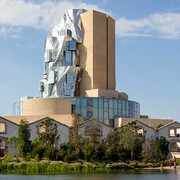
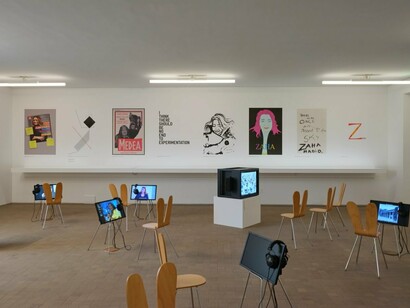
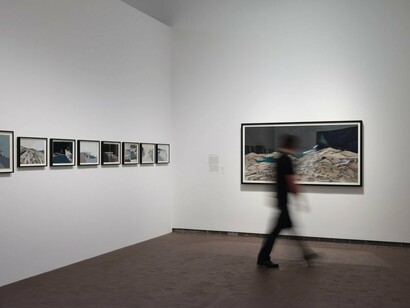
For the first time since the Serpentine’s posthumous exhibition Zaha Hadid: early paintings and drawings in 2016, this landmark LUMA Arles exhibition brings together her early calligraphic paintings and notebooks–exercises in Suprematist geometry that inform her built projects, from her first completed building, the Vitra Fire Station in Weil am Rhein (1988–1993) to the CMA CGM Tower (2004–2011) in Marseille and Pierresvives (2002–2012) in Montpellier. Presented in The Tower in the Parc des Ateliers, designed by the late Frank Gehry, a close friend of Hadid’s, the show spans three interconnected chapters of her career as an architect: from Constructivism to her early projects and reception in the French context, to her longstanding relationship with Obrist. Through paintings, drawings, archival material, hours of previously unseen video interviews from 2001 to 2013, and posters realized by her peers and admirers, the exhibition reveals the full scale of a practice that moved with equal intensity between architecture, art, publication, and discourse, presenting Hadid not just as a builder of monuments, but as a restless philosopher of space.