English
 Español
 Français
 Deutsch
 Italiano
 Português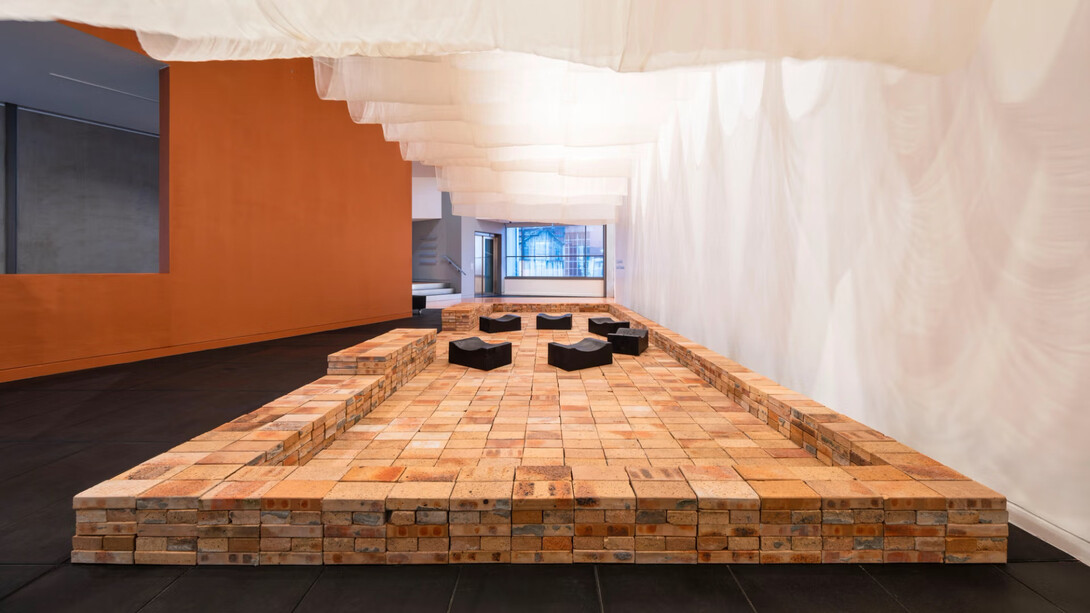
An architectural installation that centres the gathering of people, Elisapeta Hinemoa Heta’s Ua tafa mai ata: matāli’i ki wainuiātea also invites looking outward, beyond the confines of built space. In this context and season, the work directs our thoughts to the rising of the constellation Matariki / Matāli’i over the sea on the north-east horizon, marking the beginning of a new year. The work’s title, Ua tafa mai ata: matāli’i ki wainuiātea, linguistically connected to the artist’s Sāmoan gafa (whakapapa), draws attention to the ata or morning light that cuts through the darkness, analogous to the capacity of art to reveal that which may be less visible or material.
Taking the form of an ātea—a public forum, most commonly referring to the open area in front of the wharenui where visitors are welcomed and issues are debated—the installation grew from Heta’s interest in narrative surrounding the atua Wainuiātea, associated with the vast waters of the ocean and the primordial sea that pre-existed the physical world as we know it. Wainuiātea’s name also holds within it the kupu / upu / word ātea. The work becomes a platform from which one might, metaphorically or in more tangible ways, [re]connect with the expansiveness of Moana-nui-a-Kiwa, including the celestial realm above.
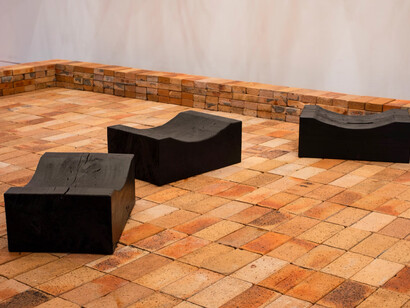
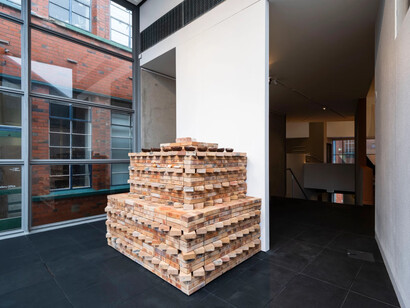
Here the ātea is a foundation of bricks, formerly located in Wellington’s Te Ngakau Civic Square. One enters the installation facing toward the northeast, where Matariki / Matāli’i rises low on the dawn horizon at this time of year. In earlier research, Heta recalled the history of churches often being built on top of marae / malae. Here in Te Whanganui-a-Tara, the university itself was built on top of a hill, requiring it to be partially levelled, while the awa Kumutōtō that emerges from beside Te Tumu Herenga Waka, the university’s marae, remains culverted for most of its course to the sea. Nofo pou, low seats made from charred local timber, are positioned in a circle at the cardinal and inter-cardinal compass points, orienting us within a navigational framework and evoking connection with the winds’ direction and the sea’s currents. The nofo pou offer a practical support structure for extended discussion, the talanoa and wānanga fundamental to the work’s purpose.
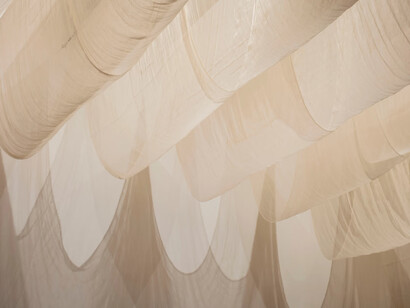
Above the ātea, gauze-like textile is suspended in airy loops. These relate to the 12 heavens common to many cosmologies across Te Moana-nui-a-Kiwa, distinct layers ascending from the sky closest to earth up to the spiritual realms. The fabric transmits light and makes a pillowy contrast to the hard lines of the surrounding built space. Each day the installation is opened and closed with karanga by Rhonda Tibble, and throughout the day a soundscape composed for the work by Salvador Brown plays. Nearby, in the gallery’s southeast facing window space, from which you can see the sea and Matairangi (Mt Victoria), is an altar holding coconut shells filled with coconut oil: an offering to all the senses.
This is the third time this installation has been realised. Originally titled The body of Wainuiātea, it was commissioned for Re stor(y)ing Oceania, in a project curated by Taloi Havini for Ocean Space in Venice in 2024. The work was subsequently shown at Artspace Sydney in 2025. Each time the materials have been sourced locally, and gifted or returned to where they came from at the end of exhibition, as they will be in this iteration. Both former sites stand in close proximity to the ocean. In Te Whanganui-a-Tara the exhibition site is on a hill rather than by the shore, and the timing and presence of Matariki / Matāli’i is fundamental, with connection to cycles of death, birth and rebirth. In Ua tafa mai ata: matāli’i ki wainuiātea the tenets of the work, however, remain unchanged. At its core is the role of talanoa, of narrative, and of structures designed for dialogue in how we collectively navigate our multiple and pressing relationships to the ocean that surrounds us.