English
 Español
 Français
 Deutsch
 Italiano
 Português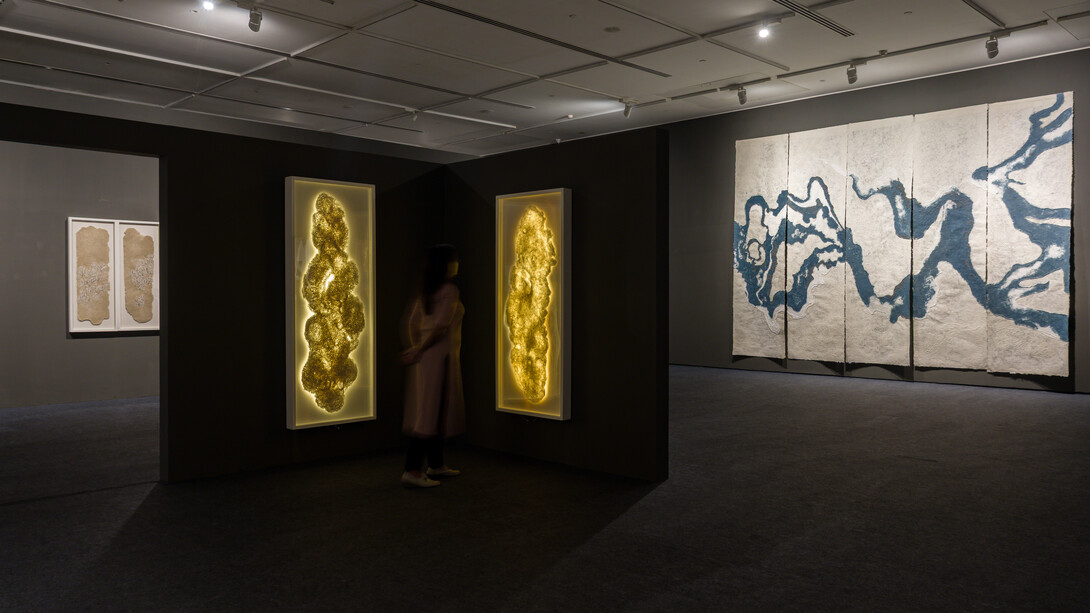
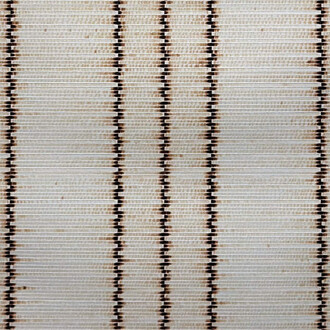
There is a moment, in Ruma Choudhury’s practice, before the paper is paper at all, when it is still fibre gathered from the fields around Santiniketan, still the tussar waste the weavers of Tāntipārā would have given to the fire, still one of the thirty-eight plants of Birbhum whose properties she has learned over years the way a botanist learns a flora. It is in this moment, rather than in any that comes later, that the work is decided. She boils it, washes it, soaks it, grinds it to pulp, and the labour is slow because it has to be, its patience not a temperament but a method, the discipline the sheet is finally made of. Only then does she lay the fibres on the deckle, and carry the sheet outdoors to give it over to the sky. What the monsoon inscribes in stain and rupture, what the wind leaves of itself, what the sun draws out of colour and, in time, out of the very body of the sheet, none of it can be foreseen and none repeated. To make this way is to accept a collaborator she cannot govern, and in the interval between what is set out and what is returned, paper gives up its long service as the ground of writing and image and becomes instead a catchment, a register of the world, an archive on which climate and season and place inscribe themselves in their own hand.
The lineage behind this is a real one, and close at hand. Choudhury studied painting at Kala Bhavana, the school Tagore founded, where she came to papermaking in her first year and made it the matter of her dissertation, and where she has since given the better part of a decade to it in the studio she founded, Paper Nest, in 2019. Tagore’s was a pedagogy in which the seasons were not the backdrop to instruction but its substance, marked at Varsha Mangal, at Halakarshan, at Vriksharopan, and in which the artists of the school went out into the landscape and came back with their materials and colours. Choudhury has spoken of wanting to inhabit that inheritance rather than merely receiving it. Ramkinkar Baij had set his figures out in the open, to be of a piece with the landscape. In the printmaking department, Somnath Hore, pressing paper pulp into matrices of clay and wax and cement, arrived at a paper in which the wound was not represented but was the very substance of the sheet. He came to this on his own, before the workshops of Europe and America had made a movement of it. This is the ground she works from, and what she does with it is to carry the sheet out of the studio altogether and hand the last of its making to the season.
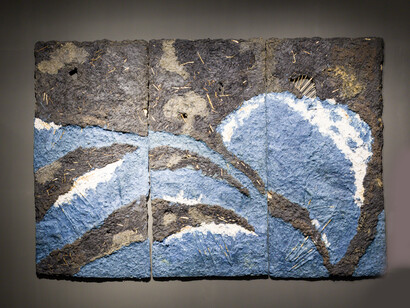
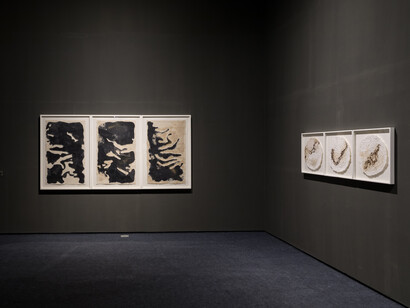
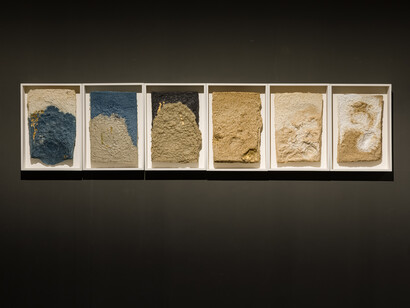
Some things are already within the sheet before the weather comes to it. Charcoal recurs, at once matter and pigment, drawn from the stubble the fields are cleared with, while the tussar lends its browns and greys and the cotton its pristine whites, so that a good deal of what is visible was never, strictly, added at all. And where colour is added, it comes from the plants of the region, indigo among them, entering the pulp as a substance with a history rather than as a chemistry. Her politics of ecology lives here, in the fact of the material, and not in any rhetoric of catastrophe. When the weathering is done, she will, at times, return to the sheet with gold. Gilding, that old vehicle of the sacred and the sumptuous, is laid here on paper made of waste and on the marks the weather left, dignifying what another eye would pass over.
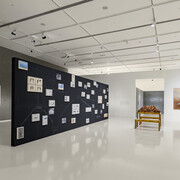
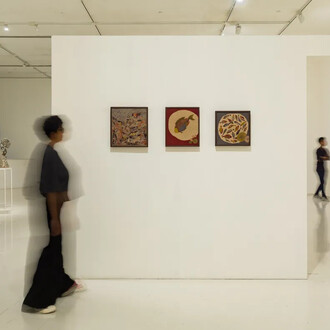
By now the word 'paper' no longer holds. What is on the wall has the density of an object, a body bearing the record of all that has acted upon it, and the archive it makes is of a singular kind. An archive is ordinarily raised against time, its objects held apart from whatever might alter them. Choudhury’s sheets were made the contrary way. What recorded the season in them was the same weather that marked them, so that in the making, to keep and to be altered were one gesture, and the record forms not in spite of what the season does but through it. Because no adhesive binds these layers, because the sheet holds by the will of its own fibres, it will outlast most of what is set down on more obedient surfaces, so that a season long past goes on being legible when the year that bore it is forgotten.
She speaks of the pancha bhuta, and means it literally rather than as metaphor. Prithvi is in the fibre and the residue worked through it, ap in the soaking and the washing and the rain that is a partner to the monsoon works, tejas in the fire beneath the fibres and the sun that bleaches them, vayu in the wind and its cargo, and akasha, the open air the sheet is left lying in, whose property is shabda, sound. The sheets keep that too, the sound of rain on drying paper, of pulp beaten to a rhythm, of a wind heard before it is seen. Like a raga they are bound to their hour and their weather, and cannot be lifted free of either. A catchment holds whatever falls into it, and an archive keeps what it holds. These sheets have held a season, and hold it still.
(Text by Ushmita Sahu)