English
 Español
 Français
 Deutsch
 Italiano
 Português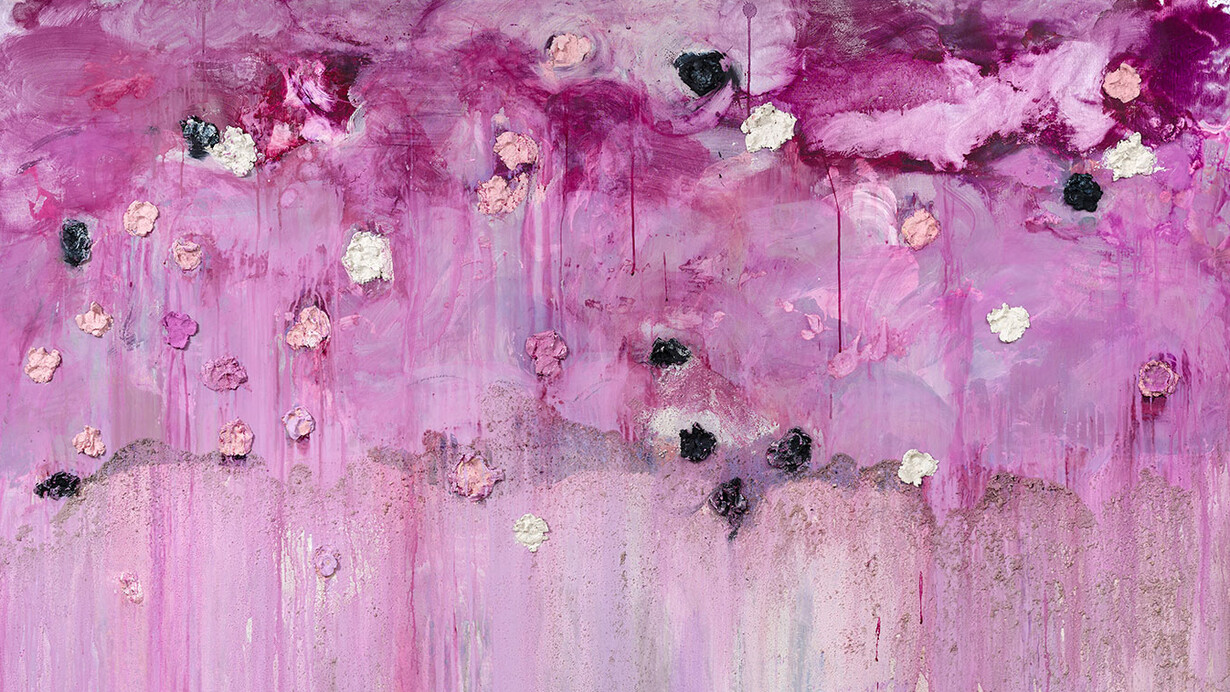
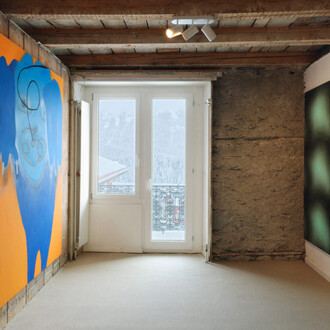
Carl Kostyál and Jan Kaps are pleased to present all that grows, Melike Kara’s first solo exhibition in Sweden, at Hospitalet, Stockholm. The exhibition brings together a new body of paintings that sees Kara working with coffee grounds, oil stick, acrylic and ink on canvas. Drawing on the ritual of coffee divination, the works extend her longstanding interest in cultural inheritance and collective memory through chance, transformation and connection. First introduced at Art Basel (2025), they were most recently exhibited in Whispers at Kunsthaus Hamburg, 2026, curated by Anna Nowak, on view until August 23, 2026.
“Since the early 2010s, Melike Kara (b. 1985) has developed an artistic practice spanning painting, sculpture, installation and the work with an image archive. Across these different forms, she explores the ways in which personal memory and broader historical narratives become intertwined. Born and raised in Germany, Kara began an extensive process of collecting photographs from the visual culture of the Kurdish diaspora as a means of approaching her family’s history and forging her own relationship to Kurdish identity. The archive became not only a way of preserving images, but also a way of exploring how their meaning continues to shift once they leave their original context.
For more than a decade, the archive has served as both source and material within Kara’s work. Photographs have been transformed and incorporated into installations, sculptures and paintings. They have not illustrated history so much as kept it alive. Her work has revolved around questions of belonging, migration and cultural memory, while focusing on the everyday, the beautiful and the fragile – experiences that have rarely been allowed to define the narrative of Kurdish history. This became Melike Kara’s way of approaching Kurdish identity on her own terms.
More recently, however, her practice has undergone a gradual shift. Not away from the Kurdish experience, but away from the notion that it alone should define her work. Another necessity has begun to emerge. What remains when the stories we carry no longer need to serve as the sole point of departure for how we see the world – or how the world sees us?
This movement found tangible form in Whispers, presented at Kunsthaus Hamburg in the summer of 2026. Here, Kara burned copies of photographs from her archive, allowing their ashes to become part of the installation. The gesture was never about rejecting the archive, instead about asking what happens when the archive itself is allowed to change. How can memory remain alive without solidifying into a historical document? How can an archive continue to move without becoming something one is expected to live up to?
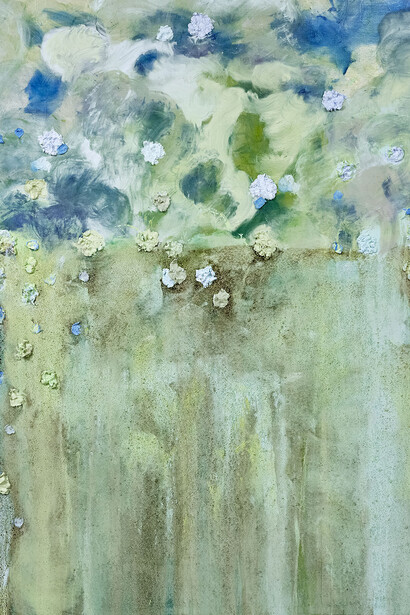
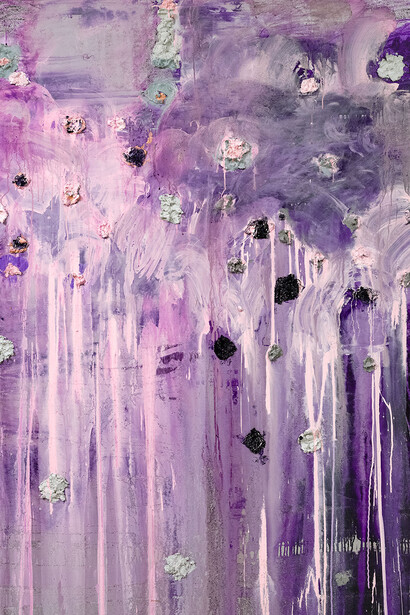
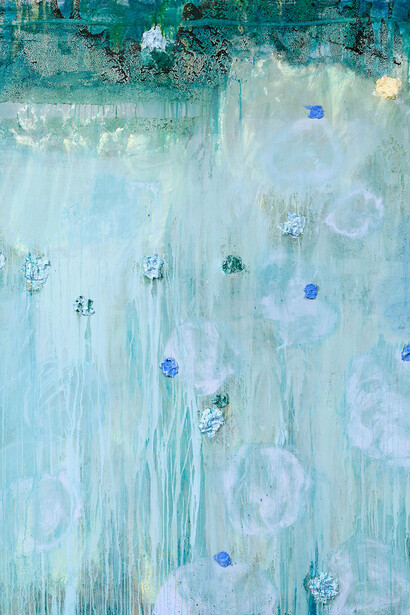
The new paintings presented at Hospitalet in Stockholm have grown out of this same enquiry. The photographic elements and recognisable figures have given way to a painterly language in which colour, material and gesture carry the image.
The canvases are worked horizontally, vertically and at an angle. They are moved, turned and repeatedly returned to the studio floor before rising once again against the wall. Paint is brushed onto the surface, allowed to flow freely and spread with the artist’s hands or with tools she has made herself. In vertical incisions cutting through the wet material and the horizontal sweeps opening and closing the pictorial space, the movements of her hands and fingers remain visible. This energy continues into blurred, opaque passages and undulating lines that recall the trace of a fingertip drawn across a misted window. Thick oil pastel builds a relief-like surface in which colour becomes as much matter as image. The weight and movement of the materials prevent the painting from ever fully settling; it remains in a continual state of becoming.
For some time now, Kara has also incorporated coffee grounds into her paintings. She grew up with a grandmother who read the patterns left behind in coffee grounds – a familiar domestic ritual in which the future was divined through the traces remaining in the cup, a practice later passed on to Kara herself. Within the paintings, the coffee grounds relinquish this former function and become a new painterly material. What was once used to read the future now begins to write its own history across the surface of the work. In much the same way, photographs become ash and the archive becomes painting. Transformation is not simply a theme in Kara’s practice – it is her method.
We instinctively search for motifs, narratives and meaning. Melike Kara’s new paintings propose something else. They allow colour, light and material to exist without coalescing into anything immediately recognisable. The viewer encounters a form of painting that opens a space and invites presence. This shift does not appear as a break with Kara’s earlier practice, but as its continuation through different means. The image no longer needs to represent an identity to carry it; it has moved from the motif into the gesture itself.
For Melike Kara, abstraction is not primarily an art-historical position, but a way of working. It enables her to surrender control and momentarily free herself from the frameworks through which she has come to understand herself. She describes the act of painting as entering a state of stillness in which the unexpected and the unknown are allowed to emerge, where this can sometimes take her further than words are able to reach. Through this process, her practice has become freer, more playful and filled with a renewed sense of joy. The luminous colours and expansive visual fields initially surprised even the artist herself. At the same time, the question she has set herself has become increasingly radical: to explore what remains when history, background, roles and identities are allowed, however briefly, to fall away. What remains when everything that follows, I am falls silent?
It is not an escape from history. It is a way of continuing to live with it.”
(Text by Tessa Praun, curator and writer, The Wanderlust Institute of Art)