English
 Español
 Français
 Deutsch
 Italiano
 Português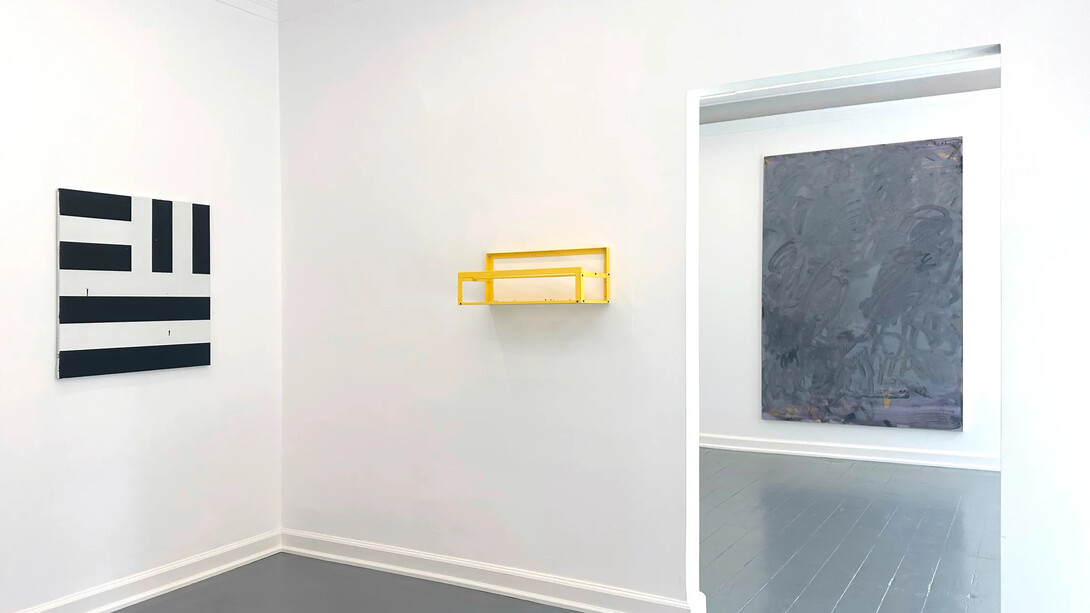
Gardar Eide Einarsson’s practice explores the complex dynamics of personal liberty, belonging, and the ideological influence of propaganda. Working across diverse media – including installation, painting, and sculpture – he repurposes found materials to examine the friction between individual freedom and the constraints of societal systems. His work often carries a wry sense of humor, balancing subversive undertones with a measured, critical distance.
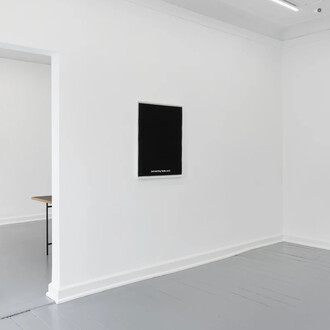
A geometric, seemingly abstract painting derived from the Bank of America logo – which itself is a stylized abstraction of the American flag – Bank of America (B/W) is rendered entirely in black on a white background, replacing the logo's original red, white, and blue. The work recalls the formal language of postwar painting, from Frank Stella to Jasper Johns, while the stark monochrome palette lends the familiar corporate symbol a sinister, authoritarian quality. In doing so, Einarsson points to the complicity of financial institutions such as Bank of America in the forms of repression and violence that underpin – and at times openly sustain – contemporary capitalism.
Einarsson's Mining rig (RAL 1018 zinc yellow) belongs to a series of steel sculptures based on cryptocurrency mining rigs, powder-coated in RAL colours derived from Donald Judd's early sketches. The work emerges from reflections on the artwork as both a container and generator of value, while also invoking Joseph Beuys's conception of the artwork as a repository of energy.
At the same time, the sculpture alludes to the early ideological promise of cryptocurrency and the rapid pace of technological obsolescence. Today, cryptocurrency mining is overwhelmingly carried out in vast industrial facilities rather than through the domestic setups referenced here. In this sense, the work also echoes Minimalism's appropriation of industrial forms and materials that were already becoming obsolete, transforming them into relics of a specific technological and economic moment.
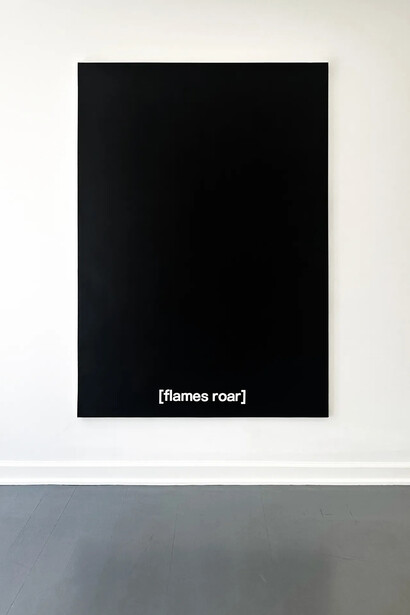
Closed captioning for television and film translates sound into text, providing information considered essential to the narrative for viewers who are unable to hear the original audio. Gardar Eide Einarsson's flames roar is based on a screen grab in which the closed caption "[flames roar]" appears in – the unpainted surface of the pre-primed canvas – while all other visual information has been obscured with black paint.
Deprived of imagery, the caption invites viewers to imagine its source: the aftermath of a catastrophic accident, a car crash, or a house consumed by fire. Yet the flames burning across the world today – whether literal, as in the wildfires in Los Angeles or the bombed apartment buildings of Kyiv, or metaphorical, in the erosion of the liberal order and the rise of populism and autocracy – are often presented as accidents when they are anything but. Rather, they are the consequences of deliberate actions and political decisions, sustained by information that is absent, wilfully ignored, or intentionally withheld.