English
 Español
 Français
 Deutsch
 Italiano
 Português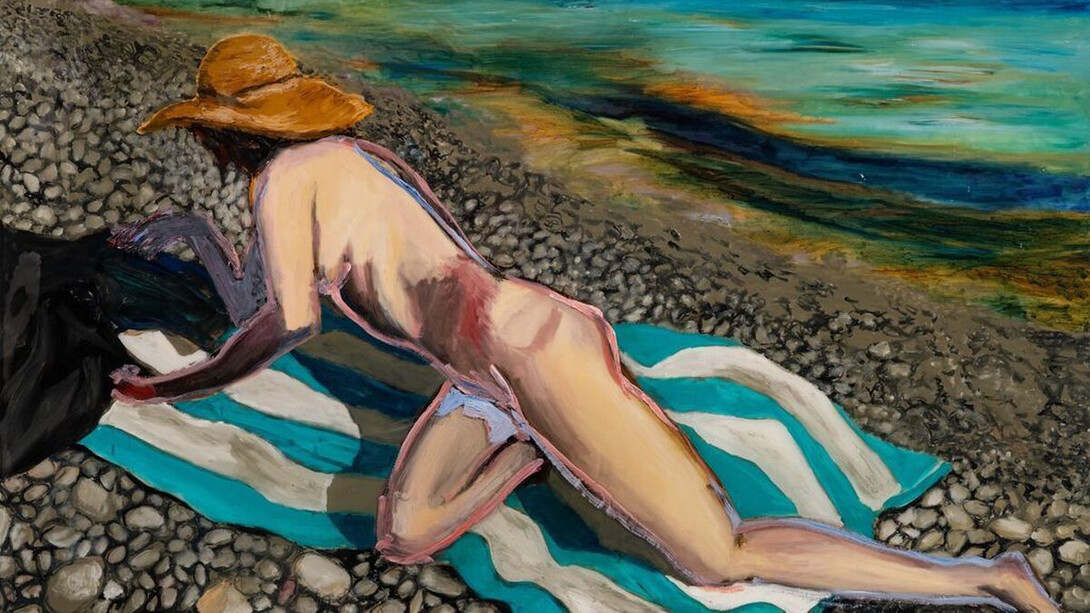
The Grenning Gallery is pleased to announce our Darius Yektai Solo Exhibition, opening Thursday July 23, at 26 Main Street, Sag Harbor, NY, 11963. Please join us at our Opening Reception Thursday evening, from 6:30 – 8:00pm; the artist will be in attendance. The exhibition will hang through Sunday August 16th.
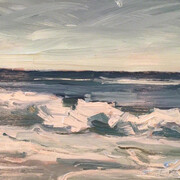
Now in its seventh consecutive year, the annual show has become a summer fixture at Grenning Gallery — a milestone that finds Yektai returning to beloved territory while pushing into new ground. Longtime collectors will be pleased to find his signature 3-dimensional waterlily paintings and abstract flower compositions that have become synonymous with his name at Grenning Gallery, alongside the debut of a colorful new figurative series and several abstract paintings. These new works expand Yektai’s oeuvre beyond the florals and waterscapes, for which he is best known. Where Kasos 8 lingers on texture and color up-close, Kasos 5 pulls back to a wider, almost surrealist view of the island. The figure stands partially submerged, back to the viewer, gazing toward the horizon. Heavy impasto in the rocky bluffs plays against the mirrored finish of the sea, where a deep blue sky drips down in pigment.
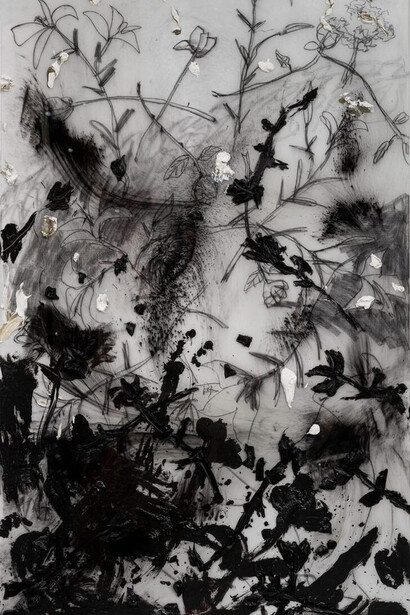
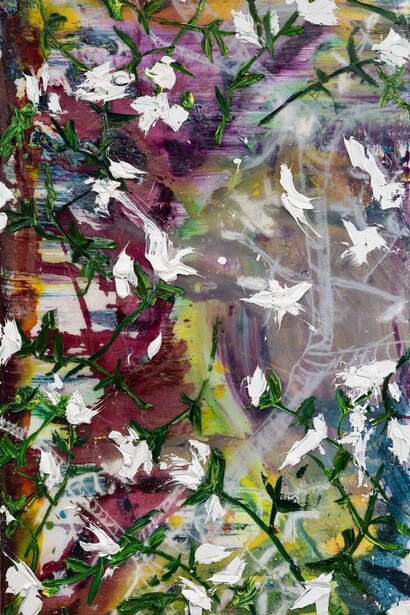
Yektai’s range of color, vivid or restrained, comes through in a trio of new, large scale falling flower paintings: Rising rose, Falling lily tree, and Dark charcoal lilies — that share the same branching floral motif carried across three distinct palettes. Rising rose burns in gold, orange, and red, with high-contrasting stems and clusters of red blossoms ascending above a ground that appears to radiate heat. Falling lily tree shifts into deep plum and magenta, its white blossoms and green vining stems threading through the composition like the last light of dusk on an overcast day. Dark charcoal lilies strips the palette down entirely, pairing ghostly fusain line work in the upper register with a dense, inky mass of black foliage below — shadow standing in for color. Seen together, the three paintings function almost as a study in mood: the same botanical language, refracted through fire, air, and light.
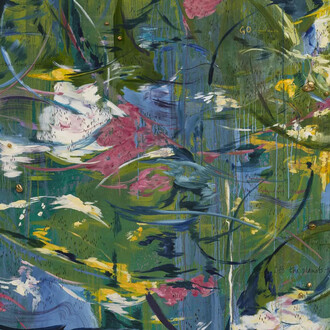
The show also introduces several new entries in Yektai's popular waterlily series, including Manganese cerulean pond. The painting's cool, silvery hues echo its namesake mineral, while a single weeping willow branch extending from the upper left corner — its foliage bright white and yellow — anchors an otherwise somber, contemplative landscape, offering a quiet visual respite from the noise of daily life. Across the broader waterlily series, Yektai continues to explore varied hues — from subtle neutrals to electric chartreuse — alongside an assortment of sizes, shapes, and an eclectic mixture of frames.
Like Yektai’s waterlily paintings, his closely observed local landscapes benefit from his intimate and concentrated attention. Edge of long pond exhibits Yektai’s impression of the Long Pond Greenbelt, just steps from his studio. Branches reach across the canvas atop that landscape, forcing the viewer to closely observe the scene’s native flora. Long pond through the Trees is all about the titular subject, the trees. Up close, we see thickly painted branches standing upright, catching light and casting shadows. A green underpainting presents a watering hole just below the horizon, relaying a glimpse of the landscape in which these trees inhabit. And finally, in Duck blind, our eye naturally gravitates to the eastern redbud which stretches across the canvas, yet the painting takes its name from what lies hidden beneath. A verdant pondscape encircling a duck blind, a small hut camouflaged by natural reeds and grasses, to allow hunters to take aim on their prey, hidden in plain sight. Yektai’s ability to look deeply at the local landscape and create gorgeous abstractions continues to amaze us.
In Corner of table by field, Yektai continues to blur the line between still life and landscape. One of the more traditional compositions in the exhibition centers a colorful tabletop holding two flower vases, situated within a field beneath a blooming tree. A post-and-rail fence stretches across the canvas, emphasizing the unadorned charm of this rural landscape. As always, his thick layering of paint and resin invites the eye to linger, tracing each emerging layer of the composition. Rendered in natural colors yet accentuated with lush jewel-toned brushstrokes, the pastoral scene recalls the sensuous French landscapes of Pierre Bonnard.
As does, View of porter and roses – a colorful mountain scene rendered in loose pointillistic brushstrokes. Sweeps of grey and blue pigments make up the sky above a contrasting forest green mountain peak, which encompasses ragged valleys and bluffs of soft pale greens and earthy oranges. At the mountain’s base, is a life-size vase of flowers; facing the viewer head-on with romance – dried roses preserved in resin mimic the pointillist brushwork throughout.
That romance continues in Moonrise over Chamonix; a large vertically oriented painting which amplifies and exaggerates the light of a full moon over the French Alps. Beams of light reach from the lustrous orb at the mountain’s peak, in every direction. A meadow is illuminated at the base of the mountain range, where a field of wildflowers shimmer in red, pink and yellow forms. A backlit figure stands before the glorious scene with a dog, taking in the moonlit beauty. This composition reminds us how tiny one can feel amongst the grandeur of our environment.
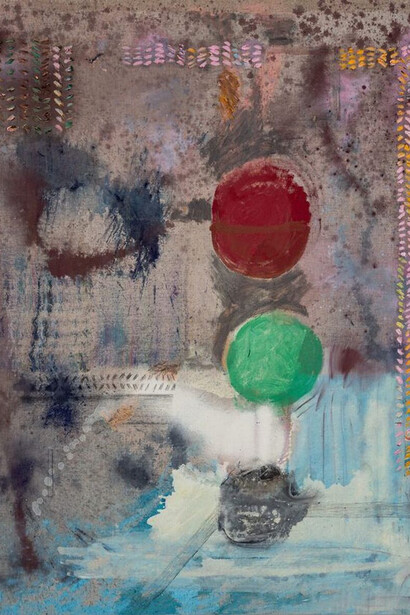
Yektai’s abstraction Earth touching 1 is a raw canvas washed in a splattering of neutral pigments showcases spheres of both solid color and negative space. A red sphere floats above a green sphere, which sits upon a ground of blue and airy white. Yektai implements a pattern of pink and orange hash-like brushstrokes that outline the upper edge of the composition. Although other than shapes, there are no representational forms, the composition offers the viewer a chance to observe and anticipate what may be happening. The viewer may sense a similar experience as the figure did in Moonrise over Chamonix, where one’s own form debates the scale and tangibility of forms before us, and how they may exist beyond our perceptible comprehension.