English
 Español
 Français
 Deutsch
 Italiano
 Português
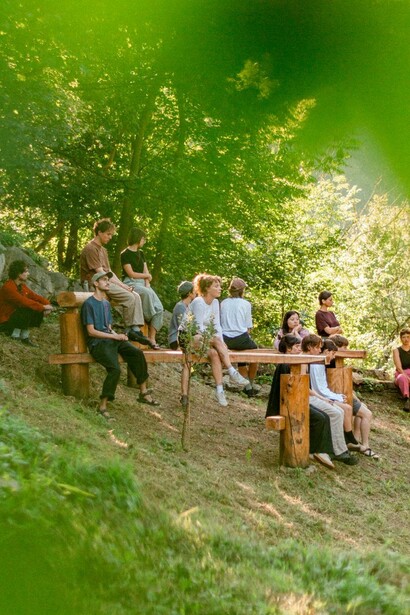
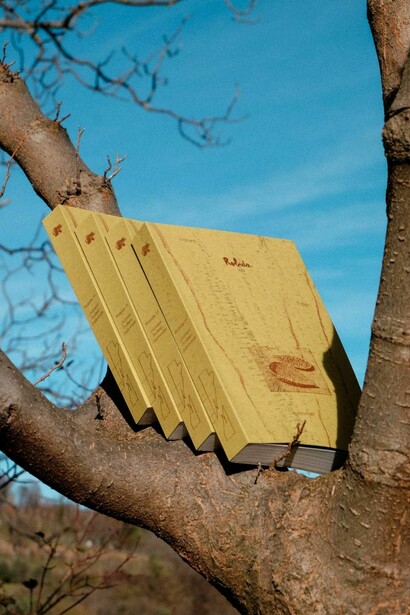
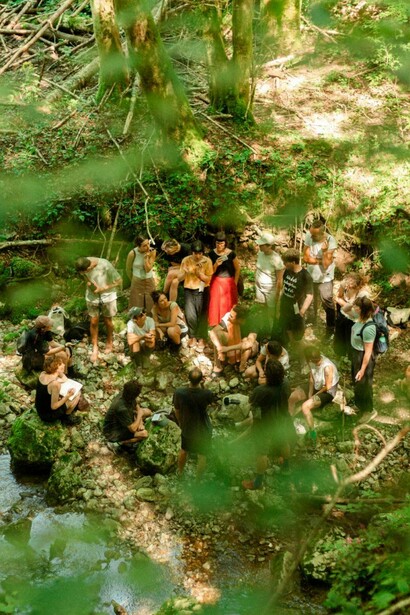
Between roots and crowns: branches as a porous border presents some of the practices and themes Robida explores in Topolove/Topolò, a village on the border between Italy and Slovenia. It comprises a reader, a listening room with readings by multiple voices, a spatial textile intervention, and an ambient sound recording of Topolove acting as an environmental layer connecting the exhibition space with its geographical and seasonal contexts, thus extending it beyond its physical boundaries.
Together the elements form a branched space of reading and listening, in which the 11th issue of Robida magazine, whose main theme is fruit trees and orchards, is presented not as a finished object, but as a set of spatially open materials – as an environment in which ramification is read not only conceptually, but also physically and experientially.
In terms of content, the core of the installation consists of the reader and the listening room, together offering multiple entry points into the rethinking of four binary oppositions: nature/culture, individual/community, center/margins, and rootedness/rootlessness – and the borderlands between them. Each of these oppositions constitutes the (meta)physical tissue of Topolove and all the other places (re)configured throughout the process of modernity. The purpose of the reader is not to dismantle borders between these concepts, but to make them porous. If porous, the border itself unites and creates affinities between the two sides. The ramified structure of the reader does not articulate and hierarchize multiplicities, but acts like a tree, or like a rhizome growing between roots and shoots. The questions then emerge: How can we think of conceptual oppositions so as to let them intermingle, mix, or even hybridize? How might we imagine a world where borders remain, but are fluid, dynamic, and open to exchange?
Fruit trees and orchards think of branches in a special way. An orchard is not just a place of producing, but one of grafting, interdependence, seasons, and care; it is a meeting place between the wild and the cultivated, heritage and the future, individual trees and communities of trees. A grafted tree carries within itself at least two different lives united in one trunk – it is living proof that identity is not uniform, but composite, intermixed, hybrid. An orchard is thus a conceptual and material model of a porous border: between species, between human work and plant growth, between old varieties and as-yet-unknown fruits.
At the same time, an orchard is a place of temporal tension: evoking a past of lost knowledge and vanishing languages, it demands presence and a commitment to a future that can never be fully foreseen. A planted tree outlasts a human lifetime; we prune it for someone else to pick its fruit. In this way, an orchard constitutes a border between generations – a border that does not separate but connects. In it, mourning for a fallen tree coexists with the clearing that opens up in the process; loss creates space for new growth. As a branching structure of roots and crowns, an orchard is both an archive and a laboratory: a carrier of words, gestures, and practices, as well as a space for testing different forms of community. And more than branches, it also develops relationships – between people, plants, landscapes, and languages. In this sense, an orchard not only represents a porous border, but lives it.
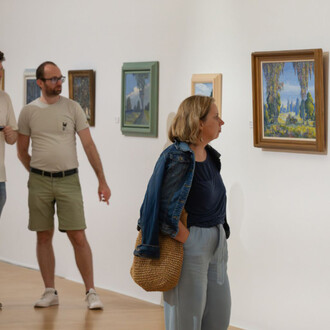
Between roots and crowns: branches as a porous border is not just a presentation of publications, but a situation in which the border between reading, listening, and existing in space gradually blurs. Rather than stand in front of the work, visitors enter it – like a branching, multi-layered orchard of words and voices.