English
 Español
 Français
 Deutsch
 Italiano
 Português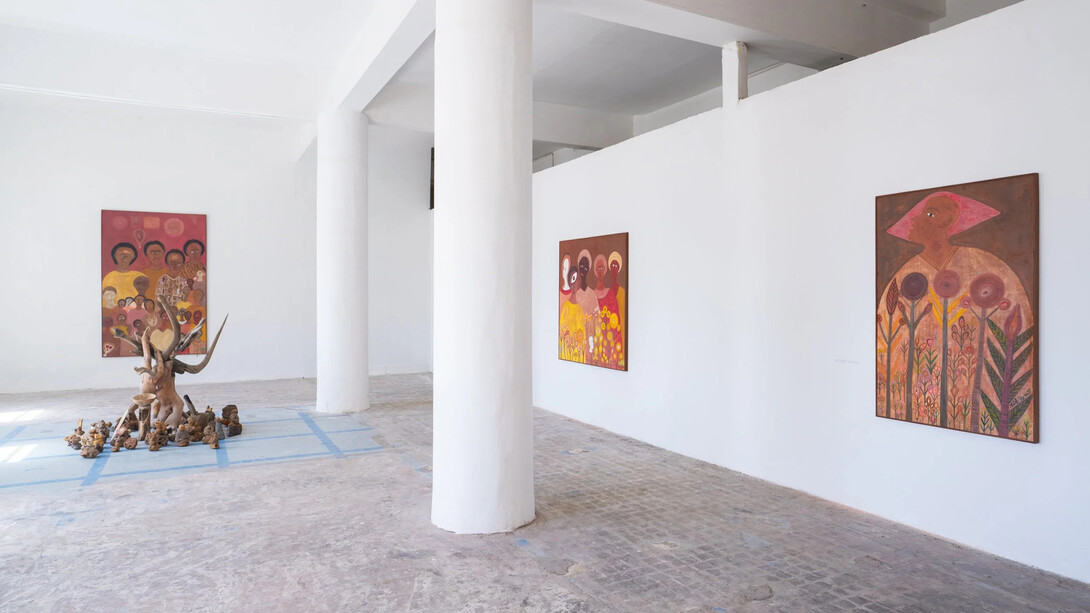
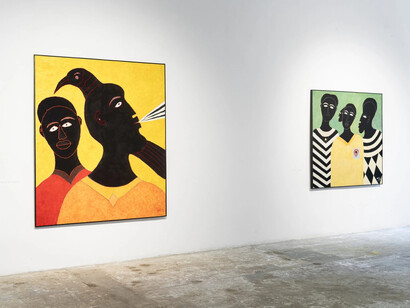
Presenting the work of Alioune Diouf, six years after the inauguration of our space, is to reveal the relentless quest of an artist searching for possible forms of humanity through artistic creation; it is to reaffirm the importance of a timeless message that nevertheless remains barely audible. The repetition of these figures, these human communities that gaze back at us, speaks to the possibility for humankind to approach the sacred beyond religion. Ak Jaam, which means “with peace” in Wolof, is offered here as a form of prayer.
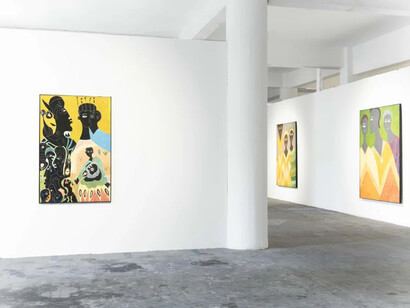
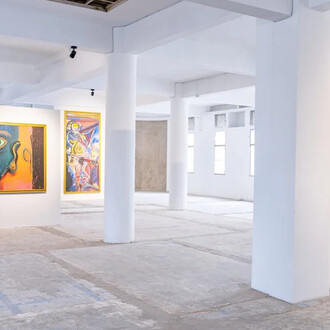
Of Serer origin and as a former farmer, Alioune Diouf lived for many years at 17 rue Jules Ferry in the city center of Dakar, within the the Laboratoire Agit’Art—known as the courtyard of Issa Samb, his companion since 1989. As a “child of the courtyard,” he absorbed both the artistic legacy of the post-independence 1990s and the subversive vitality that defined that era. This vitality permeates his work, imbued with poetry and compassion, calling for life, vital breath, and reconciliation. While some compositions evoke haloed figures reminiscent of religious iconography, others—populated by hybrid silhouettes—recall echoes of West African statuary. Beyond any specific reference, these assemblies of figures seek to bring together the world’s spiritualities through an interweaving of symbols and floral and geometric compositions.
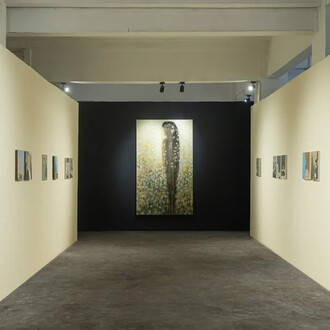
Two series stand out within the exhibition. The series set against black backgrounds combines painting and stitching, incorporating the recurring motif of the bird. “The bird is spirit,” the artist asserts, presenting it in his works as an existential possibility for humankind, in a form of fundamental ecology. Alioune Diouf also pays particular attention to ornamentation, notably through the garments of his figures, whose geometric patterns unify the assembly and structure the canvas. Other works depict figures surrounded by floral compositions reminiscent of illuminated manuscripts, as though elegance itself could alleviate the world’s afflictions.
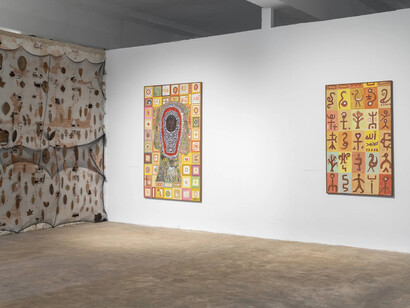
His other series, produced near Lac Rose in Senegal, reveals a palette made from natural pigments. The same figures seem to emerge from the earth, shaped with diluted clay, extracts of hibiscus leaves, or even pools of coffee grounds applied to the canvas. A cultivator of both land and existence, Alioune Diouf anchors his figures within floral fields that recall their fundamental belonging to the living world.
Silent and deeply attentive to otherness, his work engages a way of being in the world—a practice of a humanity in the making. Repetitive and timeless, his work is today more necessary than ever, in the vital impulse it calls us to protect and sustain.
(Written by Jennifer Houdrouge. Text copyright by Selebe Yoon)