English
 Español
 Français
 Deutsch
 Italiano
 Português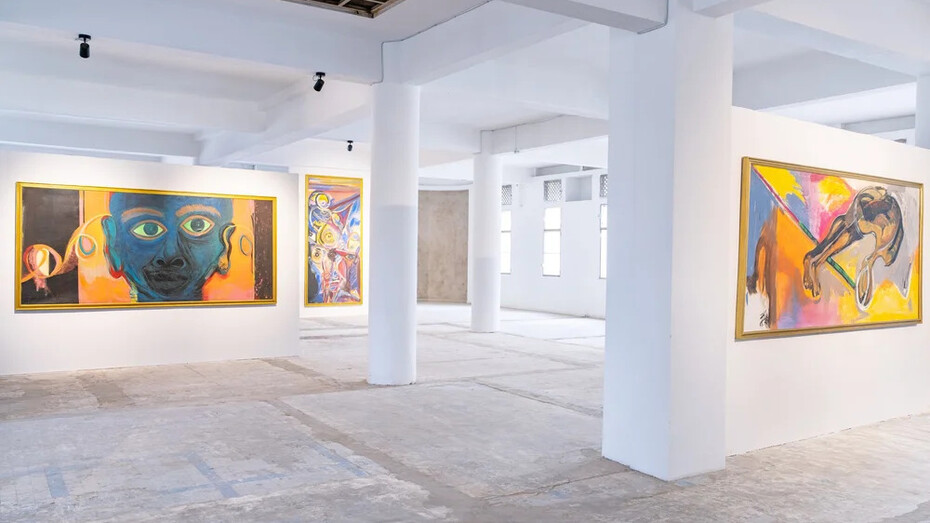
For the fairly detached observer, the sight of the capital’s streets conjures up a general feeling of nonchalance, recklessness and even insouciance, questionable though that is.
(Ass Mbengue, Recalling the future, in Deliss, Clementine, Seven stories about modern art in Africa, Whitechapel Art Gallery, London 1995, p.232)
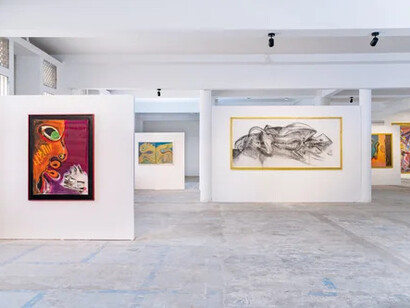
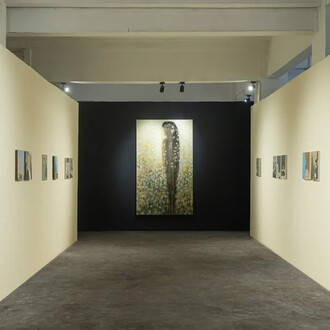
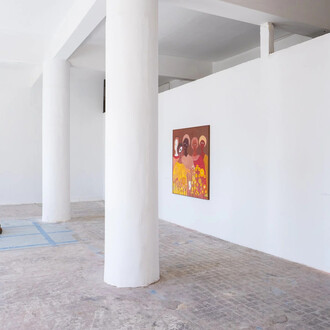
Entitled El Hadji Sy: new paintings, the exhibition brings together a range of large-scale works made over the last fifteen years of senegalese artist El Hadji Sy. Whether viewed from the front or in profile, the characters painted by El Hadji Sy impose themselves on visitors with the power of their gaze and their contours. The visages encountered day after day intertwine with those of legendary or historical figures, making each painted character the heir to a history that is both collective and singular. His use of colour becomes a time machine, ultimately erasing spatial and temporal references to emphasise solely the figures that emerge from the frames as if they were windows, staring at us in the 21st century.
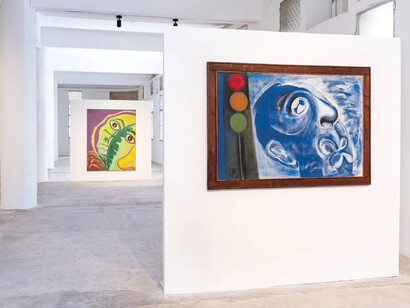
At the entrance to the gallery, the work entitled Feu rouge (2022) refers to the film-maker and artist Bouna Medoune Seye. Seen in profile, facing a traffic light where each coloured signal is lit, his facial expression, similar to a traditional mask and immersed in bright blue, signals a certain urban disruption, an alert.
The works Nubian (2023) and Black pharaoh (2019) evoke the 25th Dynasty of black pharaohs from Nubia (present-day Sudan), who once reigned over ancient Egypt. While this part of history has long been forgotten in Egyptian historiography, these works confront the viewer with the immensity of past history and forgotten legacies, ensnaring the visitor in an apparent interplay of gazes, creating a sense of constant awareness.
Playing with the principle of glissement d’identités (sliding identities), L'homme caméléon (2011) reveals a character delicately concealing himself in a large leaf, his face morphing into a botanical form. This doubling effect is also found in the work entitled Celle qui porte (2023), where one reptile covers another. Whether a chimera, lizard or fantasy animal, it stands out for its lack of colour, abandoned in favour of charcoal, giving it an intangible presence.
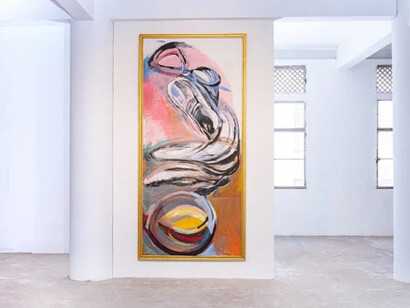
Finally, three works from 2023 — L'acrobate, La danse de la calabasse and Le ballet — depict dynamic sequences of performing arts on large-scale canvases. A true ode to movement, El Hadji Sy paints three scenes in which the body is challenged to perform, whether through dance or acrobatic exercises. His characteristic arabesques appear equally active, juxtaposed with more sober swathes of colour on the abstract background, highlighting the figurative silhouettes accentuated by El Hadji Sy's use of black paint to guide the eye. In a way, the figures are absorbed by the coloured layers of the background, which may seem docile at first glance, but in fact encompass a visual maelstrom, a musical structure and a hidden rhythm. With figures levitating and dancing, these works recall the importance the artist has attributed to the corporal experience throughout his career. In the 1970s, he abandoned brushes to paint directly with his feet, freeing himself from the aesthetic dogmas of Fine Arts and invoking the place accorded to the body in cultural expressions across the African continent. Seeking a balance between intentional and accidental forms, the representation of these anonymous protagonists also evokes the body of El Hadji Sy captured in full choreography in front of the canvas.
(Text copyright: Selebe Yoon ©)