English
 Español
 Français
 Deutsch
 Italiano
 Português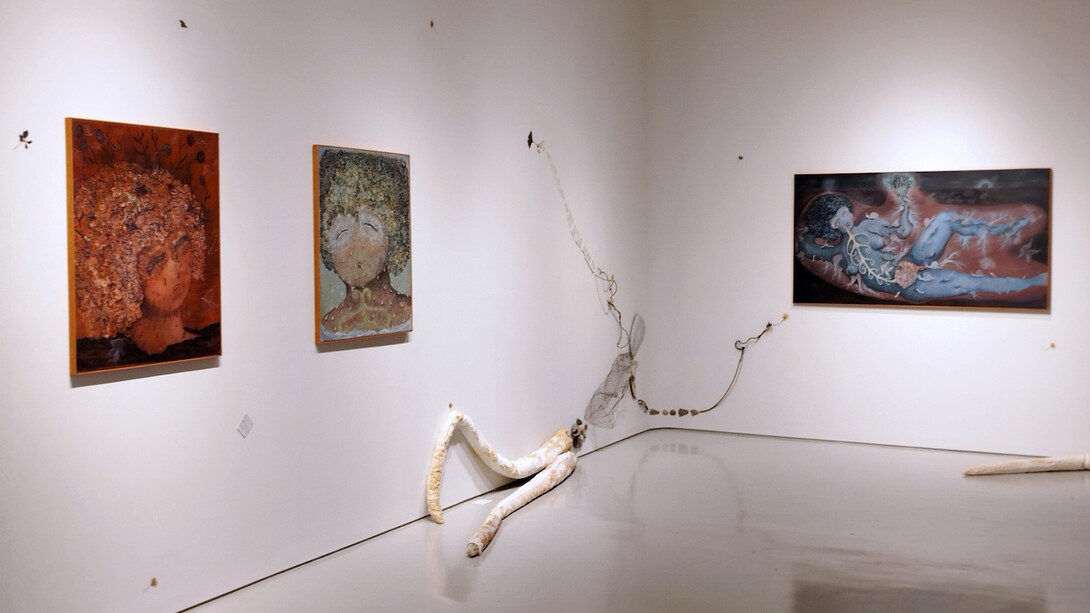
This exhibition by Marina Daiez, her second with the gallery, finds the artist at a moment of consolidation, in which her practice asserts itself through a strong narrative impulse. Daiez conceives the exhibition almost as an expanded literary work: a story narrating the lives of plant-beings, hybrid organisms whose existence seems to unfold according to their own temporality. The title incorporates the word “ontogeny,” a term from biology referring to the development of an organism from gestation through maturity and senescence. Here, this desire to narrate intertwines with a reflection on the ways life becomes, transforms, and relates to its surroundings.
Drawing from the writings of Verónica Gago, Marina adopts the notion of the “body-territory”: a perspective that rejects the possibility of thinking of the body as separate from the geographical, economic, cultural, and affective conditions that constitute it. The body always exists alongside others, including non-human agents; all life unfolds within a network of interdependencies. As Gago writes, this entails “a political, productive, and epistemic continuity of the body as territory,” where the body emerges as a composition of affects, resources, and potentials that exceed the individual.
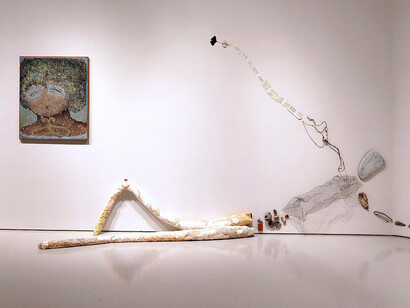
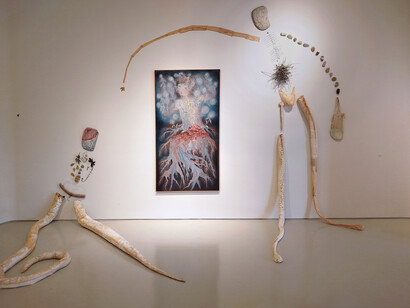
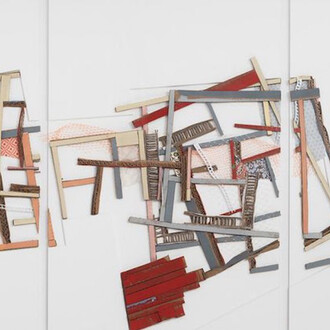
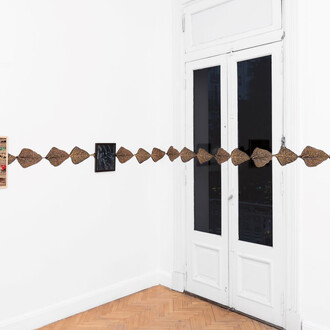
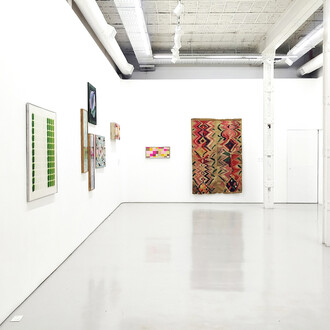
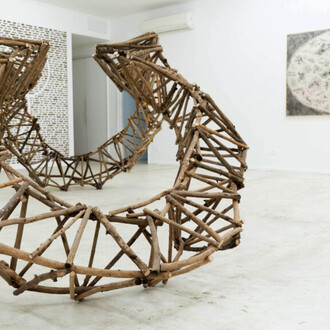
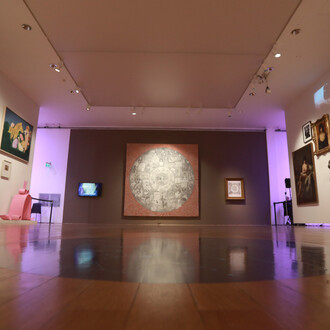
This story of beings unfolds both through the paintings and through the exhibition’s installation-based dimension. The idea of gathering—and also of collection—occupies a central place. Large figures assembled from fabricated and found elements appear to “harvest” the paintings, selecting them according to secret affinities. For Marina, situating the works within a setting inhabited by these beings—alongside dried flowers affixed to the walls or small benches encircling the columns—is essential. The neutrality of the white cube, interchangeable and detached from place, is precisely what she seeks to move away from.
The paintings evoke a genesis of life in which no clear separation exists between being and environment. Tears become water nourishing vegetal growth; surfaces vibrate with a proliferation of details that seem to overflow the limits of the frame, as though the energy of the images continued beyond the visible fragment. Historical references also emerge throughout the works: the quotation of an ombú tree borrowed from a painting by Prilidiano Pueyrredón, rendered here through a more gestural brushstroke, or echoes of the palette of Raquel Forner and other Surrealist artists.
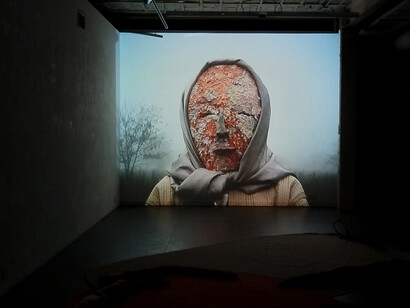
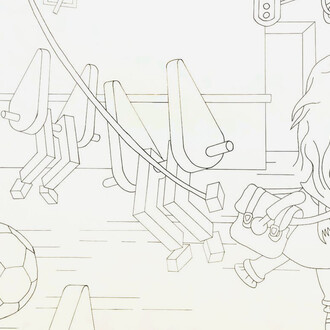
In the basement gallery, the video Bolsa, created in collaboration with Victoria Barca, functions as an audiovisual experiment seeking to translate into images The carrier bag theory of fiction by Ursula K. Le Guin, dispensing entirely with language. In opposition to the “hero narrative,” fiction understood as a “carrier bag” enables another mode of storytelling: a history of life grounded in gathering, coexistence, and care. In a post-agricultural landscape, a being walks outside of time collecting elements from nature and fragments of herself—parts that constitute her and allow her to connect with the landscape she inhabits. The work thus proposes a poetic narrative oriented not toward the resolution of conflict, but toward an ongoing process of contemplation and exploration.